



AI Summary
- Discover the future of sustainable finance with green crypto-friendly neo-banking solutions for large enterprises!
- As global markets shift towards sustainability, companies are redefining their digital finance models to align with ESG mandates.
- By integrating features like energy-efficient ledgers, carbon accounting, and tokenized green assets, enterprises can enhance trust, compliance, and competitiveness.
- The time is now for big businesses to embrace sustainable neo-banking due to regulatory pressures, mature technology, and market momentum.
- Choosing the right development partner is crucial, with considerations like energy-efficient tech stack, sustainability certifications, and transparent carbon reporting.
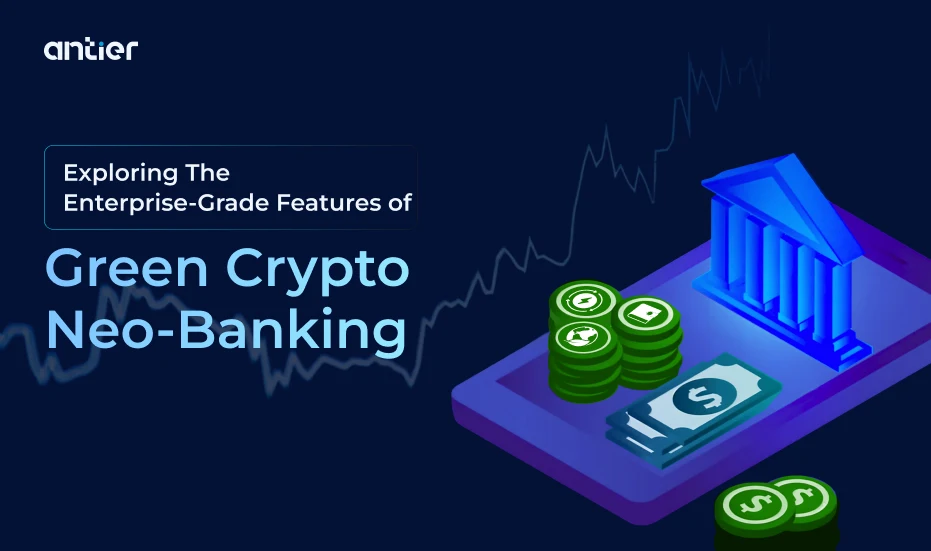
Did you know that over 70% of global enterprises are revisiting their digital finance models in light of rising sustainability benchmarks? The market is shifting at an unprecedented pace, where carbon-conscious banking is no longer a choice but a defining metric of resilience in the Web3 economy. As enterprises scale into 2025–2026, the expectation isn’t just about seamless digital banking; it’s about whether these systems are energy-efficient, auditable, and future-proof. That’s where green crypto-friendly neo-banking comes in. Enterprises can maintain an innovation advantage by combining programmable finance with sustainability-driven frameworks to align treasury operations with global ESG mandates. In this new era, banking green isn’t a corporate statement; it is the foundation of digital trust, compliance, and competitiveness.
Let’s explore!
Why Should Large Enterprises Move to Sustainable Neo-Banking Solutions?
Enterprises today juggle three hard truths: investors and regulators demand measurable ESG performance, customers care about climate-conscious partners, and digital finance needs to scale without ballooning energy use. Sustainable crypto neo-banking solutions answer all three: Crypto-friendly neo banking solutions transform corporate treasury, payments, and tokenized finance into auditable, low-carbon processes that plug into enterprise ESG reporting and compliance workflows. As Web3 practitioners, we see this transition not as a niche benefit but as a strategic imperative for risk management, stakeholder trust, and long-term cost predictability.
Why Now for Big Enterprises?
1. Regulatory & investor pressure is real : Corporates must demonstrate measurable emissions reductions and trustworthy data. Integrating payments and treasury on sustainable rails simplifies disclosures and feeds enterprise ESG systems.
2. Technology is mature enough : PoS blockchains and layer-2 scaling have removed the core energy objection that dominated crypto discussions a few years ago. That technical maturity unlocks enterprise adoption for high-value flows.
3. Market momentum accelerates integration : Digital banking and neobanking markets are expanding rapidly, and crypto-friendly rails are increasingly accepted, creating the ecosystem enterprises need to move with confidence.
Now that enterprises and businesses have committed to immediate investment, they must define the green features their crypto neo-banking platforms must include. If speed to market matters, white-label crypto neo-banking development offers a pragmatic route: a customizable, enterprise-grade solution that reduces development time and cost, accelerates regulatory readiness, and lets you launch a differentiated product faster and with greater confidence.
Top Green Features of Crypto Neo-Banking Platforms
Enterprises stepping into the future of finance know that sustainability can no longer be treated as an afterthought. With global regulations tightening and consumer expectations leaning toward eco-conscious choices, the foundation of digital banking platform is being redefined. Green-centric design in crypto neo-banking isn’t simply about reducing energy use; it is about embedding trust, accountability, and forward-looking innovation into the very fabric of financial ecosystems. Before exploring the specific features, it’s crucial to understand why sustainability is the new baseline for enterprise finance. These are features, functional building blocks, that enterprises should demand when evaluating a sustainable neo-banking development partner.
1. Proof-of-Stake / Energy-Efficient Ledger Options
Enterprises must be able to route settlement and tokenization to PoS or other low-energy chains (or permissioned PoS variants) by default. This is a platform-level option, not a marketing claim; it directly changes the energy characteristics of on-chain activity.
ethereum.org
2. Layer-2 & Rollup Integration for Bulk Settlement
Native support for L2 rollups (optimistic and zk-rollups) reduces on-chain costs and per-transaction energy by batching settlements. Enterprises handling high volumes (payroll, supplier payments, micropayments) need native L2 rails as a non-negotiable feature.
3. On-Chain Carbon Accounting & Transaction Labeling
A feature that attaches standardized carbon metadata to each on-chain transaction (scope 3 tagging for digital payments). This is different from “offering offsets”; it’s precise telemetry that feeds ESG systems and audit trails.
4. Programmable Green Wallets / ESG Wallet Profiles
Crypto wallet development solutions that enforce corporate ESG policies: e.g., only allow transfers to vetted vendors, block funding to high-emission activities, or automatically route a percentage to green liquidity pools. This is programmable policy enforcement built into the payments layer.
5. Tokenized Carbon Credits & Native Offset Marketplace
A built-in smart-contract marketplace that mints, verifies (via oracles), and retires tokenized carbon credits on behalf of enterprise transactions. The difference from a benefit claim: this is a native feature set (issuance, retirement, audit trail) that removes reconciliation friction.
Connect With Our Experts & Invest in Customized Crypto Neo-Banks Today
6. Renewable Energy Validator/Node Attestation
Support for validator/environment attestations: validators provide signed proof (via recognized standards) that their staking infrastructure runs on renewable sources. Platforms expose that attestation so enterprises can select or prefer greener validator sets.
7. ESG Reporting APIs & Audit-Ready Ledgers
A standardized API layer that exports verifiable ESG data (transaction emissions, offset retirements, and green validator attestations) into corporate GRC/ESG platforms and audit packages. This feature makes Web3 finance plug-and-play with SAP, Workiva, or custom reporting stacks.
8. Green-Native Stablecoins & Tokenized Green Assets
Support for stablecoins or tokenized instruments explicitly backed by green assets or green revenue streams (e.g., renewable energy credits). As a platform feature, this enables treasury teams to keep digital working capital aligned with sustainability policy.
9. Embedded Carbon UX & Customer-Facing Labels
A developer-facing feature kit that lets enterprises surface carbon impact per payment or invoice to their customers and partners, not a marketing banner, but the actual SDK and UI components to expose transaction-level carbon numbers.
10. Interoperable ESG Oracles & Data Feeds
Built-in connectors to trustworthy ESG oracles (climate data, emissions factors, renewable certificates) so that transaction tagging and tokenized credits are based on auditable inputs rather than opaque models.
Partnering with the right and experienced white label crypto bank development company ensures that these sustainability-driven features are not only integrated but also scalable, auditable, and future-ready. For businesses aiming to lead in 2025–26, building on green foundations is the only way forward.
How Do These Features Convert Into Enterprise Readiness?
Enterprises require more than a “green” badge; they need measurable controls, auditable trails, and integration points with existing finance and compliance systems. The green crypto neo banking app development features above are the technical contracts that make sustainable claims verifiable, repeatable, and reportable, exactly what CFOs, sustainability officers, and auditors ask for when evaluating partners. Research shows neobanks and digital financial services reduce paper and logistical emissions while adding transparency, a direct win for enterprise sustainability programs.
How to Choose the Right BaaS Development Company Following Sustainable Practices?
When enterprises look for a Banking-as-a-Service (BaaS) development company aligned with sustainability, the selection must go beyond technical expertise. The right partner should not only deliver scalable banking solutions but also embed green-first practices into their neo banking infrastructure, operations, and technology stack. Here are one-liner ways and factors to guide your decision :
- Proven energy-efficient tech stack : Ensure they leverage PoS chains, L2s, and low-carbon infrastructure.
- Sustainability certifications : Look for partners with ESG or renewable energy compliance certifications.
- Transparent carbon reporting : Select companies that provide carbon metrics for digital transactions.
- Green vendor ecosystem : Choose firms working with renewable-powered data centers and eco-friendly validators.
- Audit-ready ESG APIs : Verify they offer integration for ESG reporting to meet enterprise compliance.
- Industry track record : Prioritize companies with enterprise-grade deployments and a reputation for sustainable delivery.
- Innovation in green finance : Pick a partner that actively integrates tokenized carbon credits and green stablecoins.
- Consultative approach : Ensure they understand both your technical and sustainability goals for long-term alignment.
Claim Your Spot in the Sustainable Finance World With Antier!
The evidence is undeniable: sustainable finance is accelerating, and crypto neo-banking platforms with green-first architectures are becoming the backbone of enterprise-ready Web3 adoption. For decision-makers, the moment calls for clarity: will you align early with platforms that embed verifiable carbon accounting, renewable-powered validators, and ESG-ready APIs, or risk lagging behind peers already redefining their financial ecosystems? Beyond compliance, this is about market trust, operational transparency, and long-term profitability. Enterprises that invest in sustainable crypto neo-banking solutions now secure more than just efficiency; they also future-proof their position in a financial system that is rapidly adopting green standards.
Hire the most comprehensive white label crypto bank services at Antier. With a team of blockchain architects, legal experts, and compliance specialists, we deliver enterprise-grade solutions designed to scale while adhering to global sustainability standards. Our commitment to renewable-powered infrastructure, carbon-conscious frameworks, and ESG-ready integrations makes us the preferred partner for forward-looking enterprises. Backed by years of Web3 expertise, we ensure your journey to sustainable digital finance is not just compliant but transformative and future-focused.
Frequently Asked Questions
01. Why should large enterprises consider sustainable neo-banking solutions?
Large enterprises should consider sustainable neo-banking solutions because they address investor and regulatory demands for measurable ESG performance, cater to customer preferences for climate-conscious partners, and enable scalable digital finance without excessive energy use.
02. What factors are driving the urgency for big enterprises to adopt sustainable banking now?
The urgency for big enterprises to adopt sustainable banking is driven by regulatory and investor pressure for emissions reductions, the maturity of technology that supports low-energy solutions, and the rapid expansion of digital and neobanking markets that facilitate integration.
03. What are the key features that enterprises should look for in crypto neo-banking platforms?
Enterprises should look for features that ensure energy efficiency, auditability, and compliance with ESG reporting, as well as the ability to integrate seamlessly with existing treasury operations and payment systems.