




AI Summary
- Looking to launch a token on TRON?
- Learn about the crucial steps beyond deployment in this comprehensive guide.
- From choosing between TRC-10 and TRC-20 to setting tokenomics, ensuring legal compliance, integrating with platforms, and security auditing, this guide covers all aspects of successful TRON token development.
- Discover how a well-structured plan can lead to sustained value and market readiness.
- Once your plan is set, execute by defining core parameters, deploying smart contracts, integrating with wallets, auditing for security, verifying on the mainnet, and listing on exchanges.
Launching a token on TRON is a straightforward process. Launching one that survives the first 90 days is where founders earn their stripes. If you’re weighing TRC-10 vs TRC-20, sketching tokenomics, or wondering how audits, liquidity, and listings fit together, this guide is your founder-friendly walk-through of crypto token development.
We’ll zoom out before we zoom in: why architecture decisions (supply, decimals, vesting, burn) shape utility and price discovery; how compliance (KYC/AML, tax, securities mapping) protects your runway; and what “production-grade” really means on TRON. You’ll also get the playbook for go-to-market and a maintenance cadence that keeps your contracts safe and your roadmap credible.
If your goal is more than “get it minted,” you’re in the right place. Read on to learn how to plan, build, audit, list, and grow a TRON token that’s technically sound, regulator-ready, and genuinely useful.
How Do You Plan Your TRON Token Development?
A successful TRON token development journey begins long before you write the first line of code. Too many projects focus solely on deployment while overlooking the strategic, regulatory, and technical foundations that determine adoption and long-term value. A well-structured plan ensures that your token is not only functional but also market-ready, legally compliant, and scalable.
- Token Architecture & Parameters: Choose between TRC-10 and TRC-20, set total supply, decimals, and allocation. Factor in vesting schedules and burn mechanisms to maintain long-term value. Define the purpose of the token: transactions, staking, voting, or rewards. Include governance rules for upgrades, forks, and emergency protocols.
- Legal & Regulatory Readiness: Map token issuance to local securities laws, taxation rules, and KYC/AML verification requirements. A compliance-first approach reduces the risk of future shutdowns or legal disputes.
- Integration & Scalability: Plan wallet, exchange, payment gateway, and dApp integrations from the outset. Ensure your blockchain architecture supports increasing transaction volumes without performance loss, enabling seamless scaling.
- Security & Smart Contract Assurance: Incorporate formal verification, penetration testing, and third-party smart contract audits. These measures prevent exploits and vulnerabilities that rushed projects often overlook, avoiding costly security breaches.
- Market Strategy & Ecosystem Growth: Identify target users, incentivization methods, liquidity provisioning, and marketing touchpoints to drive real-world engagement. Define marketing touchpoints to drive adoption across the Web3 space and build a strong, engaged community.
By addressing these overlooked areas upfront, founders ensure technical robustness, legal safety, and market readiness. A holistic plan positions your TRON token to deliver sustained value, avoid common pitfalls, and scale confidently across the blockchain ecosystem, making it a model of effective crypto token development.

What Are the Technical Steps in Creating a TRON Token?
Once your TRON token development plan is set, it’s time to move into the execution phase.
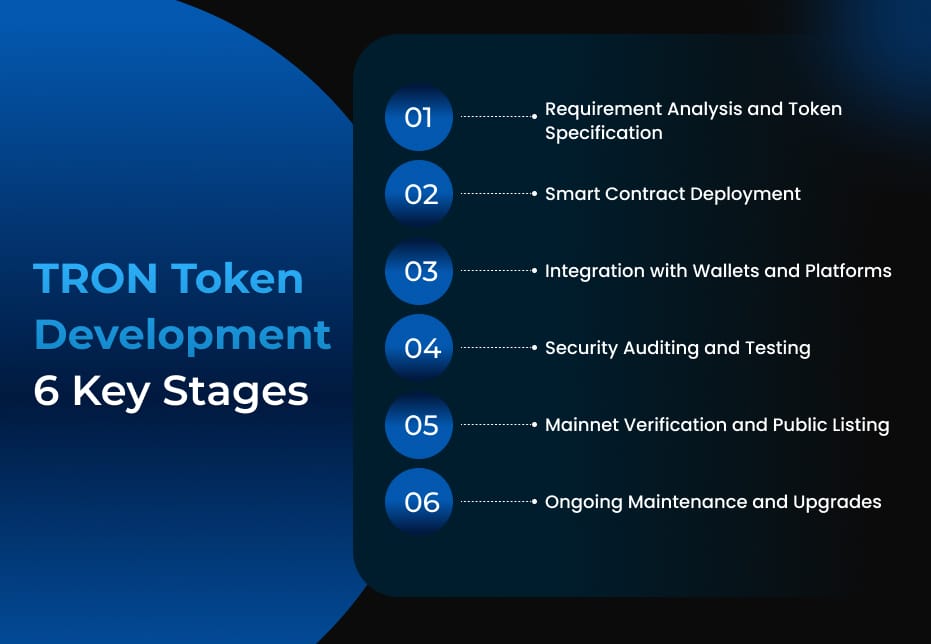
- Requirement Analysis and Token Specification – Start by defining every core parameter: token name, symbol, decimal units, total supply, and issuance logic. Decide whether you’ll use TRC-10 for simpler assets or TRC-20 for smart contract-enabled tokens. This foundational work ensures your Token Development meets both technical standards and long-term business objectives.
- Smart Contract Deployment – Deploy the finalized contract to TRON’s testnet for initial validation, then to the mainnet. Correct initialization of total supply, ownership, and permissions at this stage is critical to avoiding costly post-deployment issues, making it a key step in quality crypto token development.
- Integration with Wallets and Platforms – Configure token compatibility with TRON-compatible wallets (e.g., TronLink), payment gateways, and decentralized applications. Successful crypto token development ensures seamless user interaction across multiple platforms, boosting adoption.
- Security Auditing and Testing – Run exhaustive security checks, including unit testing, integration testing, and manual code reviews. Engage third-party auditors to perform penetration testing and formal verification to identify and patch vulnerabilities before launch.
- Mainnet Verification and Public Listing – Verify your smart contract on TRONSCAN for transparency. List your token on reputable exchanges, DeFi protocols, and liquidity pools to increase market reach. A trusted token development company can facilitate exchange onboarding and liquidity provisioning.
- Ongoing Maintenance and Upgrades – Post-launch, track token metrics, fix bugs, and release smart contract upgrades when necessary. Adjust governance protocols to align with evolving regulations and market needs, ensuring your development remains future-proof.
How Much Does TRON Token Development Cost?
The cost of TRON token development is not a fixed number. It is a strategic investment that depends on your vision, technical requirements, and the market impact you want to create. A simple TRC-10 utility token may have a shorter development cycle, while a fully custom TRC-20 smart contract with advanced governance, staking, or DeFi integration requires a more extensive build. Factors such as blockchain architecture, smart contract complexity, UI and UX integration, wallet compatibility, and post-launch support all influence the investment required.
The real question is whether you are aiming to create just another token or a market leader. When executed by an experienced token development company, TRON token creation becomes more than coding. It transforms into a high-value business asset designed to attract users, inspire investor confidence, and scale into global markets. By partnering with experts, you are also securing security audits, scalability planning, exchange listings, and ongoing technical support that give your project a competitive edge.
In a market where speed, security, and innovation determine success, delaying your launch could allow competitors to capture the audience you are targeting. Your TRON token could become the next breakout asset in gaming, DeFi, or enterprise blockchain solutions. The first step is to start building now. Connect with a leading TRON token development company today for a custom project evaluation tailored to your goals.

What’s Next After Launching a TRON Token?
Launching your TRON token is an achievement, but the real journey begins once it goes live. Post-launch success depends on strategic execution that drives adoption, scalability, and long-term market relevance.
- List your TRON token on major centralized and decentralized exchanges. Create diverse trading pairs and incentivize liquidity pools to maintain healthy trading volume and market stability. Strategic liquidity planning is key for any project undergoing TRON token development services.
- Integrate the token into dApps, DeFi protocols, NFT marketplaces, gaming platforms, and payment gateways. The wider the token’s utility, the faster its adoption, making development efforts more impactful.
- Run AMAs, airdrops, loyalty rewards, and targeted marketing campaigns. A strong, active community drives organic growth, fuels trading activity, and boosts investor confidence in your TRON token project.
- Continuously monitor smart contract performance, implement security patches, and roll out governance upgrades. Ongoing improvements keep your token competitive in a rapidly evolving blockchain ecosystem.
- Collaborating with a specialized TRON token development company ensures you have the technical expertise and market insights needed to bridge the Web2-to-Web3 gap. Expert guidance can accelerate adoption and position your token as a long-term market leader.
Conclusion
Here’s the simple truth. You do not win on TRON by just shipping a token. You win by shipping a product with purpose, security, liquidity, and a community that cares. In the world of TRON Token Development, you now have the full playbook—from architecture and audits to listings, integrations, and growth. The next move is disciplined execution that turns your TRC-10 or TRC-20 into real adoption across wallets, dApps, DeFi, gaming, and payments.
If you want a partner that treats your launch like a business, not a code drop, bring in specialists. Get a clear scope, a tokenomics sanity check, an audit plan, an exchange and liquidity roadmap, and a post-launch growth calendar you can start using immediately.
Ready to turn your TRON token into a marketable asset that scales with confidence? Partner with a proven token development company for end-to-end execution on TRON, including audits, integrations, listings, and ongoing upgrades? Antier can help you launch with confidence and grow with intent. Book a demo!