







2025 is shaping up as a transformative year for digital currencies. Stablecoins enable fast, low-cost payments, seamless cross-border transfers, and strong DeFi liquidity, while CBDCs offer government-backed digital currency to modernize domestic payments and expand financial inclusion. Enterprises, fintech companies, and banks that adopt CBDC and stablecoin development can enhance efficiency, lower costs, and drive innovation.
This blog examines the rapid growth of these digital assets, highlights their key differences, and explores strategic opportunities for businesses and banks to leverage stablecoin development services and CBDC solutions to stay competitive in the evolving digital economy.
Understanding Stablecoins and CBDCs
Stablecoins are privately issued digital currencies pegged to traditional assets, such as the U.S. dollar, and backed by fiat reserves, crypto collateral, or algorithmic mechanisms. Innovations in stablecoin development ensure these currencies enable 24/7 instant settlements, programmable payments, and cost-efficient transfers, benefits that traditional banking systems simply cannot match.
CBDCs (Central Bank Digital Currencies), on the other hand, are government-issued digital currencies fully regulated and backed by central banks. CBDC development focuses on creating sovereign digital currencies designed to modernize monetary policy, enhance payment efficiency, and promote broader financial inclusion, distinguishing them from privately issued stablecoins.
The Explosive Growth of Stablecoins and CBDCs in 2025
The global adoption of stablecoin development has accelerated at an explosive pace.
- Monthly adjusted transaction volume: $1.25 trillion (September 2025)
- Market concentration: Tether (USDT) and Circle (USDC) control 87% of the market
- Market cap: USDT ~$180 billion; USDC ~$76 billion
Three factors driving this surge:
- Regulatory Clarity: The GENIUS Act mandates 1:1 reserve backing, monthly audits, and AML/BSA compliance for U.S. issuers. MiCA harmonizes EU regulations with segregated reserves, redemption rights, and comprehensive disclosures.
- Institutional Adoption: Financial institutions are actively deploying stablecoins. Nine European banks formed a consortium to launch a MiCA-compliant euro stablecoin by 2026. PayPal’s PYUSD facilitates B2B cross-border flows with up to 90% lower fees. Stripe’s $1.1 billion acquisition of Bridge highlights strategic confidence in stablecoin-enabled payment rails.
- Expanding Use Cases: Stablecoins power 75% of all DeFi liquidity, enable $3 billion in monthly B2B payments, and reduce remittance fees from 6.6% to under 3%, often below $0.01 per transaction.
Stablecoin infrastructure has matured from experimental to mission-critical, rivaling traditional networks like the U.S. ACH system.
Global CBDC Progress in 2025:
- Fully Launched: Nigeria (eNaira), Bahamas (Sand Dollar), Jamaica (JAM-DEX), Zimbabwe (ZiG)
- Advanced Pilots: China (digital yuan), Brazil (DREX), India (Digital Rupee expansion)
- Regional Initiatives: EU Digital Euro pilot programs, Japan’s Digital Currency Act
- Cross-Border Experiments: Australia’s eAUD trials with Singapore & New Zealand, Hong Kong’s mBridge project
Core drivers for CBDC adoption:
- Financial Inclusion: Digital accounts accessible via basic mobile phones
- Payment System Modernization: Faster, lower-cost domestic transactions
- Monetary Policy Enhancement: Programmable money, real-time economic visibility, and fiscal stimulus distribution
See How Stablecoin and CBDC Solutions Work in Action.
For enterprises exploring CBDC development services, opportunities include technical infrastructure, compliance frameworks, wallet apps, and interoperability solutions.
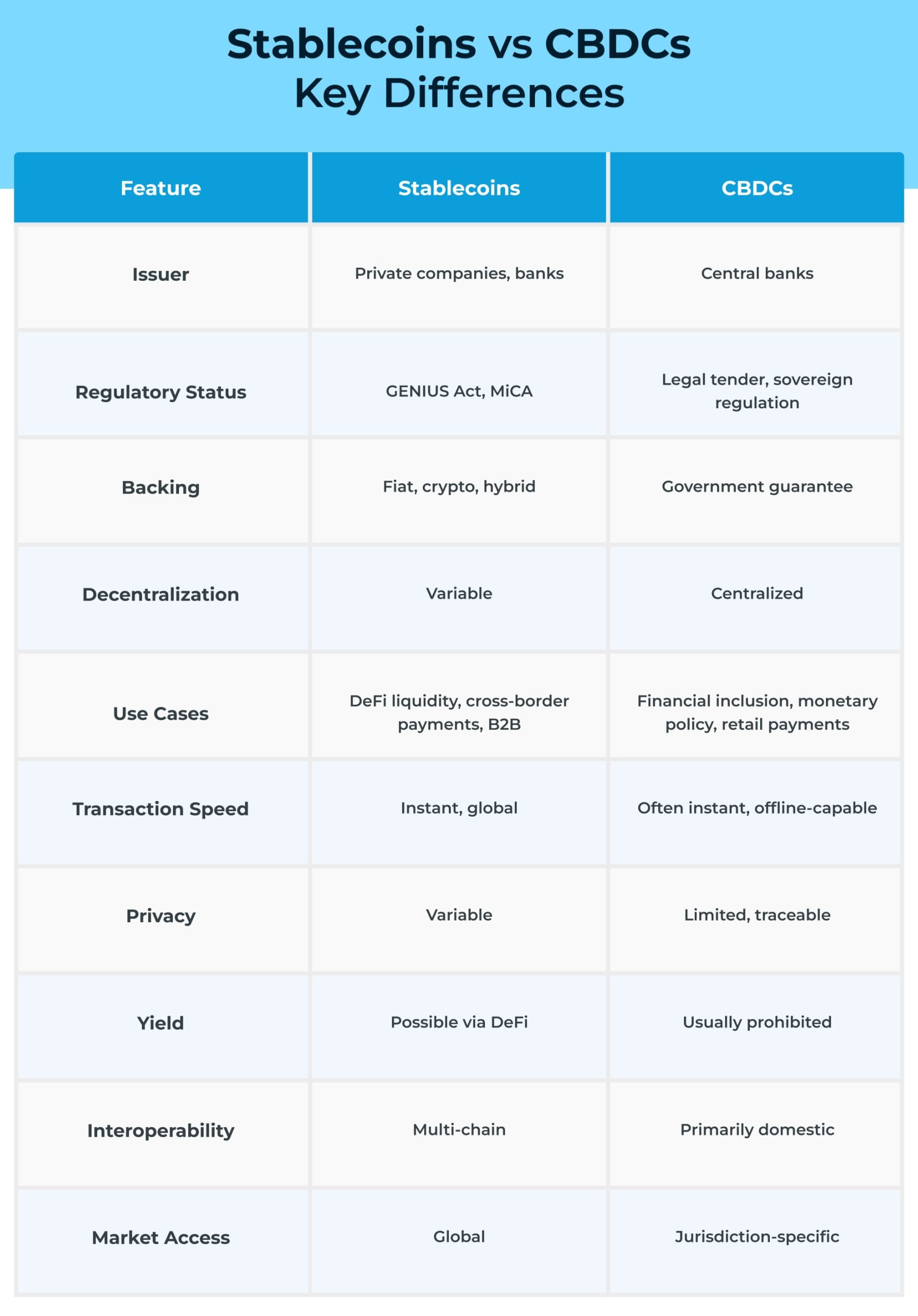
In contrast, CBDCs focus on sovereign control, domestic efficiency, and inclusion mandates, with CBDC development driven by central banks to modernize monetary systems and strengthen trust in digital economies.
Why Stablecoin and CBDC Development Is the Next Big Opportunity?
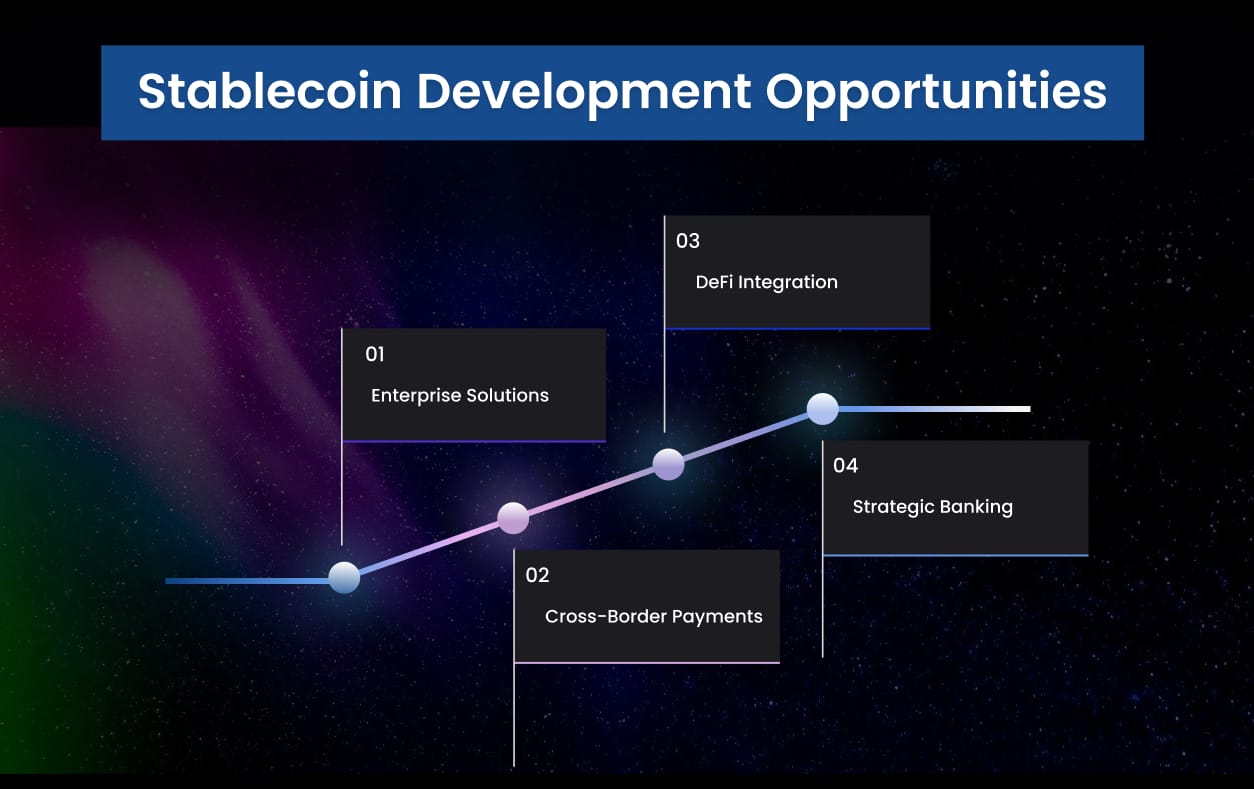
- Enterprise Solutions: Companies can leverage white-label stablecoin development for quick deployment or fully customized enterprise solutions for advanced features like multi-currency support, treasury integrations, and on-chain programmability. These models empower businesses to launch secure and compliant stablecoins for internal or commercial use.
- Cross-Border Payments: Stablecoins are reshaping international remittances by cutting global average fees from 6.49% to under 3%, often below 1%. For example, businesses processing $10 million in remittances annually could save nearly $350,000. Platforms like Bitso and Aspora illustrate the operational scalability and cost efficiency of stablecoin payments in real-world scenarios.
- DeFi Integration: Stablecoins underpin over 70% of DeFi trading pairs, enabling on-chain liquidity, lending, and yield generation. Conservative protocols offer 3–10% APY, while more advanced strategies yield 10–20% APY. This enables enterprises to utilize stablecoin development services, integrating DeFi efficiency with institutional-grade trust and treasury management.
- Strategic Banking: Banks are integrating fiat-to-stablecoin conversion layers, custody solutions, and AML/KYC modules. Early entrants can capture conversion fees of 0.1–0.2% for large transactions, creating a new revenue stream. Enterprises leveraging stablecoin development services can ensure interoperability with both TradFi and DeFi ecosystems.
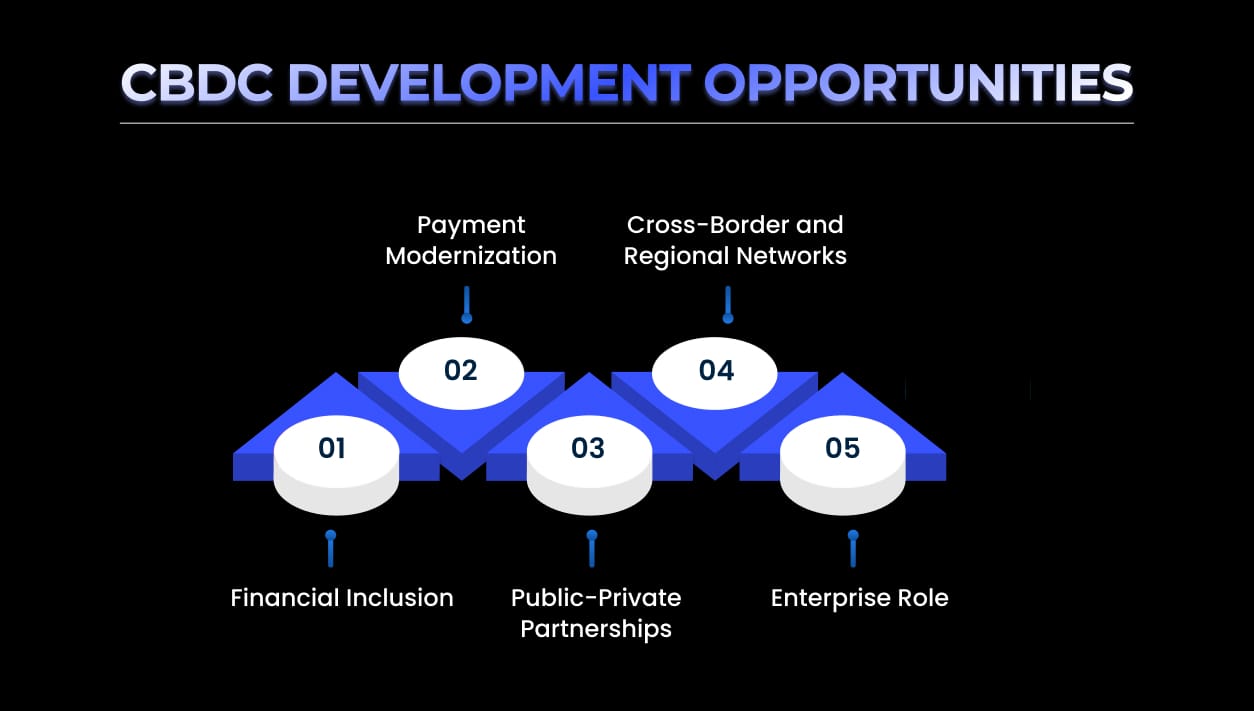
- Financial Inclusion: CBDC development services enable access for 1.4 billion unbanked adults, with mobile-based wallets using USSD or offline modes reaching populations without smartphones or internet connectivity. This infrastructure empowers financial participation through remittances, micro-payments, and government transfers.
- Payment Modernization: CBDCs enable instant, programmable, and low-cost transactions for domestic and cross-border use cases. India’s Digital Rupee, China’s e-CNY, and Brazil’s DREX demonstrate that scalable CBDC networks can support millions of users while offering offline functionality, retail and wholesale settlement, and enhanced monitoring for central banks.
- Public-Private Partnerships: Governments are collaborating with fintech firms and blockchain enterprises to co-develop compliant, interoperable CBDC systems. Over 60% of central banks cite financial inclusion as a primary motivation, creating opportunities for technology partners to build wallets, compliance tools, and API bridges that connect CBDCs with private payment networks.
- Cross-Border and Regional Networks: Multi-CBDC corridors such as Hong Kong’s mBridge and Australia’s eAUD pilot projects facilitate frictionless international settlements, programmable trade finance, and liquidity management. Enterprises offering CBDC development services can participate in designing these scalable, cross-border infrastructures.
- Enterprise Role: The opportunity for enterprises lies in developing wallet apps, compliance frameworks, API integration, offline solutions, and interoperability tools that connect CBDCs with stablecoins, private payment rails, and global financial networks. These solutions allow businesses to participate in the digital currency ecosystem while ensuring regulatory compliance.
Get exclusive insights into advanced stablecoin & CBDCs opportunities today.
How Enterprises Can Capitalize on Opportunities
Financial Institutions
- Launch proprietary stablecoins with the guidance of an expert stablecoin development company or participate in multi-bank consortiums.
- Provide fiat-to-stablecoin conversion, custody solutions, KYC/AML compliance, and treasury advisory services.
- Distribute CBDCs via two-tier frameworks to enhance reach and control.
Fintech Companies
- Integrate global cross-border payment rails using stablecoin development services for faster, cost-efficient transactions.
- Enable DeFi-powered treasury management and yield optimization.
- Develop robust compliance, reporting, and monitoring infrastructure.
Strategic Considerations: market positioning, geographic expansion, partnership networks, and regulatory compliance investment.
Conclusion
The global financial system is rapidly evolving as stablecoins and CBDCs redefine how value is created, stored, and exchanged. Stablecoins bring flexibility and efficiency to private markets, while CBDCs offer trust, regulation, and inclusivity at a national level. For enterprises, this is the time to build on secure and compliant infrastructures through expert Stablecoin Development Services and CBDC Development Services. From cross-border payments to programmable finance, these technologies are shaping the future of money.
Partnering with a trusted CBDC and stablecoin development company like Antier. We ensure your business stays ahead of this financial transformation. With deep blockchain expertise and proven delivery in global projects, we empower you to innovate with confidence and lead the shift toward a digital-first economy.
Frequently Asked Questions
01. What are stablecoins and how do they differ from CBDCs?
Stablecoins are privately issued digital currencies pegged to traditional assets, enabling fast and low-cost transactions. In contrast, CBDCs are government-issued digital currencies regulated by central banks, designed to modernize monetary policy and enhance financial inclusion.
02. What factors are driving the growth of stablecoins in 2025?
The growth of stablecoins in 2025 is driven by regulatory clarity, institutional adoption, and innovations in payment systems, with significant participation from financial institutions and compliance with new regulations.
03. How can businesses and banks leverage stablecoin and CBDC development?
Businesses and banks can enhance efficiency, lower costs, and drive innovation by adopting stablecoin development services and CBDC solutions, allowing them to stay competitive in the evolving digital economy.