






AI Summary
- Stablecoins have shifted from uncertainty to clarity with the introduction of the GENIUS Act, establishing regulations and guidelines for stablecoin issuance, backing, and compliance.
- This shift opens a narrow window for companies to act before enforcement begins in January 2027.
- The blog emphasizes the importance of building compliant stablecoin platforms early to secure partnerships, trust, and market advantage.
- With the remittance market leading the shift towards stablecoin adoption, companies must prioritize compliance, scalability, transparency, and ecosystem integration in their platform development.
- Waiting to build a compliant platform risks higher costs, slower adoption, and missed opportunities in the rapidly evolving stablecoin ecosystem.
For years, stablecoins sat in the “wait and watch” category. Everyone understood the potential, but most serious players stayed cautious. Regulation was unclear, risks were undefined, and timing was uncertain. Now that’s over.
Regulation is no longer a moving target with the introduction of the GENIUS Act. It is defined, time-bound, and moving steadily toward enforcement. And while many are still evaluating, the market has already moved ahead.
- Stablecoin development market cap has crossed $312 billion
- Transaction volume reached $33 trillion in 2025
- Global remittances sit close to $900 billion annually
This is no longer early adoption. This is infrastructure being rebuilt in real time. What makes this moment powerful is not just the scale, but the timing. There is a short window where regulation is clear, but competition is still forming. That window does not stay open for long.
The real question is simple: Will you build before enforcement, or adapt after it? Because by the time enforcement arrives:
- The early movers will already have secured partnerships
- The compliant platforms will already have trust
- The cost of catching up will be significantly higher
This blog was designed to give you clarity on that window. Not just what the GENIUS Act says, but what it means for your product, your roadmap, and your position in a rapidly evolving stablecoin cross border payments ecosystem. If you are building in remittances, fintech, or Web3 infrastructure, this is not just another trend to track. It is a shift you need to act on.
Why the GENIUS Act Is a Big Deal
Let’s simplify it. The GENIUS Act does three important things:
- It tells you who can issue stablecoins
- It defines what backs them
- It sets clear rules for compliance
That might sound straightforward, but this is exactly what the market has been missing. For years, stablecoins operated in a gray area. Some were fully backed. Others were not. Some had transparency. Others relied on trust alone. That inconsistency made it difficult for serious businesses and institutions to fully commit. The GENIUS Act removes that ambiguity. One of the most important requirements is simple but strict. Every stablecoin must be backed one-to-one with real reserves, and those reserves must be audited regularly.
Those reserves are also limited to high-quality, liquid assets, which reduces risk and ensures stability even during market stress. That changes everything. Because now, trust is no longer something you build through branding, promises, or market perception. It is enforced through regulation, verified through audits, and visible to both users and institutions. This shift does two things at once. It reduces risk for users, and it unlocks participation from banks, payment networks, and enterprise platforms that previously stayed on the sidelines. For any company thinking about entering cross-border payments, this creates a clear path forward. You are no longer building in uncertainty. You are building within a defined framework that institutions understand and are willing to integrate with. And that is what makes a stablecoin remittance model not just viable, but scalable in a regulated financial ecosystem.
See How a Compliant Remittance Platform Actually Works
GENIUS Act Timeline and Market Momentum: Why 2026 Is the Critical Build Phase
This is where most teams underestimate what is actually happening. The shift is not just about regulation. It is about timing.
- February 2026: The OCC released detailed proposed rules
- July 2026: Final regulations are expected
- January 2027: Full enforcement begins
That is not a long runway. You are looking at a narrow window of just a few months to move from idea to execution. In most industries, that would be aggressive. In financial infrastructure, it is extremely compressed. This is why 2026 is not a “wait and see” phase. It is a build phase. Because by the time enforcement begins, the advantage will not come from understanding the regulation. It will come from already operating within it.
At the same time, the market is not waiting. Even before full enforcement, adoption is accelerating:
- USDT and USDC together control more than 90% of the market
- Real-world stablecoin payments reached $390 billion
- Business payments using stablecoins grew more than 700% YoY
And this movement is not limited to crypto-native players.
- Visa is expanding stablecoin settlement across global corridors
- PayPal has launched its own stablecoin to support digital payments
- Enterprises are steadily moving parts of their payment flows on-chain
This combination is what makes the moment unique. Regulation is becoming clear at the exact same time that adoption is accelerating. That rarely happens. In most markets, regulation slows innovation. Here, it is enabling it. So what you are seeing is not hype or early experimentation. This is financial infrastructure being rebuilt in real time. And the teams that recognize this timing shift early will be the ones that define the market once enforcement begins.
Why Remittances Are Leading the Shift and What It Means for Compliance and Competition
If you step back, it becomes obvious why remittances are changing first. This is one of the most broken parts of global finance. Remittances today are still:
Expensive, Slow, and Dependent on multiple intermediaries. The average cost of sending money globally is still above 6%, and even digital-first solutions hover around 5 percent. Now compare that with stablecoins, where transfers can cost less than 0.5% and settle in minutes. That gap is too large to ignore. This is why a modern stablecoin remittance platform is not just an improvement. It is a replacement for legacy rails in high-friction corridors. But this shift is not just about speed and cost. It is also about how you build.
What Compliance Really Means in This New Model
This is where things become more serious. Compliance is no longer a layer you add later. It defines your entire system.
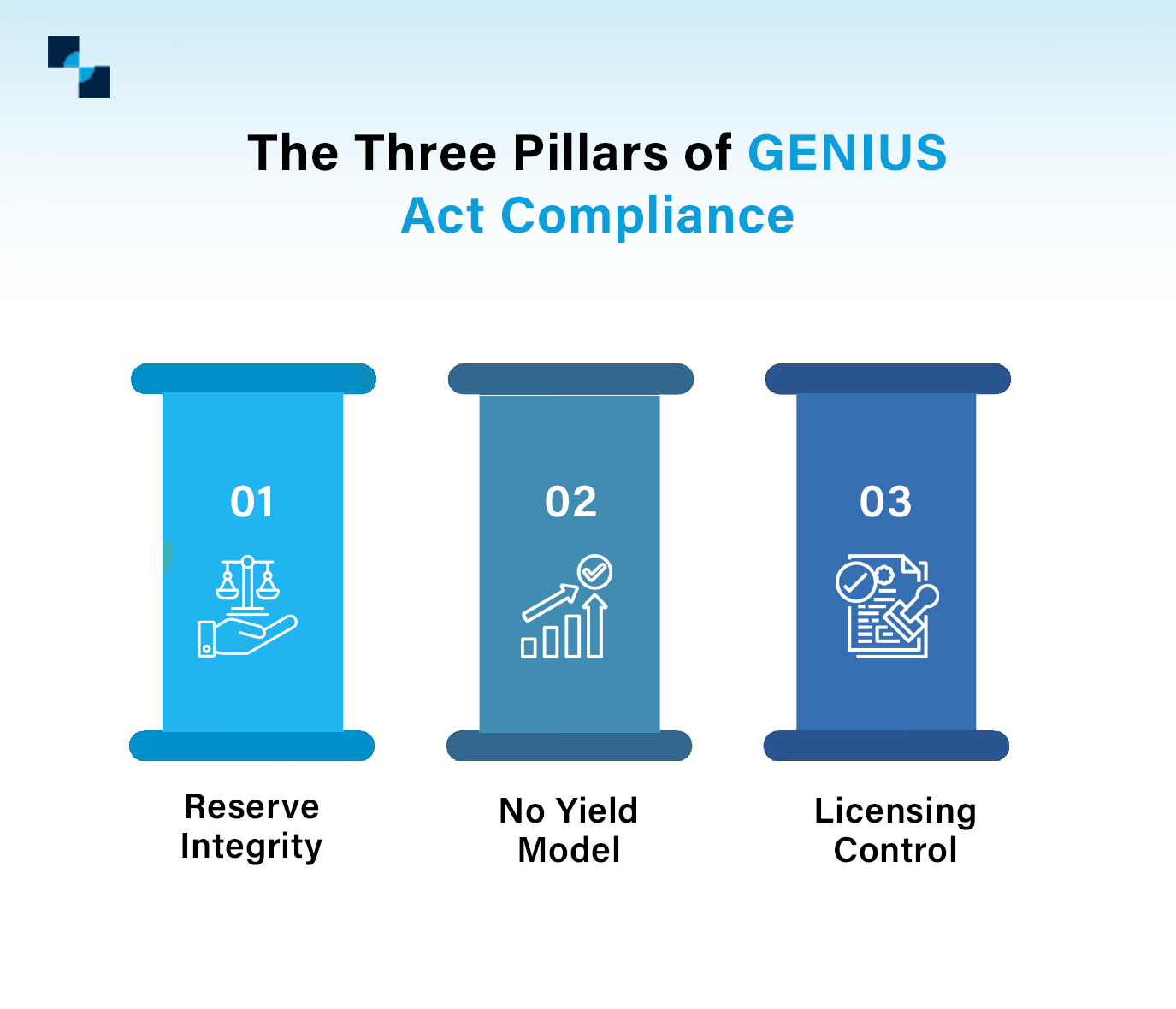
- Reserve Integrity: You need fully backed reserves, monthly audits, and transparent reporting. This is no longer a backend process. It is part of your product and your trust layer.
- No Yield Model: The GENIUS Act does not allow interest on stablecoins. That removes speculative positioning and makes the purpose clear. Stablecoins are built for payments, not for generating returns.
- Licensing Control: Only regulated entities can issue compliant stablecoins. That means if you want to build something that scales, compliance must be part of your foundation from day one. This directly shapes how you approach stablecoin remittance platform development in a regulated environment.
The Competitive Reality Most Teams Miss
This market is not wide open. It is already concentrated and becoming more competitive.
- USDT dominates distribution across emerging markets
- USDC dominates institutional adoption and regulated environments
Together, they control a massive share of liquidity and transaction volume. But within that concentration lies opportunity. The next wave of growth will not come from unregulated players. It will come from new compliant platforms that can integrate with banks, enterprises, and payment networks.
The first movers in this phase will gain:
Early banking partnerships → Enterprise-level deals → Access to regulated financial ecosystems
This is why many serious teams are already partnering with a stablecoin development company that understands both compliance requirements and scalable infrastructure. Because in this phase, speed alone is not enough. You need to build it right the first time.
Build your GENIUS Act-ready platform today.
What You Need to Build Right Now
If you are serious about entering this space, you are not just building a product. You are building a regulated financial infrastructure that requires a different mindset from day one. Your platform must be designed across four critical layers.
- Compliance by Design
Compliance cannot be an afterthought. It must be embedded into your architecture from the very beginning. That includes KYC, AML, transaction monitoring, reporting, and audit readiness. In a GENIUS Act environment, compliance is not a feature. It is your license to operate.
- Scalable Payment Infrastructure
Speed alone is not enough. Your system must handle high transaction volumes, support multiple corridors, and maintain reliability under real-world conditions. Settlement should be fast, but also consistent and secure. This is what separates a prototype from production-grade infrastructure.
- Programmable Transparency
You need real-time visibility into reserves, transaction flows, and system health. Audit trails, reporting layers, and verifiable data access are becoming standard expectations for both regulators and partners. Trust is built through what can be verified, not what is claimed.
- Ecosystem Integration
Your platform cannot operate in isolation. It must connect seamlessly with:
- Banking partners
- Liquidity providers
- On-ramp and off-ramp systems
- Payment processors
The stronger your integrations, the faster you can scale across markets. This is where the right stablecoin cross border payment platform development services create a real advantage.
Instead of building everything from scratch, you can accelerate your timeline, reduce compliance risk, and focus on what actually differentiates your platform in a competitive market.
See how we built a US-based stablecoin remittance platform.
What Happens If You Wait?
Let’s be direct. By early 2027:
- Compliance becomes mandatory
- Banks partner only with regulated platforms
- Retrofitting infrastructure becomes expensive and slow
Late movers do not just start late. They start at a disadvantage.
- Higher costs
- Lower trust
- Fewer partnership opportunities
Most importantly, less room to experiment. Because once enforcement begins, you are no longer building ahead of the market. You are trying to catch up to it. So the choice is simple. You can build now, when the cost of iteration is low, and the opportunity is wide open, or you can build later, when everything costs more, moves more slowly, and requires approval before execution. The difference is not just timing. It is how much control you have over your position in the market.
Wrapping-Up
We are looking at a $900 billion remittance market that is ready to evolve.
Stablecoins can:
- Reduce costs from 5% to below 1%
- Enable near-instant settlement
- Expand access across global corridors
Some projections suggest that stablecoins could reach $3.7 trillion by 2030, with growth driven by payments. This is not a future trend. It is a shift already in motion. The advantage now lies with those who build early, as regulation becomes clearer and infrastructure matures.
Waiting means higher costs, tighter compliance pressure, and stronger competition. Working with an experienced partner like Antier helps you move faster with a compliant, scalable foundation. Build now while the window is open. Connect with Antier to launch your stablecoin remittance platform.
Frequently Asked Questions
01. What is the GENIUS Act and why is it important for stablecoins?
The GENIUS Act establishes clear regulations for stablecoins, defining who can issue them, what backs them, and setting compliance rules. This removes ambiguity from the market, allowing businesses to operate with greater confidence.
02. How has the stablecoin market changed recently?
The stablecoin development market cap has surpassed $312 billion, with transaction volumes reaching $33 trillion in 2025, indicating a significant shift from early adoption to a rapidly evolving infrastructure.
03. What are the implications of the GENIUS Act for businesses in the fintech and remittance sectors?
The GENIUS Act creates a defined regulatory environment, allowing early movers to secure partnerships and build trust, while those who delay may face higher costs to catch up once enforcement begins.