





AI Summary
- The blog post emphasizes the importance of infrastructure for the success of Real-World Asset Tokenization Platforms, with Solana standing out for its capabilities.
- It highlights how features like Firedancer, State Compression, and Proof-of-History on Solana can lead to lower costs, faster settlement times, and enhanced compliance, ultimately resulting in a measurable return on investment.
- The post discusses how leveraging Solana's infrastructure can reduce entry costs, increase liquidity certainty, accelerate capital recycling, and boost investor confidence.
- It also provides insights into key performance metrics, market validation through projects like Franklin Templeton and Taurus, and core infrastructure layers to focus on when building a tokenization platform on Solana.
- The post concludes by encouraging businesses to partner with Antier for developing institutional-grade RWA tokenization platforms on Solana.
The success of any Real-World Asset Tokenization Platform depends on its infrastructure, and that is what Solana delivers.
While the Issuers want lower issuance costs, faster settlement, and compliance, Investors always look out for compliant infrastructure and genuine secondary liquidity. With Tokenization of Real-World Assets in Collaboration with Solana, these outcomes are the product of three concrete capabilities working together:
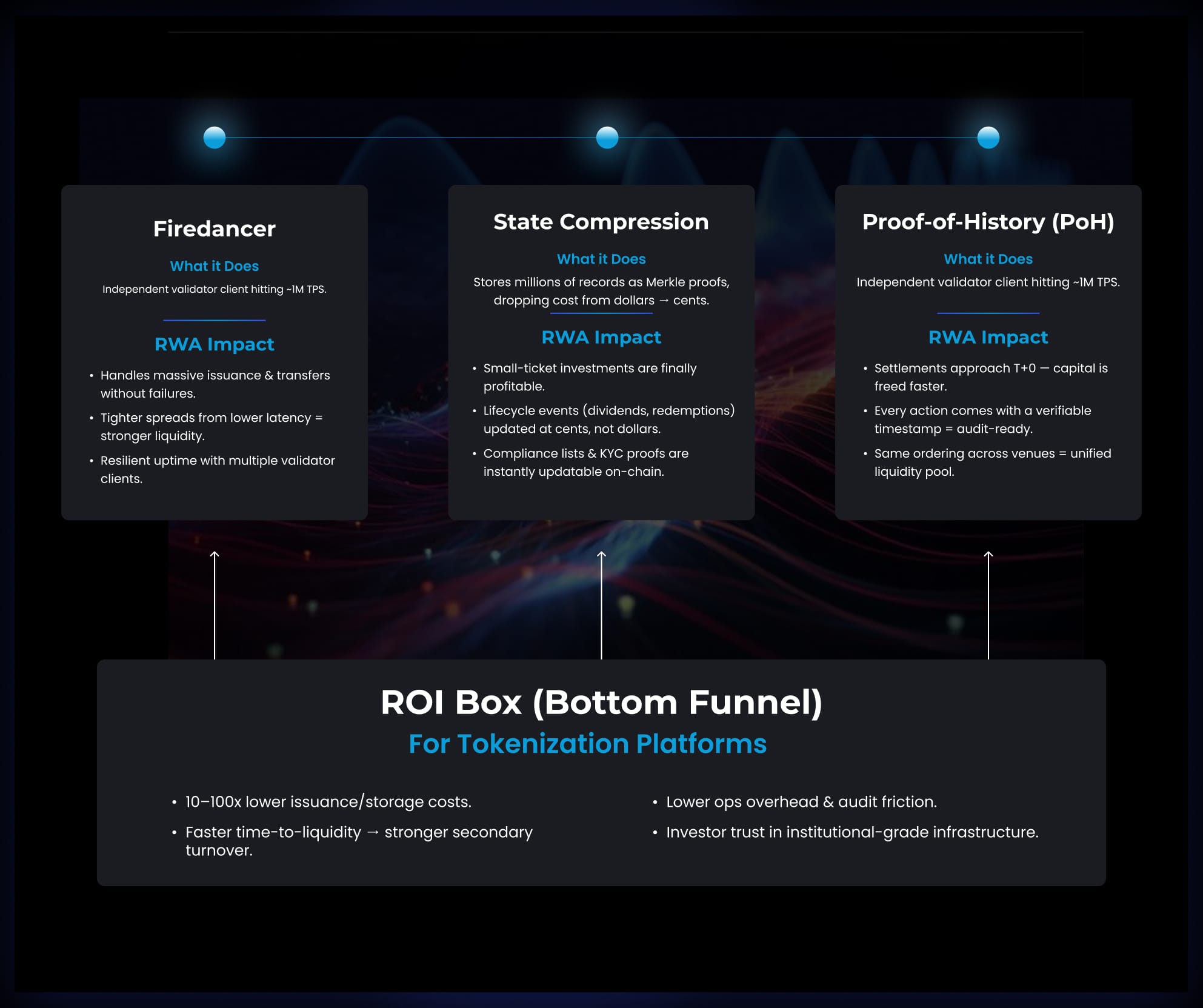
- Firedancer: A high-performance validator client that increases throughput and adds client diversity, so your platform performs reliably under institutional load.
- State Compression: a new cost base for scale, millions of positions, identities, and entitlements represented at cents, not dollars.
- Proof-of-History (PoH): deterministic time ordering, so audits get proofs, operations face fewer exceptions, and settlements progress toward T+0.
If you’re building a tokenization platform on Solana, these are some basic features that can help you reap a measurable ROI compared to a platform built on other blockchains.
The Gap Between Tokenization Vision and Reality
Most tokenization platforms charge high fees from investors that compromise the fractional issuance. The slow settlement weakens secondary liquidity, and patchy compliance adds operational limitations. Investors won’t participate in markets that feel slower, costlier, and riskier than the systems they already use
The RWA Infrastructure in Solana is designed to handle tens of thousands of transfers in seconds, millions of ownership records, and ordered transaction histories that regulators and auditors can rely on.
Impact: A platform built on Solana reduces costs as volumes increase, shortens the time-to-liquidity, and strengthens investor confidence —the three pillars that determine whether an RWA platform succeeds or fails.
Build Your Tokenization Platform on Solana Today!
Why Infrastructure Matters to Returns – Investor Edge: Liquidity, Cost, and Confidence
For investors, the value of a tokenization platform lies in the execution. Solana’s infrastructure translates directly into outcomes that impact portfolios:
- Lower Entry Costs: With state compression, fractional ownership no longer erodes returns through high fees. Investors can access small-ticket opportunities profitably, expanding portfolio diversification.
- Liquidity Certainty: Firedancer’s throughput and low-latency execution mean tighter spreads, reduced slippage, and higher turnover in secondary markets.
- Faster Capital Recycling: Proof-of-History moves settlement closer to T+0, reducing capital buffers and freeing cash for reinvestment. The compounding effect of faster recycling directly improves IRR.
- Audit-Ready Records: Every lifecycle event-issuance, transfer, and redemption is cryptographically ordered and verifiable. Investors gain operational clarity and reduced compliance friction.
- Institutional Confidence: With adoption by giants like Franklin Templeton and BlackRock shows that Solana offers demonstrated credibility. Early investors step into a market infrastructure already validated at scale.
This clearly signifies that Solana strengthens investor returns through liquidity velocity, capital efficiency, and reduced operational drag.
How Solana Infrastructure Delivers ROI for RWA Platforms
Firedancer: Performance and Resilience for Enterprise-Grade Platforms
Firedancer is an independent validator client for Solana, engineered in C/C++ with deep parallelism to maximize speed and stability. In testing, it has demonstrated throughput bursts of ~1 million TPS. The roadmap also includes proposals to remove block compute caps post-Alpenglow, enabling blocks to scale directly with hardware capacity.
How Fireblocks Enhances RWA Tokenization Platform Performance?
- Order-flow capacity: This enables the RWA Tokenization on Solana to batch large volumes of issuances, transfers, redemptions, and coupon events without hitting performance limits. This results in fewer failed transactions, cleaner service-level agreements, and lower support overhead.
- Latency to market: Lower latency enables market makers on Solana-based DEXs like Jupiter, Raydium, and Orca to quote tighter spreads. This unlocks the higher secondary-market turnover, stronger liquidity, and better fee capture.
- Resilience framework: With two production-grade validator clients, Solana minimizes dependency on a single client. This results in stronger uptime guarantees and a more reliable procurement case for enterprise buyers.
State Compression: A Sustainable Cost Base for Scale
Traditional on-chain storage models create prohibitive costs when scaling to millions of ownership records. Solana’s state compression technology fundamentally shifts this cost structure, reducing record representation from dollars to cents while preserving verifiability through concurrent Merkle trees.
Impact on RWA platforms:
- Fractional issuance: Assets can be divided into millions of units without unsustainable fees, enabling small-ticket investments that open retail participation channels.
- Lifecycle efficiency: Corporate actions such as entitlements and distributions can be processed as compressed updates with proofs, significantly reducing post-trade costs while maintaining audit clarity.
- Compliance readiness: Investor allowlists and attestations can be maintained as compressed records, allowing instant updates or revocations without requiring full token reissuance.
- Forward-looking scalability: Emerging ZK-compression methods promise further cost reductions, supporting scalable identity and entitlement mapping at institutional volumes.
Compression transforms scalability into a financial advantage, enabling tokenization platforms to expand without compromising margins.
Proof-of-History: Deterministic Time Ordering
For regulated markets, auditable sequencing is non-negotiable. Solana’s Proof-of-History (PoH) provides a cryptographic clock that establishes transaction order before consensus, reducing communication overhead and delivering deterministic sequencing.
Impact on RWA platforms:
- Settlement efficiency: Deterministic ordering reduces settlement fails and capital buffer requirements, accelerating the trajectory toward T+0 settlement and improving capital efficiency.
- Regulatory alignment: Every transaction, from subscriptions to corporate actions, is recorded with verifiable proofs, reducing audit timelines and minimizing compliance exceptions.
- Venue neutrality: PoH enforces consistent sequencing across centralized and decentralized venues, ensuring liquidity can be aggregated without legal ambiguity.
PoH provides the audit-ready foundation required for institutional adoption of tokenized assets.
Key Performance Metrics That Define Platform Success
When evaluating infrastructure, leadership focuses on tangible returns. Platforms built on Solana can demonstrate measurable advantages across the following dimensions:
- Issuance costs: Compression reduces storage from dollars to cents per record, enabling profitable support for smaller issuances and retail investor participation.
- Liquidity velocity: Firedancer throughput combined with integrated DEX aggregation accelerates time-to-liquidity, improving spreads and secondary turnover.
- Operational overhead: PoH sequencing and compliance-enabled extensions reduce reconciliation effort and back-office staffing requirements.
- Capital utilization: Faster settlement reduces collateral buffers, while permitted staking yields improve treasury returns.
- Investor retention: The ability to support smaller tickets while maintaining reliability strengthens investor engagement and lifetime value.
RWA Tokenization on Solana lowers costs, accelerates liquidity, and provides a defensible compliance framework- elements that directly determine commercial viability.
Market Validation: Top Real-World Assets (RWA) Projects on Solana
The following are the RWA Projects on the Solana blockchain:
- Franklin Templeton: Expanded its OnChain U.S. Government Money Fund (FOBXX) to Solana. Board-level approvals become easier when established asset managers validate infrastructure. This enhances Institutional credibility, reduces adoption friction.
- Taurus: Integrated Solana for custody, issuance, and institutional staking. This enables the banks and custodians to face fewer integration hurdles by offering an enterprise-grade stack with credible interoperability.
This growing adoption clearly signifies that the Tokenization of Real-World Assets in Collaboration with Solana results in high-volume and fee-sensitive issuance.
Launch Investor-Ready RWA Platform on Solana!
Core Infrastructure Layers to Focus on While Building RWA Tokenization Platform on Solana
To translate Solana’s capabilities into measurable outcomes, platforms should prioritize the following layers in their build strategy:
- Asset and Compliance Layer: Adopt Token-2022 extensions to enforce transfer restrictions, freezes, and confidential transfers. Jurisdictional mapping and revocation/update workflows should be designed into the platform architecture. This Compliance becomes an on-chain feature, reducing audit friction and strengthening regulatory alignment.
- Permissioned Execution for Regulated Flows: Where regulatory requirements demand, configure permissioned environments that restrict execution to approved participants. This accelerates approvals in banking and vendor risk processes, improving time-to-market.
- Compression-First Architecture: Apply state compression to identities, allowlists, entitlements, and high-volume positions. This significant storage cost reduction and scalable reporting enable high-volume issuance without margin erosion.
- Liquidity Infrastructure: Integrate Solana-native liquidity venues such as Jupiter, Raydium, and Orca, alongside Wormhole for cross-chain access. This expands investor reach while maintaining compliance integrity.
- Pricing Oracles: Leverage oracles such as Pyth, with circuit breakers in place to safeguard against manipulation. It offers reliable NAV calculations and enhanced market confidence.
- Firedancer Readiness: Incorporate feature flags for batch sizes, compute budgets, and performance testing to ensure future scalability. This will position the platform to seamlessly benefit as Solana’s network capacity continues to expand.
Takeaway
RWA tokenization succeeds or fails on infrastructure. Platforms built on Solana can prove tangible, and Firedancer, state compression, and Proof-of-History are already driving institutional adoption.
For investors, this boosts confidence in the markets they enter. For issuers and platforms, it means a credible path to scale without eroding margins.
Build Your RWA Tokenization Platform on Solana with Antier: From Spec to Production
Antier delivers institutional-grade RWA tokenization platforms built for compliance, scale, and liquidity. From Token-2022 design to compression-first issuance and PoH settlement, our RWA Tokenization Development Company can help businesses cut costs by 10–100x and accelerate time-to-market. Build your next tokenization platform with Antier to capture investor trust, expand liquidity, and position your platform as market-ready from day one.
FAQs for Investors and Compliance
1. Is a compressed state less secure?
No. Compression doesn’t weaken security-proofs remain on-chain and verified through Merkle trees. The result is reduced storage costs by orders of magnitude while maintaining full auditability. Investors get cheaper participation without compromising regulatory clarity or integrity. It’s efficiency, not a shortcut.
2. What throughput can investors actually expect?
Firedancer testing has demonstrated bursts near 1M TPS, with roadmap proposals to remove compute caps entirely. This capacity scales with hardware. The practical outcome is earlier liquidity capture, fewer failed transactions, and a competitive moat over slower networks still struggling with congestion.
3. Why not just use Ethereum with an L2?
High-frequency lifecycle events and low-ticket issuances remain inefficient on Ethereum even with rollups. Fees erode margins, slow settlement drags liquidity, and operational complexity compounds. Solana, by contrast, sustains profitable small-ticket assets and high-volume events, making it commercially viable at an institutional scale.
4. Do institutions really care which chain is used?
Absolutely. Chain choice affects risk, latency, and cost; factors boards scrutinize. Franklin Templeton, Securitize, and Taurus adopting Solana signals credibility. Institutions don’t chase hype; they pick infrastructure that clears procurement, compliance, and cost hurdles. That’s why Solana is winning real deployments, not just pilots.
5. Do institutions really care which chain is used?
Absolutely. Chain choice affects risk, latency, and cost; factors boards scrutinize. Franklin Templeton, Securitize, and Taurus adopting Solana signals credibility. Institutions don’t chase hype; they pick infrastructure that clears procurement, compliance, and cost hurdles. That’s why Solana is winning real deployments, not just pilots.