




AI Summary
- In the dynamic landscape of Web3 game development, architecture decisions play a pivotal role in the success of gaming projects.
- Choosing between off-chain processing and on-chain game logic is a critical technical decision that impacts scalability, performance, cost, and player experience.
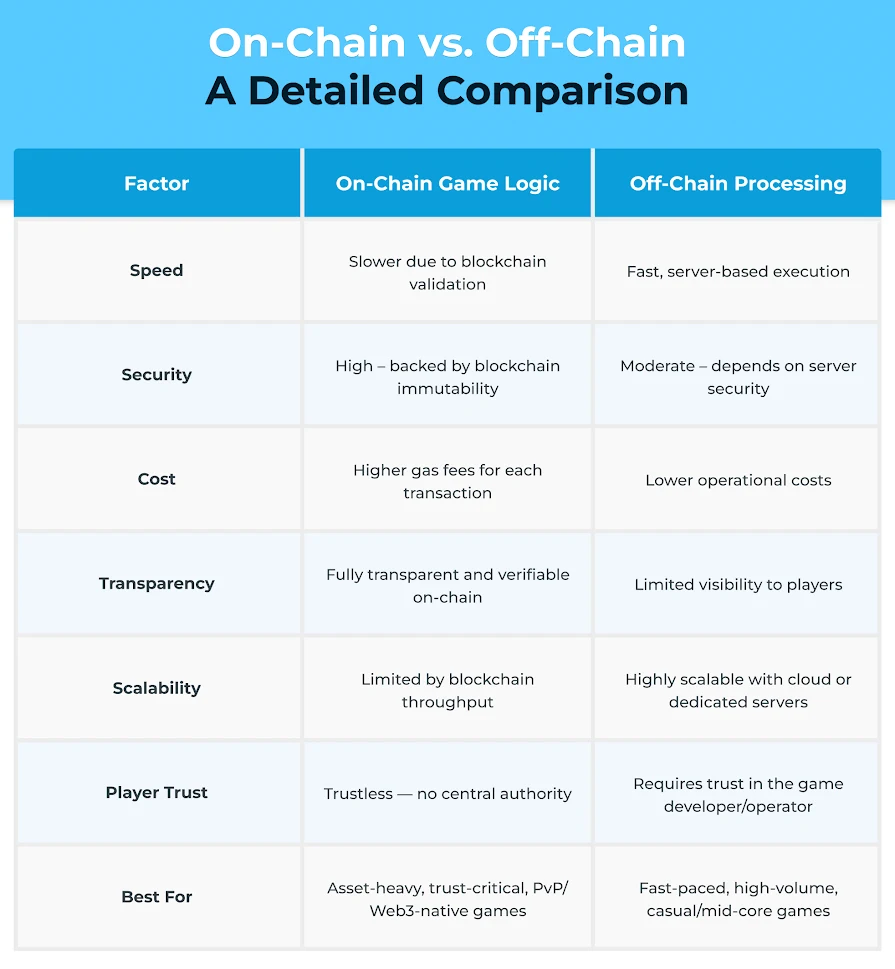
- On-chain game logic executes core game rules directly on the blockchain, offering benefits like security, transparency, and true ownership but may face limitations such as performance bottlenecks and high costs.
- In contrast, off-chain processing keeps most game logic outside the blockchain for speed and cost efficiency but comes with centralization risks and lower transparency.
- Hybrid models, blending both approaches, offer a balance between performance and decentralization.
Architecture decisions can make or break a gaming project in the rapidly changing field of Web3 game development. One of the most important technical choices for developers, studios, and investors is whether to use off-chain processing or on-chain game logic. Scalability, performance, cost, and—above all—the player experience are all impacted by this decision. Making games that are both captivating and future-proof in the blockchain era requires an understanding of the advantages and disadvantages of both strategies.
Understanding On-Chain Game Logic
On-chain game logic means that the core rules, mechanics, and transactions of a game are executed and stored directly on the blockchain. Smart contracts power this setup, ensuring transparency, immutability, and decentralization.
Key Advantages
- Security: Transactions and game outcomes are tamper-proof, secured by blockchain consensus.
- Transparency: All players can verify results and asset ownership on-chain.
- True Ownership: In-game items, NFTs, and tokens remain with the player, not the developer.
Limitations
- Performance Bottlenecks: Blockchain validation can slow down gameplay.
- High Costs: Gas fees for every interaction can add up, especially in asset-heavy games.
On-chain logic is ideal for asset-intensive, competitive, or trust-critical games, but not always the best fit for high-speed, casual experiences.
Understanding Off-Chain Processing
Off-chain processing keeps most game logic outside the blockchain, using centralized or decentralized servers for execution. The blockchain is used only for essential actions, such as asset minting, ownership verification, or reward distribution.
Key Advantages
- High Speed: Eliminates blockchain validation delays, enabling real-time gameplay.
- Cost Efficiency: No gas fees for every in-game action.
- Flexibility: Easier to update and modify without redeploying smart contracts.
Limitations
- Centralization Risks: Game outcomes depend on server integrity.
- Lower Transparency: Players can’t always verify all processes.
Off-chain models are best suited for fast-paced games, casual genres, or experiences where decentralization isn’t the primary concern.
The Best of Both Worlds with Hybrid Models
A lot of contemporary blockchain games are using hybrid architectures, which keep assets and important logic on-chain while off-chaining computations that are not absolutely necessary. This strategy strikes a balance between performance and decentralization, allowing developers to create safe but fluid gaming experiences.
A PvP battle result, for instance, could be confirmed on-chain while UI and animations run off-chain for speed. Because of this combination, studios can produce scalable games without sacrificing the fundamental principles of Web3 game development.
Accelerate Your Game Development Timeline With Us
Key Factors to Consider Before Choosing an Architecture
In Web3 game development, the choice between on-chain and off-chain architecture necessitates a thorough evaluation of player experience, scalability objectives, and performance requirements. To make sure the selected strategy fits with both technical and business goals, developers must consider elements like transaction costs, latency, decentralization requirements, and the overall game design.
- Game Genre & Mechanics – Does your game rely on speed, transparency, or both?
- Transaction Volume – High-frequency actions may be costly on-chain.
- Cost Constraints – Budget considerations for gas fees and server infrastructure.
- Blockchain Protocol – Some blockchains offer better scalability and lower fees.
- Future Scalability – Architecture should support long-term growth.
Technology Stack for On-Chain and Off-Chain Development
The effectiveness and scalability of your Web3 game are significantly influenced by the technology stack. Off-chain processing makes use of conventional servers, APIs, and cloud infrastructure, whereas on-chain development frequently depends on blockchain networks, smart contract frameworks, and decentralized storage solutions. Finding the ideal balance between these tools can improve user engagement, lower expenses, and maximize gameplay.
A professional Web3 game development company will often work with:
- Blockchain Platforms: Ethereum, Polygon, BNB Chain, Solana
- Game Engines: Unity, Unreal Engine
- Smart Contract Languages: Solidity, Rust
- Off-Chain Infrastructure: Cloud computing, APIs, edge networks
The right combination of tools depends on whether the project prioritizes decentralization, performance, or a balance of both.
Security Considerations
When creating Web3 games, security is crucial because flaws can result in lost assets, exploits, or eroded player confidence. While off-chain systems need strong authentication, encryption, and fraud detection procedures, on-chain logic benefits from blockchain’s intrinsic immutability. Both on-chain and off-chain components are protected against changing threats thanks to a hybrid security approach.
- On-Chain Risks: Vulnerable smart contracts can lead to exploits.
- Off-Chain Risks: Server hacks, data manipulation, and downtime.
- Best Practices: Smart contract audits, server hardening, and multi-layered security protocols.
The Verdict
The success of your game in the Web3 era can be determined by your strategic choice between off-chain processing and on-chain game logic. Antier is a top Web3 game development company that has mastered both architectures and produces safe, scalable, and high-performing games for customers all over the world.
Antier’s 800+ blockchain specialists can precisely design and implement your game, regardless of your preference for a fully decentralized experience or a hybrid model that balances speed and security. Our track record of success in Web3 game development guarantees that your project will not only launch successfully but also prosper in the cutthroat world of blockchain gaming.