




AI Summary
- Step into the future of AI with multi-agent systems!
- Say goodbye to standalone tools and hello to collaborative intelligence transforming businesses.
- By 2026, over 40% of enterprise workflows will involve AI agents, marking a significant shift in organizational operations.
- These agents, working together towards shared goals, outperform traditional AI models by handling complexity with speed and precision.
- Imagine a team of experts tackling tasks together, ensuring efficiency and adaptability.
The era of standalone AI tools is fading fast – we are now entering the age of intelligent, collaborative systems powered by multi-agent AI solutions. Businesses today demand more than automation; they need systems that can think, coordinate, and act autonomously in real time. In fact, by 2026, over 40% of enterprise workflows are expected to involve AI agents, highlighting a major shift in how organizations operate. This is where AI agents in business are transforming decision-making, efficiency, and customer experiences. From finance to healthcare, companies are adopting AI-powered automation solutions to streamline complex workflows. The rapid rise of multi-agent AI applications in real-world scenarios is driving enterprises toward becoming truly AI-native.
Understanding Multi-Agent AI: The Foundation of Intelligent Enterprises
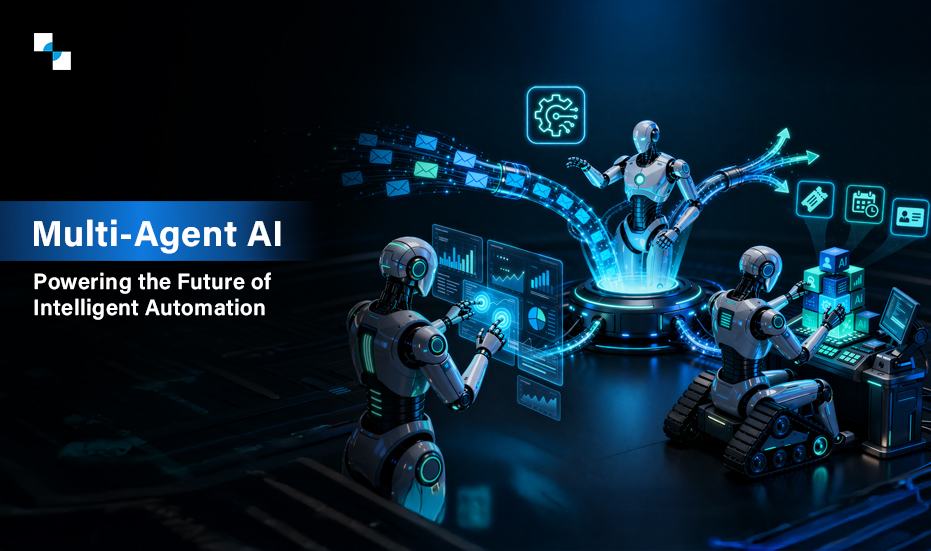
At its core, multi-agent AI solutions represent a powerful shift from isolated intelligence to collaborative, distributed intelligence systems. Instead of relying on a single AI model to handle every task, this approach brings together multiple intelligent agents each designed with a specific capability – working in coordination toward a shared business objective.
These agents are not just independent tools; they are goal-oriented, context-aware, and capable of communication. Each agent focuses on a particular function such as data collection, analysis, decision-making, execution, or monitoring. By working together, they form a system that is far more efficient, scalable, and adaptable than traditional AI models.
Traditional AI vs. Multi-Agent AI
To better understand the significance of this approach, consider the difference:
- Single AI Systems
A single, centralized model is responsible for handling multiple tasks. While effective for simpler use cases, it often becomes overwhelmed when dealing with complex, multi-step workflows or dynamic environments. - Multi-Agent AI Systems
A network of specialized agents, where each agent performs a dedicated role and collaborates with others. This creates a system that can handle complexity with greater speed, accuracy, and flexibility.
In simple terms:
- Single AI tries to do everything alone
- Multi-agent AI works like a team of experts solving a problem together
This team-based intelligence is what makes multi-agent artificial intelligence services highly effective for modern enterprises.
Why This Matters for Businesses
Today’s business landscape is defined by increasing complexity and speed. Organizations must continuously manage:
- Complex workflows that span multiple departments, tools, and processes
- Massive datasets generated from customers, operations, and digital platforms
- Real-time decision-making requirements, where even small delays can impact outcomes
In such environments, relying on a single AI model often leads to inefficiencies. These systems struggle with:
- Handling multi-step processes
- Managing context across different tasks
- Scaling across multiple operations simultaneously
This is where AI-powered automation solutions built on multi-agent AI solutions create a significant advantage.
Breaking Down Complexity into Intelligent Units
Multi-agent systems tackle complexity by dividing large problems into smaller, manageable tasks, each handled by a specialized agent. These agents then collaborate and share information to achieve the final outcome.
For example:
- One agent gathers and processes data
- Another analyzes patterns and generates insights
- A third executes actions based on those insights
- A fourth monitors results and optimizes performance
This structured collaboration enables:
- Parallel execution of tasks, reducing delays
- Higher accuracy, as each agent focuses on its expertise
- Faster decision-making, driven by real-time insights
- Continuous improvement, through feedback and learning
By leveraging AI agents in business, organizations can move beyond basic automation and unlock intelligent orchestration where systems not only execute tasks but also coordinate, adapt, and evolve.
This is why multi-agent AI applications in real world scenarios are gaining rapid adoption across industries. They transform rigid processes into flexible, intelligent systems capable of handling modern business demands.
Explore the Future of Multi-agent AI
How Multi-Agent AI Works in Real Business Environments
To truly understand the power of multi-agent AI solutions, it’s important to look at how they function in real-world business environments. Unlike traditional systems, these architectures are designed for collaboration, adaptability, and continuous optimization.
A well-designed multi-agent artificial intelligence services framework is not just a collection of agents; it’s a structured ecosystem where every component plays a critical role in delivering intelligent outcomes.
1. Task-Specific Agents – The Specialists
At the foundation of every system are task-specific agents, each built to handle a clearly defined responsibility with precision and efficiency.
These agents typically cover functions such as:
- Data Collection → Gathering structured and unstructured data from multiple sources
- Data Analysis → Processing and extracting meaningful insights
- Execution → Performing actions based on decisions (e.g., triggering workflows, sending responses)
- Validation → Verifying outputs to ensure accuracy, compliance, and quality
By assigning focused roles, multi-agent AI solutions ensure that each part of the workflow is handled by an “expert agent,” leading to better performance and reduced errors.
2. Orchestration Layer – The Decision Engine
The orchestration layer acts as the central coordinator or “manager” of the system. It is responsible for:
- Assigning tasks to the right agents
- Managing workflows and dependencies
- Prioritizing actions based on business goals
- Ensuring smooth collaboration across agents
This layer transforms individual agents into a cohesive, goal-driven system, making AI agents in business capable of handling complex, multi-step processes without human intervention.
3. Communication Framework – The Collaboration Backbone
For a multi-agent system to function effectively, agents must communicate seamlessly in real time.
The communication framework enables:
- Instant data sharing between agents
- Context transfer across tasks
- Coordination of sequential and parallel workflows
This ensures that no agent operates in isolation. Instead, AI-powered automation solutions become interconnected systems where every action is informed by shared intelligence.
4. Memory & Context Engine – The Intelligence Core
One of the most critical components is the memory and context engine, which allows the system to retain and utilize information over time.
It enables:
- Context-aware decision-making
- Historical data referencing
- Personalized and adaptive responses
- Learning from past interactions
Without this layer, agents would behave like isolated tools. With it, multi-agent artificial intelligence services evolve into intelligent systems that improve continuously.
5. Feedback Loops – The Optimization Driver
The final layer is the feedback loop mechanism, which ensures continuous improvement and system refinement.
This includes:
- Monitoring outcomes and performance metrics
- Identifying errors or inefficiencies
- Updating agent behavior based on results
- Enabling self-optimization over time
Feedback loops turn static automation into dynamic, learning-driven systems, which is a core strength of multi-agent AI applications in real world scenarios.
Multi-Agent AI Applications in Real World
Let’s dive into multi-agent AI applications in real world scenarios that are actively transforming industries.
1. Finance: Real-Time Intelligent Decision Systems
Financial institutions are adopting multi-agent AI solutions to manage risk, detect fraud, and optimize investments.
Example Workflow:
- Risk analysis agent
- Fraud detection agent
- Trading strategy agent
- Compliance monitoring agent
Customer Problem Solved:
- Delayed decision-making
- Fraud vulnerabilities
- Lack of personalization
Outcome:
Using AI-powered automation solutions, financial firms achieve:
- Real-time insights
- Reduced fraud losses
- Smarter investment strategies
2. Healthcare: Collaborative Intelligence for Better Outcomes
Healthcare systems leverage AI agents in business workflows to assist doctors and improve patient care.
Multi-Agent Setup:
- Diagnosis agent
- Medical history analyzer
- Research agent
- Treatment recommendation agent
Customer Problem Solved:
- Diagnostic delays
- Human error
- Fragmented patient data
Outcome:
With multi-agent artificial intelligence services, hospitals deliver:
- Faster diagnoses
- Personalized treatments
- Improved patient outcomes
3. E-commerce: Autonomous Revenue Optimization
E-commerce brands are using multi-agent AI solutions as growth engines.
Agents Involved:
- Pricing optimization agent
- Inventory forecasting agent
- Customer support agent
- Marketing automation agent
Customer Problem Solved:
- Low conversions
- Overstock/understock issues
- Poor customer engagement
Outcome:
Through AI-powered automation solutions:
- Dynamic pricing increases revenue
- Inventory is optimized
- Customer experience improves
4. Supply Chain: Self-Healing Ecosystems
Supply chains are becoming autonomous using multi-agent AI applications in real world.
Agents:
- Demand forecasting agent
- Logistics optimization agent
- Disruption detection agent
Customer Problem Solved:
- Delays and inefficiencies
- Lack of visibility
- High operational costs
Outcome:
Using multi-agent artificial intelligence services:
- Faster deliveries
- Predictive logistics
- Reduced costs
5. Software Development: AI Engineering Teams
Companies are deploying AI agents in business processes to accelerate development.
Agents:
- Code generator
- Tester
- Debugger
- Documentation writer
Customer Problem Solved:
- Slow development cycles
- High engineering costs
Outcome:
With AI-powered automation solutions:
- Faster releases
- Higher code quality
- Reduced costs
6. Marketing: End-to-End Campaign Automation
Marketing is one of the biggest adopters of multi-agent AI solutions.
Agents:
- Market research agent
- Content generation agent
- Campaign execution agent
- Analytics agent
Customer Problem Solved:
- Inefficient campaigns
- Low ROI
- Poor targeting
Outcome:
Through multi-agent AI applications in real world:
- Hyper-personalized campaigns
- Real-time optimization
- Better ROI
Key Benefits of Multi-Agent AI Solutions
Organizations adopting AI-powered automation are already seeing measurable results. Deloitte reports that over 66% of companies have achieved productivity and efficiency gains, while real-world implementations show AI can reduce workflow cycle times by 30% or more in specific use cases.
1. True Business Automation
Unlike traditional systems that automate isolated tasks, AI-powered automation solutions built on multi-agent frameworks enable end-to-end workflow execution. From data ingestion to decision-making and final action, every step is seamlessly connected; helping businesses achieve up to 50% faster process completion rates.
2. Scalability Without Complexity
With multi-agent artificial intelligence services, businesses can scale operations without adding unnecessary complexity. Each agent handles a specific function, allowing organizations to expand capabilities modularly while maintaining system efficiency, flexibility, and control.
3. Faster Decision-Making
One of the biggest advantages of multi-agent AI solutions is the ability to process tasks in parallel. Multiple agents work simultaneously on different aspects of a problem, enabling faster analysis and real-time responsiveness. In many cases, this approach can reduce operational latency by up to 60%, accelerating business outcomes.
4. Cost Efficiency
By leveraging AI agents in business, organizations can significantly reduce dependency on manual processes and repetitive human effort. This leads to lower operational costs while maintaining high levels of accuracy, consistency, and productivity across workflows.
5. Continuous Learning Systems
A key strength of multi-agent AI applications in real world environments is their ability to continuously learn and improve. Through feedback loops and shared intelligence, agents evolve with every interaction, enhancing performance, adapting to new data, and delivering smarter outcomes over time.
Latest Trends in Multi-Agent AI (2025-2026)
The evolution of multi-agent AI solutions is accelerating rapidly, reshaping how businesses build, deploy, and scale intelligent systems. According to industry projections, multi-agent systems are expected to become a core component of enterprise AI architecture, driven by their ability to improve efficiency, scalability, and real-time decision-making.
1. Rise of Agentic AI Platforms
A new wave of platforms is emerging to simplify the development and deployment of multi-agent artificial intelligence services. These platforms offer pre-built frameworks and orchestration tools, enabling businesses to scale faster. As adoption increases, organizations are reporting significant reductions in development time and operational complexity.
2. AI as a Digital Workforce
Businesses are increasingly treating AI agents in business as a structured digital workforce with defined roles and responsibilities. Organizations assign tasks, monitor performance, and continuously optimize outcomes, similar to managing human teams. This approach allows companies to scale operations efficiently, where human teams focus on strategy while AI agents handle execution and repetitive workflows.
3. Orchestration is the New Competitive Advantage
The true value of multi-agent AI solutions lies in how effectively agents are orchestrated to work together. Businesses are focusing on coordination, task allocation, and real-time communication between agents to drive efficiency. Strong orchestration ensures faster execution, better decision-making, and improved outcomes, making it a key differentiator in building successful AI-driven systems.
4. AI Governance Layers
As adoption grows, organizations are implementing governance frameworks to ensure safe and controlled use of multi-agent artificial intelligence services. These layers include monitoring systems, compliance checks, and decision boundaries to manage risks effectively. By integrating governance into AI-powered automation solutions, businesses can maintain trust, security, and alignment with regulatory standards.
5. Cross-Platform Agent Collaboration
Modern multi-agent AI applications in real world environments enable agents to operate seamlessly across multiple platforms, tools, and systems. These agents can interact across cloud, mobile, and enterprise applications, ensuring smooth data flow and task execution. This capability allows businesses to achieve true end-to-end automation across their entire digital ecosystem.
6. Hyper-Specialized AI Agents
The future of multi-agent AI solutions is driven by highly specialized agents designed for specific tasks or domains. Each agent focuses on a narrow function, delivering higher accuracy and efficiency compared to generalized models. When combined, these agents create powerful systems that enhance scalability, precision, and overall performance in complex business environments.
Ready to Implement Multi-agent AI in your Business?
How Businesses Can Get Started
If you’re planning to adopt AI-powered automation solutions, here’s a practical roadmap to successfully implement and scale multi-agent AI solutions in your organization.
Step 1: Identify High-Impact Use Cases
Start by identifying business areas where complexity, inefficiencies, or manual processes are slowing operations. Focus on workflows that involve multiple steps, data sources, or decision points, as these are ideal for multi-agent AI applications in real world scenarios and can deliver maximum impact.
Step 2: Start Small, Then Scale
Begin with a pilot project by implementing a focused multi-agent AI solution for a specific use case. This allows you to test performance, measure ROI, and refine the approach before expanding. A phased rollout ensures lower risk and smoother adoption across the organization.
Step 3: Invest in Integration
Ensure seamless integration between your existing systems, tools, and data sources to enable effective communication between agents. Strong integration is critical for AI agents in business to function cohesively, share context, and execute workflows without disruptions or data silos.
Step 4: Partner with Experts
Collaborate with providers offering multi-agent artificial intelligence services to accelerate implementation and avoid common pitfalls. Experienced partners bring the right frameworks, technical expertise, and strategic guidance needed to build scalable and efficient AI-powered systems.
Step 5: Monitor & Optimize
Continuously track performance, analyze outcomes, and refine agent behavior to improve efficiency over time. By leveraging feedback loops and analytics, businesses can enhance AI-powered automation solutions, ensuring long-term value, adaptability, and sustained competitive advantage.
The Future Belongs to Those Who Orchestrate Intelligence, Not Just Adopt It
The rise of multi-agent AI solutions is redefining how modern enterprises operate, shifting from static automation to intelligent, collaborative ecosystems. Businesses today are no longer just implementing AI; they are building systems that can think, adapt, and execute autonomously at scale. By leveraging AI-powered automation solutions and embedding AI agents in business, organizations can overcome complexity, accelerate decision-making, and deliver highly personalized customer experiences.
As multi-agent AI applications in real world scenarios continue to expand, their impact across industries is becoming impossible to ignore. Companies that invest in multi-agent artificial intelligence services today will not only stay competitive but lead the next wave of innovation. At Antier, we specialize in building scalable, enterprise-grade multi-agent AI solutions tailored to complex business needs. Our expertise in multi-agent AI solutions empowers organizations to transform operations, drive efficiency, and achieve sustainable growth.
FAQs
1. What are multi-agent AI solutions, and how are they different from traditional AI?
Multi-agent AI solutions consist of multiple intelligent agents working together, each handling a specific task. Unlike traditional AI, which relies on a single model, these systems collaborate, share context, and execute workflows collectively, making them more scalable, adaptive, and efficient for complex business problems.
2. What industries benefit the most from multi-agent AI applications in real world scenarios?
Industries like finance, healthcare, e-commerce, supply chain, and SaaS are seeing the highest impact. Multi-agent AI applications in real world environments help these industries improve efficiency, reduce costs, enhance decision-making, and deliver highly personalized customer experiences.
3. What problems do multi-agent AI solutions solve for businesses?
Multi-agent AI solutions solve challenges like fragmented workflows, slow decision-making, data overload, and operational inefficiencies. By enabling multiple agents to collaborate, businesses can automate end-to-end processes and handle complex tasks with greater speed and accuracy.
4. Are AI-powered automation solutions suitable for small and mid-sized businesses?
Yes, modern AI-powered automation solutions are becoming more accessible and scalable. Businesses can start with specific use cases and gradually expand, making multi-agent AI adoption practical even for startups and mid-sized companies.
5. What are the biggest challenges in implementing multi-agent AI solutions?
Common challenges include system integration, data quality, agent coordination, and governance. However, with the right strategy and multi-agent artificial intelligence services provider, businesses can overcome these hurdles and ensure smooth implementation.
6. Is multi-agent AI secure and reliable for enterprise use?
Yes, when implemented with proper governance layers, monitoring systems, and compliance controls, multi-agent AI solutions can be highly secure and reliable. Enterprises are increasingly adopting frameworks to ensure safe and controlled AI operations.