




AI Summary
- Tokenization has evolved from a blockchain experiment into a vital tool for enterprises seeking liquidity and transparency.
- Early on-chain tokenization models lack enterprise requirements.
- Hybrid tokenization blends blockchain innovation with enterprise controls, filling this gap.
- It strategically combines blockchain with enterprise systems to maximize benefits and minimize risks.
- The hybrid model includes on-chain tokenization for ownership tracking and auditability, and off-chain enterprise layers for compliance and data management.
Tokenization has rapidly evolved from a niche blockchain experiment into a strategic enabler for enterprises seeking greater liquidity, operational efficiency, and transparency across asset classes. However, as enterprises move beyond proof-of-concept initiatives, it has become increasingly clear that early, fully on-chain tokenization models are not designed to meet real-world enterprise requirements.
Enterprises operate within complex ecosystems defined by regulatory oversight, data privacy mandates, legacy infrastructure, and multi-jurisdictional compliance obligations. While public blockchain networks offer decentralization and transparency, they often lack the governance controls enterprises require. Conversely, fully private systems limit interoperability and long-term scalability.
This gap is being decisively filled by hybrid tokenization, a pragmatic and future-ready framework that blends blockchain innovation with enterprise-grade control. Hybrid models are emerging as the preferred foundation for enterprise asset tokenization, enabling organizations to unlock tokenized value without compromising compliance, privacy, or operational stability.
What Is Enterprise Asset Tokenization and Why Are Enterprises Re-Evaluating Tokenization Models in 2026?
Enterprise asset tokenization is the practice of using tokens built on blockchain technology to digitally represent ownership, rights and economic value of an enterprise’s asset[s] while embedding the governance, compliance, and operational controls that large organizations require.
Assets that can be tokenized include but are not limited to financial securities; portfolios of real estate; interests in private equity; commodities; infrastructure-related assets; intellectual property; and instruments for sharing revenue.
Numerous large structural shifts are influencing how organizations view and approach the tokenization of their assets:
- The regulatory landscape has matured. As such, regulators are now requiring that asset tokenization projects be auditable and provide investor protection through jurisdictional enforcement rather than being experimental efforts.
- Institutional participation has increased in the tokenization of assets. Institutional investors are establishing higher standards for how organizations should protect the confidentiality of their data, accurately report their results and mitigate risk.
- There has been an expansion of operational scale; enterprises have progressed from conducting small pilots of tokenizing their assets to developing and implementing broad-based strategies for tokenizing multiple types of assets in multiple markets.
- Enterprises can no longer avoid integrating their legacy systems and other operational platforms into their tokenization platforms. Tokenizing assets and developing tokenized asset-based products will require seamless integration between the tokenization platform and legacy ERP systems, the provider of custodial services, banks, and systems for complying with regulations.
These developments are causing organizations to rethink their evaluation of enterprise tokenization models by prioritizing those models that align with how they operate on a day-to-day basis rather than those that require organizations to alter their methods of operation.
Evaluate whether Hybrid Tokenization fits your Enterprise Roadmap
What Is a Hybrid Tokenization Model?
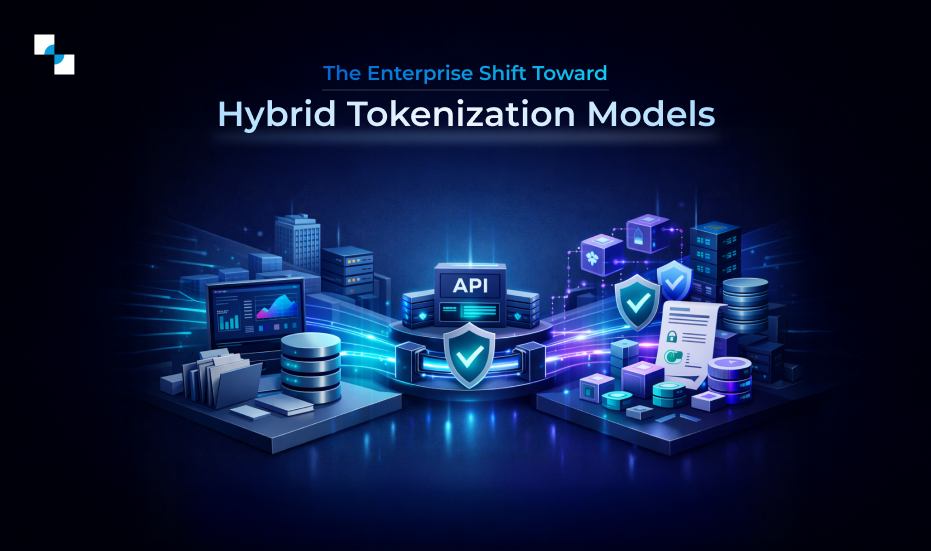
A hybrid tokenization model is an architectural approach that strategically distributes tokenization functions across blockchain networks and off-chain enterprise systems. Instead of forcing all processes onto a decentralized ledger, hybrid models apply blockchain selectively—where it delivers the greatest value—while retaining centralized control where required.
The following three components are integral to the hybrid tokenization architectural:
- A blockchain layer for token issuance, ownership tracking, and transaction immutability
- An off-chain enterprise layer for compliance, identity management, legal documentation, and sensitive data
- Middleware that synchronizes on-chain events with off-chain business logic and enterprise workflows
The Hybrid Tokenization Models provide a method for Enterprises to maximize the use of Blockchain technology while minimizing their exposure to regulatory and operational risks.
How Hybrid Tokenization Architecture Combines On-Chain and Off-Chain Tokenization
The success of tokenization of hybrid assets is dependent upon how well the on-chain and off-chain tokenization functions are coordinated. Each layer has been specifically designed to carry out the operations that will work most effectively in that environment.
1. On-chain Tokenization Layer
The on-chain tokenization layer has responsibility for activities that can be carried out in a decentralized, immutable, and automated manner:
- Issuing Tokens and Managing Their Life Cycle
Tokens will be generated on chain as a method of providing a cryptographic proof of ownership of the asset they represent. When life cycle events occur (minting, burning, freezing, or unlocking tokens), they are executed in an open and transparent manner to ensure that the integrity of the asset is maintained.
- Records of Transfer of Ownership
All transfers of the token from one holder to another will be recorded on the blockchain, resulting in an unalterable record of who owns an asset. The result is a reliable record for enterprises, investors & regulators to rely upon to establish provenance of the asset and validate any corresponding transactions.
- Smart Contract Execution
Smart contracts provide an automated means of enforcing all contractual obligations (e.g., transfer restrictions, vesting schedules, dividend distributions, redemption of asset rights). As a result of using smart contract execution, manual interventions can be reduced, reducing the likelihood of operational errors. All contractual obligations will be consistently enforced.
- Audit and Traceability
Auditability in real time is possible due to the recordkeeping of the blockchain. Regulators and internal compliance departments can verify the validity of transactions with no reliance on reconciled reports, thereby creating far greater trust and transparency with all parties involved.
2. Off-chain enterprise layer
The off-chain layer provides functionality that requires privacy, flexibility, and regulatory discretion.
- KYC/AML Verification & Investor Accreditation
Identity verification in different jurisdictions has different processes and is continuously changing. By managing these workflows off-chain, businesses can quickly adapt their compliance logic to accommodate changing regulations and apply eligibility checks before participating on-chain.
- Legal Agreements & Contractual Governance
Ownership of assets is determined by legal documentation (prospectuses, shareholder agreements, and regulatory filings). Off-chain storage of these documents provides the ability to keep them updated and still be cryptographically linked to the on-chain token.
- Asset Valuation, Reporting, and Metadata Management
Many types of assets will need to be valued periodically, sometimes using third-party data feeds or human intervention. An off-chain system can facilitate accurate financial reporting and mitigate the risk of unnecessary oracle dependency.
- Integration to Enterprise Systems
Hybrid architectures facilitate the integration of ERP systems, accounting packages, custodial services and banking infrastructure. This enables tokenization to build on existing operations and not disrupt them.
Tokenization Models Comparison: Public, Private, and Hybrid Enterprise Tokenization Models
A comprehensive tokenization models comparison highlights why hybrid approaches are increasingly favored by enterprises.
Public tokenization models
Public models operate entirely on open blockchains, offering transparency and composability. However, they present challenges such as:
- Exposure of sensitive transaction data
- Limited jurisdictional enforcement capabilities
- Unpredictable transaction costs and network congestion
- Governance dependency on public network consensus
While suitable for open ecosystems, public-only models struggle to meet enterprise governance and compliance standards.
Private tokenization models
Private models emphasize control and confidentiality but introduce other limitations:
- Restricted interoperability and liquidity
- Heavy reliance on centralized administrators
- Limited external auditability
- Reduced long-term flexibility
These constraints can hinder scalability and investor confidence.
Hybrid enterprise tokenization models
Hybrid models combine the strengths of both approaches:
- Selective transparency with controlled access
- Built-in compliance and governance mechanisms
- Scalable participation across markets and asset classes
- Future adaptability to regulatory and technological change
For enterprises pursuing long-term digital asset strategies, hybrid models offer the most resilient foundation.
Why Hybrid Tokenization Will Define Enterprise Asset Strategies
As enterprises consider tokenization as long-term infrastructure, decision-makers are increasingly prioritizing frameworks that align with governance, compliance, and scalability. In this shift, the hybrid tokenization model is emerging as the most practical and future-ready choice for enterprise asset tokenization.
Key factors contributing to the adoption of hybrid tokenization by enterprises:
- Hybrid tokenization architecture balances decentralization with enterprise governance
Unlike fully public systems, hybrid tokenization architecture allows enterprises to use blockchain for immutable ownership and auditability while retaining off-chain control over compliance, identity, and legal enforcement—an essential requirement for regulated enterprise environments.
- Supports regulatory-ready enterprise tokenization models
Enterprise tokenization models will enable the enterprise to manage compliance regulations, jurisdictional limitations, and reporting procedures off-chain, therefore enabling the enterprise to update its compliance regulations more easily and with fewer disruptions than if using a fully decentralized architecture.
- Optimized use of on-chain and off-chain tokenization layers
A hybrid implementation allows an enterprise to maximize the benefits of implementing on-chain and off-chain tokenization while providing transparency, as appropriate, and confidentiality as needed on its blockchain infrastructure.
- Delivers superior results in tokenization models comparison
In any realistic tokenization models comparison, hybrid tokenization approaches often surpass completely public and completely private tokenization approaches by delivering selective transparency, controlled access, and long-term scalability—critical factors in determining whether enterprises will adopt tokenized assets.
- Enables scalable hybrid asset tokenization across multiple asset classes
With hybrid asset tokenization, enterprises can tokenize a variety of assets (e.g., securities, funds, real estate, RWAs) over a single shared blockchain layer while applying customized off-chain governance, valuation, and compliance workflows for each asset type.
- Reduces cost volatility and operational risk at scale
Enterprises using fully public or private on-chain systems experience significant volatility in fees due to fluctuating network congestion and stable fees. In contrast, hybrid tokenization models move the majority of high-volume and compliance-centric processes off-chain and deliver a more predictable level of performance and cost savings as a result of this approach.
- Strengthens institutional trust and accelerates market participation
Institutional investors require a high level of trust based upon the governance and enforceability of how assets are tokenized. Hybrid frameworks provide on-chain transparency coupled with off-chain legal and compliance controls to create a more credible and investable enterprise asset tokenization.
- Best implemented with an experienced asset tokenization development company
In order to implement hybrid tokenization solutions, it is important to partner with an experienced asset tokenization development company with expertise in blockchain, compliance, and enterprise integration so that the architecture supports legislative and operational realities.
Explore Enterprise-Ready Hybrid Tokenization
A Strategic Enterprise Outlook
With more organizations starting to implement their tokenization initiatives instead of merely experimenting with these new technologies as they come to market, hybrid tokenization models are clearly proving to be one of the leading approaches for enterprise asset tokenization due to their ability to combine on-chain and off-chain tokenization in a manner that ensures transparency, governance, and flexibility to operate in various asset classes and jurisdictions.
Of all the various tokenization models being evaluated today, hybrid tokenization models stand out because they achieve a proper balance between innovation and control; thus, providing enterprises with the means to execute their long-term tokenization strategy through 2026.
Organizations cannot achieve hybrid tokenization at scale without deep technical and regulatory knowledge. As an established and reliable asset tokenization development company, Antier is able to assist these enterprises by not only providing the asset tokenization development services and expertise needed to design and deploy compliant hybrid tokenization architectures but also by providing the blockchain, Web3, and enterprise integration capabilities necessary to create tokenization platforms that will meet future regulatory requirements in an efficient and secure manner.