



AI Summary
- In 2026, blockchain networks are shifting focus towards sustaining real-world usage over time, rather than just speed.
- Major upgrades across networks like Ethereum and Solana are aimed at improving execution limits, reducing data load, and enhancing system reliability under scale.
- These upgrades are revolutionizing how applications are built and operated, while also simplifying user interactions with blockchain systems.
- Enterprises are now evaluating blockchain based on long-term maintainability rather than short-term growth signals.
- The blog post explores key upgrade themes, such as cost and execution impact, scalability, user experience abstraction, operational stability, and long-term product viability.
Blockchain is no longer competing on speed alone. It is competing on whether it can sustain real-world usage over time. In early 2026, this shift is visible across major networks. Core upgrades are not focused on attracting users. They are focused on fixing execution limits, reducing long-term data load, and improving system reliability under scale.
For example, Ethereum upgrades like proto-danksharding have already reduced layer 2 transaction costs by over 90 percent in some cases, improving affordability for high-volume applications. At the same time, Solana is targeting finality speeds as low as 100–150 milliseconds through its Alpenglow upgrade, compared to around 12 seconds earlier.
These are not incremental changes. They redefine how applications are built and operated. Another shift is how users interact with these systems. Blockchain is moving into the background. Financial platforms and enterprise applications are expected to onboard users without exposing wallets or gas fees.
For enterprises, this changes how blockchain should be evaluated. The focus shifts from short-term growth signals to consistent execution, system predictability, and long-term maintainability. This post examines key upgrade themes across major networks, breaks down 2026 roadmaps, and explains what these changes mean for Web3 enterprises.
Why Protocol Upgrades Matter for Web3 Enterprises in 2026
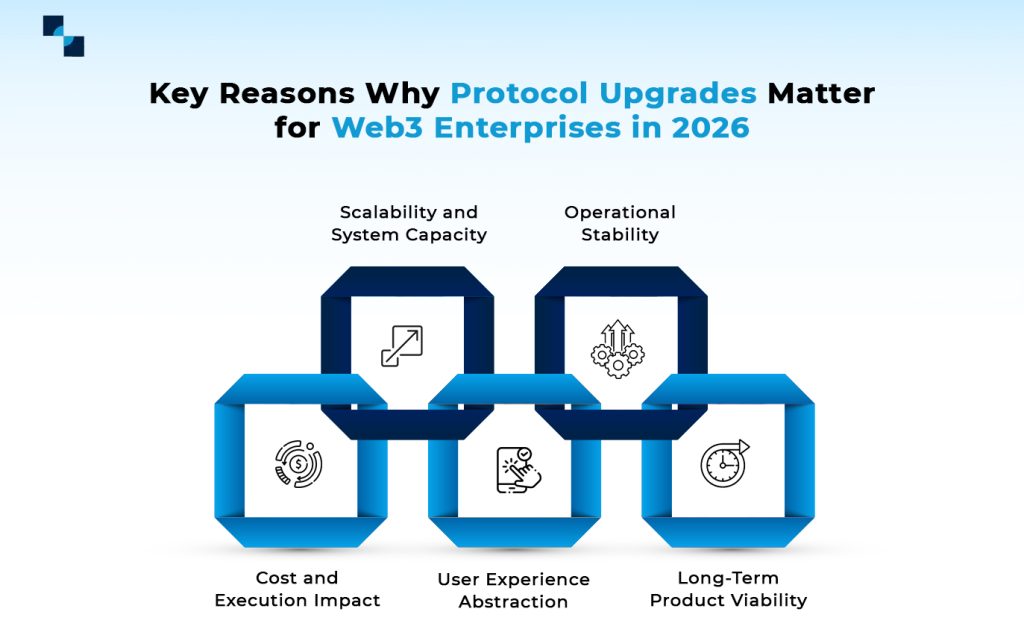
Cost and Execution Impact
Protocol upgrades directly affect transaction costs and execution predictability. Improvements in block processing and data availability reduce fee volatility and make operations more consistent. For enterprises handling payments, trading, or tokenized assets, this leads to better cost control and more reliable financial planning.
Scalability and System Capacity
As demand increases, networks must handle higher throughput without performance drops. Upgrades that address state growth, improve consensus, or increase processing capacity determine whether applications can scale without disruption. This is critical for enterprises building long-term products on-chain.
User Experience Abstraction
Protocol changes are reducing the need for users to interact with blockchain mechanics. Applications can now hide complexities such as wallet management and transaction fees. This allows enterprises to offer products that feel similar to traditional digital services while still running on blockchain infrastructure.
Operational Stability
Upgrades influence how stable a system remains under varying conditions. Networks with clear upgrade paths and predictable behavior reduce the risk of downtime, unexpected costs, or performance issues. This helps enterprises maintain consistent service levels.
Long-Term Product Viability
Protocol direction shapes how future-ready a network is. Enterprises need systems that can evolve without forcing constant redesigns. Upgrades that focus on maintainability, data handling, and infrastructure longevity support products that can operate reliably over extended periods.
Major Blockchain Upgrade Roadmaps in 2026
| Blockchain | Key Upgrades | Core Focus | What It Improves | Enterprise Impact |
|---|---|---|---|---|
| Ethereum | Glamsterdam, Hegota | Execution efficiency, state management, decentralization | Better block production, reduced node complexity | More predictable systems and long-term operability |
| Solana | Alpenglow, SIMD-0266 | Consensus redesign, resource efficiency | Near-instant finality, lower resource usage | Real-time applications like payments and trading |
| BNB Chain | Execution upgrades | High-performance EVM | Higher throughput, lower latency, parallel execution | Scales existing apps without major changes |
| Polygon | AggLayer | Interoperability, shared liquidity | Cross-chain coordination, high throughput | Access to unified liquidity and large-scale payments |
| Sui | Unified stack (S2) | Full-stack ecosystem | Built-in payments, trading, automation support | End-to-end app development within one network |
| Polkadot | Polkadot 2.0 | Elastic scaling, flexible resources | Async backing, coretime allocation | Easier deployment without managing infrastructure |
Ethereum
Ethereum’s 2026 roadmap is centered on two upgrades, Glamsterdam and Hegota. The focus is on improving execution efficiency, managing long-term state growth, and maintaining decentralization as network usage increases. Changes such as proposer builder separation and progress toward new data structures aim to reduce node complexity and improve block production. For enterprises, this creates a more predictable environment with lower execution friction and better long-term operability.
Solana
Solana is introducing Alpenglow, a redesign of its consensus and block propagation system, along with SIMD-0266 for resource optimization. These changes reduce finality time to near-instant levels and significantly lower resource usage. The result is faster transaction confirmation and improved performance under load. This positions Solana for applications that require real-time execution such as payments, trading, and interactive systems.
BNB Chain
BNB Chain is focusing on execution performance while maintaining compatibility with the Ethereum Virtual Machine. Planned improvements include higher throughput, lower latency, and better parallel execution. The goal is to support high-frequency use cases without introducing major architectural changes. This approach allows enterprises to scale existing applications without significant redevelopment.
Polygon
Polygon’s roadmap is built around AggLayer and scaling its network for high-throughput applications. The focus is on enabling shared liquidity and interoperability across multiple chains while supporting large-scale payment systems. This allows enterprises to build applications that operate across networks without fragmentation, improving access to users and liquidity.
Sui
Sui is moving toward a unified stack that combines payments, trading, and user-facing features within a single environment. Its roadmap includes native stablecoin support, simplified transactions, and built-in capabilities for automated systems. This reduces the need for external integrations and allows enterprises to build complete applications within one ecosystem.
Polkadot
Polkadot is completing its transition to Polkadot 2.0, focusing on elastic scaling and flexible resource allocation. Improvements such as async backing and coretime allocation allow developers to access network resources without managing their own infrastructure. This lowers entry barriers and supports a wider range of applications with varying performance needs.
Contact us to talk to our protocol experts
How Web3 Enterprises Should Respond to Protocol Upgrades: 10 Practical Steps
Evaluate Networks Based on Upgrade Direction
Enterprises should assess blockchains based on how their protocols evolve over time. Roadmap clarity and consistency matter more than short-term performance metrics.
Design Systems That Adapt to Change
Application architecture must remain flexible as protocol rules evolve. Systems should function without relying on fixed execution behavior or tightly coupled features.
Expand Beyond Single-Chain Dependency
Operating on one network limits flexibility. Enterprises should prepare for deployments across multiple chains to maintain access to users, liquidity, and infrastructure options.
Understand Governance Impact on Operations
Protocol decisions are shaped by governance processes. Enterprises need awareness of how these decisions are made and how they can influence system behavior and incentives.
Identify and Manage External Dependencies
Applications often rely on layers beyond the base protocol. Enterprises must evaluate risks tied to rollups, bridges, and service providers to avoid hidden points of failure.
Define a Clear Upgrade Adoption Approach
Enterprises should establish internal criteria for when to adopt protocol changes. This includes evaluating stability, compatibility, and potential impact on live systems.
Establish Controlled Testing Environments
Before deploying updates, applications must be tested in environments that reflect actual network conditions. This helps detect issues that may not appear in isolated testing.
Coordinate with Infrastructure Providers
Node operators, custodians, and API providers must be aligned with upgrade schedules. Coordination ensures that all components of the system remain functional during transitions.
Prepare for Failure Scenarios
Enterprises should plan for cases where upgrades do not perform as expected. Backup strategies and alternative execution paths are necessary to ensure continuity.
Align with Regulatory and Compliance Requirements
Protocol changes can affect how data is stored, transactions are processed, and systems are audited. Enterprises need to ensure that any upgrade or architectural change remains aligned with regulatory expectations, especially in sectors like finance, payments, and tokenized assets.
How Antier Supports Enterprises Through Protocol Transitions
Pre-Upgrade Impact Analysis
Antier Solutions conducts detailed assessments of upcoming protocol changes to identify how they affect business logic, transaction flows, and system dependencies. This goes beyond surface-level checks and focuses on real operational impact.
Protocol-Specific Engineering Support
Each blockchain upgrade introduces unique changes. Antier provides engineering support tailored to specific networks, whether it involves changes in consensus, execution layers, or data structures. This ensures applications remain compatible without performance degradation.
Smart Contract Refactoring and Compatibility
Protocol upgrades can affect how smart contracts behave. Antier reviews and updates contract logic to ensure compatibility with new protocol rules, preventing failures or unintended execution outcomes.
Data Migration and State Handling
Changes in how networks manage data require careful handling. Antier supports migration strategies, state adjustments, and data restructuring to ensure continuity without loss or inconsistency.
Upgrade Simulation and Scenario Testing
Antier runs controlled simulations of protocol changes to observe how systems behave under different conditions. This helps identify edge cases that may not appear in standard testing environments.
Cross-Layer Coordination
Many applications depend on multiple layers such as base chains, rollups, and external services. Antier ensures coordination across these layers so that upgrades do not create misalignment or break system interactions.
Performance Recalibration
After protocol changes, system performance characteristics may shift. Antier analyzes execution patterns and recalibrates systems to maintain consistent throughput and response times.
Post-Upgrade Stabilization
Once upgrades are deployed, Antier provides active support to stabilize systems. This includes resolving unexpected issues, fine-tuning performance, and ensuring smooth operation in live environments.
Continuous Upgrade Tracking
Blockchain protocols evolve continuously. Antier maintains ongoing tracking of network developments, allowing enterprises to stay prepared for future changes without reactive decision-making.
Prepare for upcoming upgrades with clarity and confidence
Final Thoughts
Blockchain systems are entering a phase where durability matters more than rapid change. Protocol upgrades in 2026 are laying the groundwork for systems that can support continuous, large-scale activity without constant redesign.
The next phase of growth will not be driven by visibility, but by systems that operate quietly in the background. Applications will handle complexity internally, while users and machines interact with services that feel instant and reliable.
For enterprises, the opportunity lies in building for this shift early. Those who align with evolving protocols today will be prepared for a future where blockchain is not a feature, but a foundational layer powering digital systems at scale.
Frequently Asked Questions
01. Which blockchain networks are leading protocol upgrades in 2026 ?
Major networks include Ethereum, Solana, Polkadot, Polygon, Sui, and BNB Chain, each focusing on different aspects such as scalability, speed, and interoperability.
02. Do protocol upgrades require changes to existing applications?
In many cases, yes. Changes in execution logic or data handling may require updates to smart contracts, infrastructure, or system configurations to maintain compatibility.
03. What risks are associated with blockchain upgrades?
Risks include security vulnerabilities, temporary instability during transitions, dependency on external layers, and governance-related uncertainties that can affect timelines and outcomes.
04. What role does AI play in blockchain upgrades ?
AI is being integrated into development tools and applications. It supports automated decision-making, system monitoring, and machine-driven transactions, which influence how future upgrades are designed.
05. Are protocol upgrades the same across all blockchains?
No. Each network has its own upgrade approach, architecture, and priorities. Some focus on performance, others on interoperability or data management, depending on their design goals.