





AI Summary
- In a world where a gaming startup envisions launching an NFT-powered universe, the journey from idea to reality can be daunting.
- The blog post explores the benefits of using white label blockchain solutions for rapid Web3 adoption.
- By partnering with a blockchain development company, businesses can leverage pre-built core architecture, reduce technical barriers, and customize without rebuilding from scratch.
- These solutions offer ready infrastructure, lower upfront costs, built-in security, and compliance features.
- Real-world examples like Binance Cloud, Securitize, and IBM Food Trust showcase the efficiency and scalability of white label blockchain platforms.
Imagine a gaming startup preparing to launch its own NFT-powered universe. The vision is clear: bustling marketplaces, loyal player communities, and digital assets exchanging hands every second. The excitement is high, but the reality hits fast. Building a blockchain network from scratch could take over a year, demand a full in-house tech team, and burn through the budget before the first user signs up.
Now imagine a different path. Instead of spending months on foundational coding, the team partners with a blockchain development company offering a white label blockchain solution. The infrastructure is ready, security is in place, and customization is wide open. Three months later, the platform goes live, branded its way, engaging users, and already generating revenue. This is the advantage of white label blockchain solutions for rapid Web3 adoption.
Core Benefits of Using White Label Blockchain Solutions for Faster Web3 Adoption
Ready Infrastructure
A white label blockchain platform comes with a fully functional core consensus mechanism, network nodes, APIs, wallet systems, and smart contract templates. Businesses only need to configure their use case, branding, and any industry-specific compliance requirements. This drastically shortens the development cycle compared to starting from scratch.
Reduced Technical Barriers
Many companies want to enter Web3 but lack specialized blockchain development expertise in-house. A blockchain development company offering white label products removes this entry barrier while allowing organizations to launch without building deep technical capabilities internally.
Customization without Rebuilding
Unlike generic off-the-shelf products, white label blockchain solutions are designed for customization. From token standards and consensus protocols to UI/UX branding, enterprises can adapt the platform to match their market vision without touching the underlying architecture.
Lower Upfront Costs
A full-scale blockchain project often involves long-term R&D and a large team of developers, auditors, and testers. With white label blockchain software, much of this work is already completed, reducing both time-to-market and the initial financial commitment.
Built-in Security and Compliance
Security is a non-negotiable in Web3. White label solutions from a reputable blockchain development company come with pre-audited codebases and compliance-ready modules, such as KYC/AML integration, reducing the time spent on security vetting.
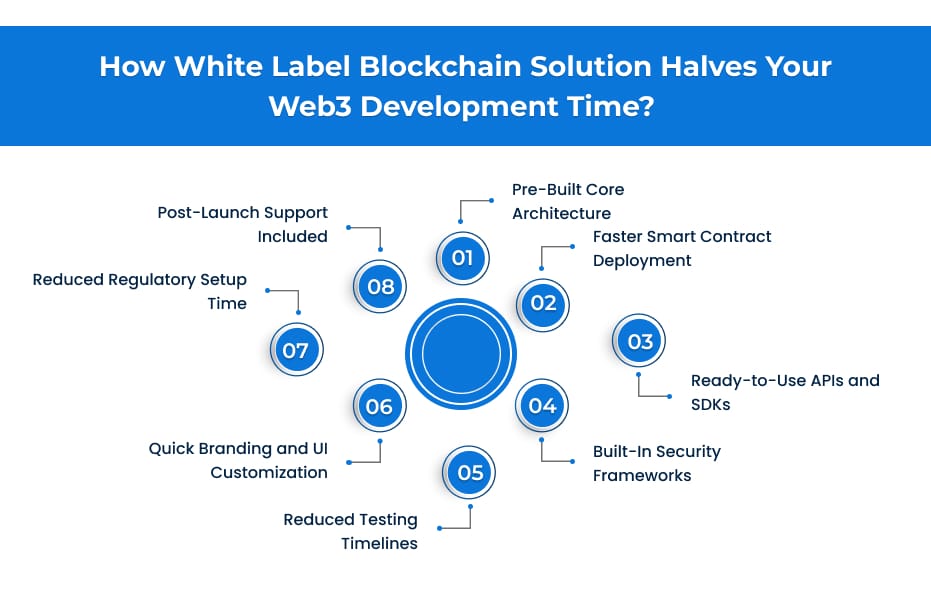
How White Label Blockchain Solutions Cut Your Web3 Development Time in Half?
Pre-Built Core Architecture
White label blockchain software comes with essential blockchain layers such as consensus mechanisms, smart contract functionality, and token standards already in place. Developers can skip the groundwork and move straight to customization, saving significant development cycles.
Faster Smart Contract Deployment
Since the platform already supports common smart contract templates, your team can adapt them rather than coding from scratch. This minimizes testing time while maintaining security and functionality.
Ready-to-Use APIs and SDKs
A good blockchain development company offering white label services typically provides APIs and SDKs for wallet integration, transaction processing, and data analytics. These pre-tested tools help developers connect services quickly and reliably.
Built-In Security Frameworks
Security audits are time-intensive. With a white label blockchain platform, many of these checks are already complete. Developers can focus on fine-tuning and adding unique features instead of rebuilding the security layer from scratch.
Reduced Testing Timelines
White label blockchain solutions undergo rigorous pre-launch testing by the provider. This means fewer bugs to fix during your own quality assurance, which directly cuts project delivery time.
Quick Branding and UI Customization
The structure is pre-coded, but the front end can be tailored to match your brand. This strikes a balance between speed and uniqueness, allowing you to focus design efforts on customer experience instead of backend complexity.
Reduced Regulatory Setup Time
Some white label blockchain software providers offer compliance-ready modules, especially for industries like finance or supply chain. This can save weeks or months of research and regulatory adjustment.
Post-Launch Support Included
Many blockchain development services for white label platforms include ongoing updates, bug fixes, and security patches. This prevents delays when scaling or upgrading the platform post-launch.

White Label Blockchain Platforms in Use: Real-world Examples
Binance Cloud
Binance Cloud offers a white label blockchain platform for businesses looking to launch fully functional crypto exchanges without building infrastructure from scratch. Partners can go live within 3–5 days, gaining access to Binance’s liquidity, order-matching engine, and security systems. This rapid deployment reduces months of development into a matter of days, allowing businesses to focus on branding, compliance, and customer acquisition rather than core technology.
Securitize
Securitize operates a white label blockchain solution that enables companies to tokenize securities, real estate, and treasury products while handling compliance and investor management. The platform serves 3,000 clients and manages over 1.2 million investors worldwide. Securitize leads the market in tokenized U.S. Treasury offerings, with $2.8 billion in value and over 70% market share in most top tokenized asset categories. It also holds the largest single tokenized equity asset valued at $400 million, showcasing the scale possible when leveraging a pre-built blockchain framework.
Walmart & IBM Food Trust
Although not strictly a white label product, IBM Food Trust demonstrates the speed advantages of blockchain infrastructure deployment. Walmart adopted this blockchain-based supply chain solution to trace sliced mango shipments. The result was a reduction in trace time from 6 days to just 2.2 seconds, providing faster quality assurance, compliance reporting, and consumer trust in product sourcing.
JPMorgan Onyx & JPM Coin
JPMorgan’s Onyx platform and JPM Coin demonstrate how pre-built blockchain frameworks can drastically shorten operational timelines for financial transactions. The system now processes over $1 billion in transactions daily, enabling near-instant settlement between institutional clients. By relying on established blockchain infrastructure, banks can roll out new digital currency services without developing every protocol in-house.
Maersk TradeLens
TradeLens, built by Maersk in collaboration with IBM, is a blockchain-powered logistics platform used by major ports, customs authorities, and shipping companies. It processes more than 20 million shipping events each day, streamlining documentation and reducing delays in international trade. The platform’s adoption shows how large-scale blockchain networks, once deployed, can be shared as a ready infrastructure for partners to join quickly and benefit from without developing their own systems.
Things to Consider When Choosing a White Label Blockchain Solution
Core Blockchain Infrastructure
Before committing, understand the underlying blockchain architecture the solution is built on, whether it’s Ethereum, Polygon, Hyperledger, Solana, or a proprietary chain. This determines transaction speeds, scalability, security protocols, and developer ecosystem support.
Customization Flexibility
A good white label solution should allow you to brand, modify, and extend functionalities to match your unique business model. Check if it supports custom UI/UX, feature modules, and API integrations. Limited customization can make your offering look like a generic copy in a competitive Web3 market.
Compliance & Regulatory Readiness
Web3 regulations vary across countries. Your white label platform should come with built-in compliance features like KYC/AML modules, GDPR support, and audit trails. This helps avoid legal pitfalls and positions your business for expansion into regulated markets without heavy retrofitting.
Security Protocols
Since blockchain deals with high-value assets, ensure the solution follows best security practices such as multi-signature wallets, hardware wallet support, encrypted key management, penetration-tested smart contracts, and DDoS protection. The cost of ignoring security far outweighs the initial investment in robust measures.
Scalability & Performance
Evaluate how the platform handles increased users, transactions, and integrations. Does it support horizontal scaling? Are there layer-2 or sharding solutions for throughput? Without scalability, you risk slow speeds and poor user experiences during peak demand.
Integration Ecosystem
Check whether the solution integrates with payment gateways, decentralized storage, NFT marketplaces, DeFi protocols, and analytics tools. A wide integration ecosystem means you can launch faster and expand offerings without heavy development costs.
Transparent Pricing Model
Understand the pricing structure, whether it’s a one-time license, subscription, or revenue share. Also, check for hidden fees such as upgrade costs, transaction commissions, or API usage limits. Transparency upfront helps avoid budget overruns.
Track Record & Client References
Always assess the provider’s credibility. Request case studies, user testimonials, and performance benchmarks. If a vendor has already powered multiple successful Web3 launches, you can trust their stability and domain expertise.
Future-Proofing
Web3 evolves fast, your white label platform should be adaptable to emerging standards like zero-knowledge proofs, cross-chain interoperability, and decentralized identity. Future-proofing ensures your investment stays relevant in the next 3–5 years.

Conclusion
White label blockchain solutions are more than just a fast path to Web3 adoption. They are business frameworks with multiple revenue levers hidden in plain sight. The key is identifying which streams align with your user base, market positioning, and regulatory environment.
By leveraging a ready-made yet customizable white label blockchain platform from a blockchain development company like Antier, businesses can focus on differentiating their product in the market instead of rebuilding existing capabilities from scratch.