



AI Summary
- The blog post discusses the evolving landscape of the payments industry with the integration of artificial intelligence and blockchain technology, leading to the emergence of tokenized agentic payments.
- This innovative approach allows AI agents to conduct transactions independently using tokenized assets within a programmable system, enhancing speed, efficiency, and security in financial operations.
- Traditional payment systems are deemed inadequate for the rapidly changing digital environment, necessitating a shift towards autonomous and scalable financial systems.
- To prepare for tokenized agentic payments, businesses are advised to modernize their payment infrastructure, adopt AI-driven financial systems, leverage AI-based tokenization solutions, invest in agentic payment development, and strengthen security and compliance frameworks.
- Embracing these strategies will position organizations as leaders in the future of finance and drive innovation in the digital economy.
The world is witnessing a significant shift in the payments industry, and the key driver is the integration of artificial intelligence and blockchain. The world is moving from static, rule-based systems to dynamic, self-executing systems, and the key driver is not just technology but rather business strategy. As the world moves towards AI-powered payment solutions, the need for infrastructure is key, and to be ready for the future, the focus should be on tokenized payment development.
What Are Tokenized Agentic Payments?
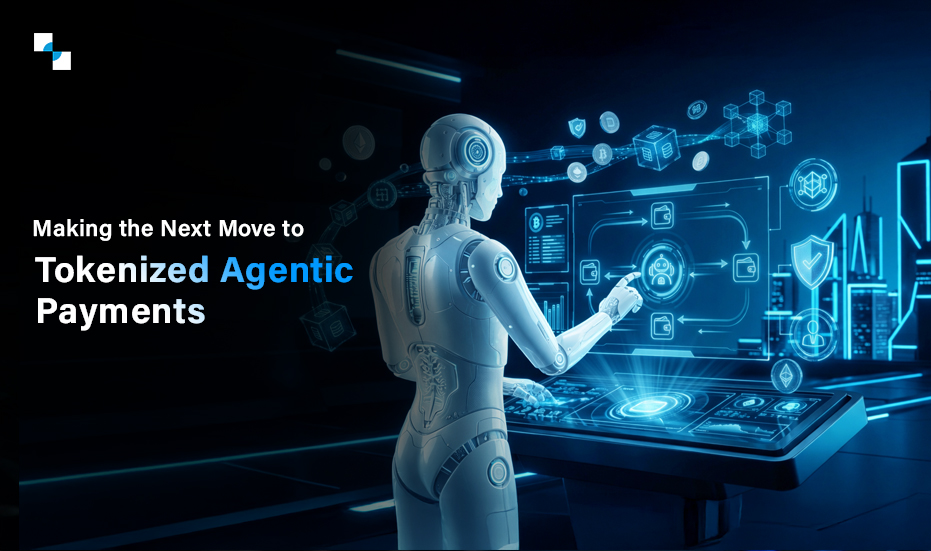
Tokenized agentic payments is a paradigm shift in which AI agents carry out transactions independently using tokenized assets in a programmable system. This technology leverages the transparency of blockchain technology and the decision-making capabilities of AI to build intelligent payment systems. Using AI-Based Tokenization Solutions, businesses can tokenize their assets and make them interact with one another in self-executing systems. This technology revolutionizes payments from traditional manual processes to intelligent, context-aware processes. This provides businesses with unprecedented control, speed, and efficiency in managing their finances.
- Agentic payment development allows AI-based systems to carry out transactions independently based on certain conditions and data inputs in real time, eliminating the need for human intervention and ensuring fast and accurate financial execution in processes.
- Tokenized payment development ensures that transactions are secure, transparent, and programmable within a blockchain-based environment. Each transaction is recorded in a tamper-proof manner, hence minimizing the risk of fraud and promoting trust among stakeholders. This system also facilitates the integration of decentralized applications and financial systems.
- The integration of AI and tokenization results in adaptive payment ecosystems that can optimize financial decisions in real time. These adaptive payment ecosystems can change to suit the needs of the market, users, and operations. This results in efficient resource allocation and enhances financial performance.
Why Traditional Payment Systems Are Failing
Traditionally designed payment systems were meant for a different era when the environment was linear, and the process was manual and centrally controlled. The present-day fast-paced digital environment is quite different from the traditional environment and requires a higher level of flexibility and intelligence in the systems to keep abreast with the real-time and automated financial transactions and operations that the businesses and the economy witness today. The traditional systems face a great deal of difficulty and challenges in accommodating the latest technological advancements such as smart contracts and AI-powered payment solutions, that the businesses look forward to incorporating into the payment systems and operations.
- Conventional systems cannot support agentic payment development, making it difficult to implement autonomous financial workflows. This results in delays, increased human intervention, and reduced operational efficiency across payment processes.
- Businesses are unable to leverage real-time decision-making capabilities effectively. Limited integration capabilities prevent organizations from adopting advanced AI-powered payment services that require seamless data flow and interoperability. Legacy systems often operate in silos, restricting the exchange of information across platforms. This hinders innovation and slows down digital transformation initiatives.
- The lack of tokenization frameworks restricts businesses from implementing scalable tokenized payment development strategies. Without tokenization, assets cannot be digitized or programmed for automated transactions. This limits the ability to participate in decentralized financial ecosystems.
Launch Scalable Tokenized Payment Ecosystem with the Experts
The Shift Toward Tokenized Agentic Payments
The move towards tokenized agentic payments is being fueled by the need for intelligent, automated, and scalable financial systems. This is where the need for AI-Based Tokenization Solutions is being felt by businesses. This change is a paradigm shift from the traditional approach to payments from manual control to automated orchestration. By investing in the development of a tokenized payment system, businesses can build robust systems that can fuel innovation and growth. This change is paving the way for a new era of financial autonomy.
- The emergence of AI-based payment systems is helping businesses automate complex financial processes more accurately and efficiently. These systems use data-driven insights to improve the flow of payments and decision-making processes. This is helping businesses improve the speed of payments and the customer experience.
- Tokenized payment system development is helping businesses facilitate seamless payments across borders by removing intermediaries and increasing the speed of payments. It is also helping businesses improve liquidity by providing the option for fractional ownership and instant asset transfer. This is opening doors for global financial participation.
- Enterprises investing in agentic payment development gain a competitive advantage by enabling autonomous and scalable financial systems. These systems can adapt to changing market conditions and business requirements in real time. This positions organizations as leaders in the evolving digital economy.
Tips to Prepare for Tokenized Agentic Payments
For tokenized agentic payments preparation, a business must take a pragmatic approach that focuses on execution rather than a technical transformation roadmap. With the development of autonomous financial ecosystems, businesses must adapt their infrastructure, AI capabilities, and financial regulation frameworks accordingly. The integration of AI-powered payment services with tokenization capabilities is a key enabler for intelligent financial operations. By focusing on strategic areas for preparation, a business may accelerate its preparation for the emerging financial ecosystem. A preparation strategy for financial ecosystems is crucial for ensuring scalability and long-term business sustainability.
1. Modernize Payment Infrastructure
Businesses should transform their payment infrastructure to enable tokenized payment platform development and programmable transactions. They should replace their traditional payment infrastructure with a blockchain-based framework that enables smooth integration with decentralized financial ecosystems. By doing so, a business may become more efficient in handling autonomous financial operations.
2. Adopt AI Driven Financial Systems
By integrating AI-driven payment systems, organizations can facilitate real-time decisions and executions for their payment processes. These systems utilize data obtained during transactions to optimize payment processes in real time.
3. Leverage AI-Based Tokenization Solutions
Organizations should consider using AI-Based Tokenization Solutions to enable the digitization of assets for smooth interactions within payment systems. Tokenization allows for the smooth tracking, fractionalization, and transfer of assets within the system.
4. Invest in Agentic Payment Development
Organizations should invest in agentic payment development to enable AI agents to execute transactions independently. These systems operate using rules and real-time data to execute transactions efficiently. This improves the scalability of the systems while reducing the likelihood of delays during transactions.
5. Strengthen Security and Compliance Frameworks
To aid in the development of tokenized payments, there is a need to strengthen security and compliance frameworks. This involves smart contract audits and AI-based fraud detection. A good framework for governance will ensure trust and transparency.
Future-Ready Payments Start Today
This transition to tokenized agentic payments represents a fundamental shift in the financial structure, where intelligence, automation, and programmability take the central role. Organizations embracing AI-powered payment solutions and tokenization strategies will reap a major advantage over others in the coming days. This is not only a chance to improve the current payment systems but also a chance to rethink the entire financial landscape. By utilizing Advanced AI-Based Tokenization Solutions and tokenized payment platform development, organizations can ensure the future of their business. Antier is at the forefront of this revolution and offers customized solutions to accelerate the journey of enterprises.
Frequently Asked Questions
01. What are tokenized agentic payments?
Tokenized agentic payments refer to a system where AI agents conduct transactions independently using tokenized assets within a programmable framework, leveraging blockchain technology for transparency and decision-making.
02. How do tokenized payment systems enhance security and trust?
Tokenized payment systems ensure secure, transparent, and programmable transactions recorded in a tamper-proof manner on the blockchain, minimizing fraud risk and promoting trust among stakeholders.
03. Why are traditional payment systems becoming obsolete?
Traditional payment systems are failing because they were designed for a linear, manual environment, whereas today's fast-paced digital landscape demands more flexibility and intelligence in payment processes.