




AI Summary
- The evolution of the Play-to-Earn (P2E) gaming model has transformed into a sophisticated Web3 ecosystem focused on sustainability, player experience, and long-term revenue models.
- In 2026, successful P2E game development involves layered monetization strategies to offer balanced gameplay, ownership, and profitability without compromising trust or stability.
- The global P2E gaming market is projected to reach $26.59 billion by 2034, emphasizing the market opportunity.
- Token-only monetization is no longer sustainable due to limitations like token inflation and short-term player behavior.
- P2E games now adopt hybrid models combining Web2 and Web3 strategies.
The P2E gaming model has undergone a significant evolution over the last few years. What just started as a token-reward-driven experiment has now evolved into a sophisticated Web3 gaming ecosystem where sustainability, player experience, and long-term revenue models matter more than ever.
In 2026, successful P2E game development is not just about rewarding players with tokens alone, since players are looking for more. Therefore, enterprises are looking forward to implementing layered monetization strategies that offer perfectly balanced gameplay, ownership, and profitability without compromising player trust or economic stability.
| Did You Know? |
The statistics give a clear indication about the market opportunity in the P2E gaming sector. Thus, businesses are planning to create P2E games that move ahead of inflation-prone reward systems by crafting scalable, player-centric economies powered by NFTs, marketplaces, premium access, and advanced tokenomics.
Why Token-Only Monetization Is No Longer Sustainable?
Early P2E games tend to heavily rely on continuous token emissions to attract players. While this approach proved to be good for onboarding players quickly, it also introduced some long-term challenges.
Key Limitations of Token-Only Monetization Models
- Token inflation: Excessive reward distribution leads to declining value of token
- Short-term player behavior: Players focus on earning and exiting rather than engaging
- Market volatility: The fluctuations in token price directly affect player motivation
- Economic imbalance: Unsustainable reward-to-value ratios collapse game economies
- Regulatory exposure: Pure financial incentive models attract scrutiny
By 2026, players expect engaging gameplay first and enhanced earning opportunities as an added benefit. This shift requires games to adopt hybrid monetization models, combining Web2-proven revenue strategies with Web3 ownership mechanics.
Core Monetization Models for P2E Game Development in 2026
Modern P2E monetization is multi-layered. Here are some of the most effective monetization streams that can be readily implemented in next-generation P2E game development.
1. NFT-Based Asset Sales
NFTs remain a cornerstone for monetization of P2E games when designed with real utility. Monetization can be done through:
- Player-owned characters, weapons, skins, vehicles, and land NFTs
- Scarcity-driven limited editions and seasonal collections
- Utility-focused NFTs that influence gameplay, progression, or access
Unlike speculative NFTs, utility-driven assets offer continuous in-game value, encouraging players to participate, trade, and reinvest in the ecosystem.
2. In-Game Marketplace Fees
A dedicated, secure, scalable, and in-game marketplace creates a recurring revenue engine by:
- Player-to-player NFT trading
- Configurable transaction fees
- Automated royalty distribution on secondary sales
- Cross-chain and multi-wallet compatibility
With high transaction volumes and micro-fee structures, marketplaces are able to generate consistent revenue without disrupting gameplay.
3. Battle Passes & Premium Access Models
Battle passes have become a dominant monetization strategy across both Web2 and Web3 gaming. P2E game development can implement:
- Tiered battle passes with exclusive Web3 rewards
- Time-limited premium access to content, missions, or events
- Subscription-style monetization integrated with NFTs or tokens
These models drive predictable revenue while encouraging long-term player engagement.
4. Cosmetic-Only Purchases
To avoid pay-to-win dynamics, cosmetic monetization plays a crucial role. Here monetization can be enabled through:
- Cosmetic NFTs and non-NFT assets
- Skins, emotes, animations, avatars, and visual effects
- Personalization features that enhance player identity
Cosmetics generate revenue without impacting competitive balance, which proves to be an essential factor for player trust and retention.
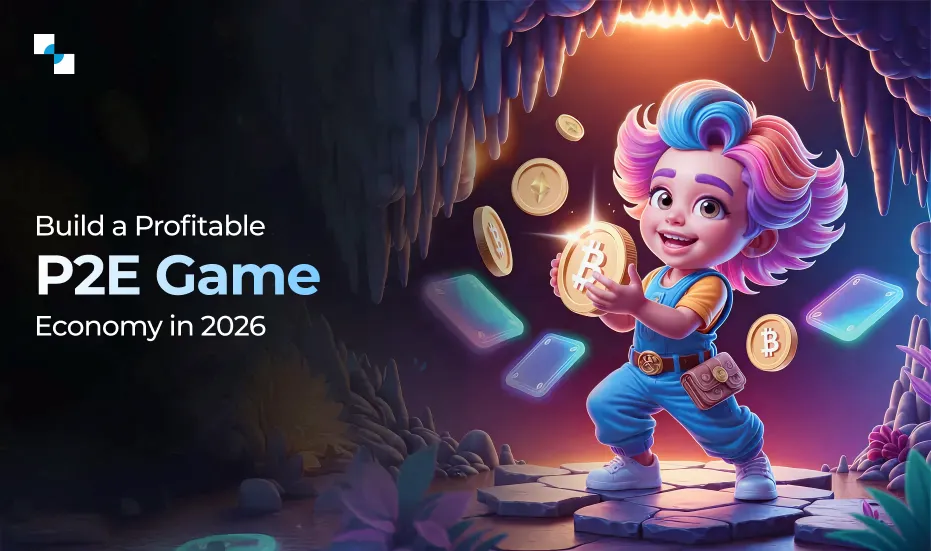
Build a Profitable P2E Game Economy in 2026
Advanced Monetization Strategies Powering P2E Games in 2026
With the evolution of the P2E market, gaming studios are adopting advanced monetization layers that go beyond traditional in-game purchases.
1. Dynamic NFTs & Upgrade Mechanics
Static NFTs are being replaced by dynamic and evolving assets that:
- Upgrade based on gameplay achievements
- Unlock paid enhancements or performance boosts
- Evolve visually and functionally over time
This approach increases NFT lifecycle value and encourages repeat spending tied to progression.
2. Brand Partnerships & Sponsored Experiences
P2E games are becoming immersive marketing platforms and monetization can take place through:
- Sponsored tournaments and competitive events
- Branded in-game assets and environments
- Co-branded NFT collections with real-world brands
When executed correctly, sponsorships create revenue streams without disrupting immersion.
3. DAO Governance & Monetization
Decentralized governance adds both engagement and monetization value where:
- Governance access is gated by tokens or NFTs
- Players stake assets to participate in voting
- Premium governance rights are monetized
This transforms players into long-term stakeholders rather than short-term earners.
Designing Sustainable Tokenomics Alongside Monetization
It is to be kept in mind that monetization cannot succeed without sound tokenomics. The tokenomics framework should focus on:
- Separating reward, utility, and governance tokens
- Controlled token emissions tied to activity, not time
- Strong token sinks (upgrades, fees, access, customization)
- Burn and lock mechanisms to control inflation
By aligning token flow with monetization mechanics, economic stability and long-term scalability is ensured.
Best Practices When You Create P2E Games
When designing monetization strategies for P2E game development, some of the proven best practices to follow are:
- Monetization should enhance gameplay, not replace it
- Prioritize player experience over short-term revenue
- Maintain complete transparency in pricing, rewards, and mechanics
- Simplify Web3 onboarding for non-crypto players
- Build compliance-ready architectures for global markets
Embedding these principles into every P2E game development project ensures long-term success.
Why Professional P2E Game Development Matters?
Monetizing a P2E game requires expertise across multiple domains—game design, blockchain engineering, tokenomics, security, and UX. Professional service providers deliver:
- End-to-end P2E game development services
- Secure smart contracts and NFT frameworks
- High-performance in-game marketplaces
- Custom tokenomics and economy design
- Cross-platform development (mobile, PC, web)
- Scalable backend infrastructure
This holistic approach ensures your monetization strategy is not only profitable but sustainable.
Why Choose Antier for P2E Game Development?
With a proven track record in Web3 gaming and blockchain development, Antier helps enterprises and studios create P2E games designed for longevity.
We do not just help you develop a P2E game, we help you build a future-ready digital economy where players stay engaged, assets retain value, and revenue scales organically.
Closing Thoughts
In 2026, monetizing a P2E game is no longer about just distributing tokens, it is all about creating a balanced ecosystem where gameplay, ownership, and revenue coexist seamlessly.
By combining NFTs, marketplaces, premium access, sponsorships, and sustainable tokenomics, gaming studios can unlock long-term profitability while delivering meaningful player experiences.
Partnering with Antier makes sure that your P2E game development comes with the right monetization foundation that is secure, scalable, and ready for the next wave of Web3 gaming.
Frequently Asked Questions
01. What is the current trend in the P2E gaming model as of 2026?
The P2E gaming model has evolved into a sophisticated Web3 ecosystem that prioritizes sustainability, player experience, and layered monetization strategies beyond just token rewards.
02. Why is token-only monetization considered unsustainable in P2E games?
Token-only monetization leads to issues like token inflation, short-term player behavior, market volatility, economic imbalance, and regulatory scrutiny, making it less viable for long-term success.
03. What monetization strategies are being adopted in next-generation P2E game development?
Next-generation P2E games are implementing multi-layered monetization models, including NFT-based asset sales, to create scalable, player-centric economies that enhance gameplay and profitability.