



AI Summary
- Enterprises are increasingly embracing hybrid crypto wallet solutions that seamlessly integrate fiat and crypto capabilities to meet business needs like liquidity, compliance, and operational efficiency.
- This shift towards hybrid wallets is driven by factors such as operational simplicity, cost savings, regulatory clarity, and new revenue opportunities.
- Key features that a hybrid wallet must offer include dual-ledger balances, fiat on/off-ramp aggregation, stablecoin support, enterprise key management, compliance tools, reconciliation capabilities, and more.
- Understanding the process of creating hybrid blockchain wallet solutions is crucial for investors seeking speed to market and regulatory compliance.
- Factors affecting the cost of hybrid wallet development include integrations, custody models, regulatory requirements, security certifications, and ongoing maintenance.
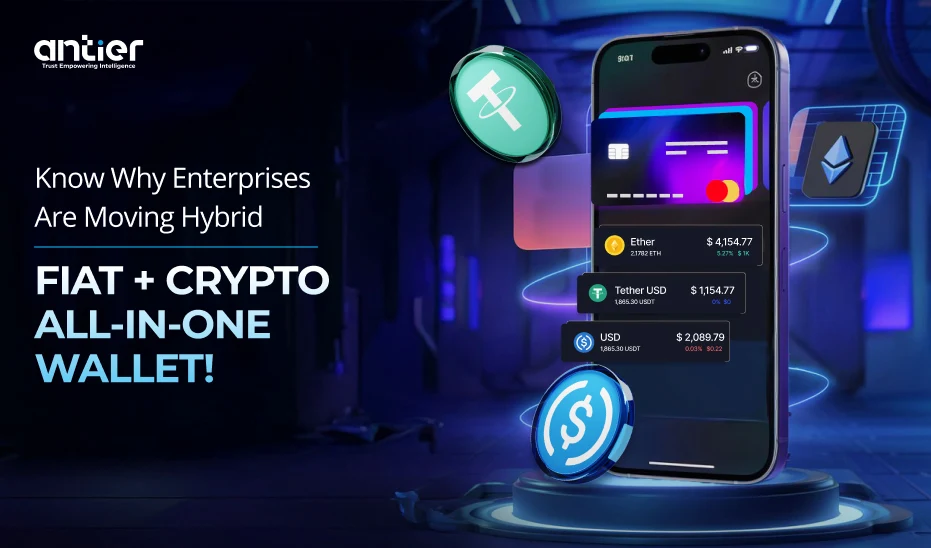
The lines between traditional finance and Web3 are disappearing. Over the last 18–24 months we have seen enterprises, fintechs and large institutional investors move from “experimenting with wallets” to standardizing hybrid crypto wallet solutions that natively handle both fiat and crypto. This isn’t hype, it is a pragmatic response to business needs: liquidity, compliance, operational efficiency and the ability to offer customers a single, trusted balance sheet that spans on-chain and off-chain money.
Let us scroll through the blog to deeply understand why enterprises are converging on hybrid wallets, the hottest market trends that are driving crypto wallet development solution adoption, and, crucial for engineering and product teams, the core features a hybrid wallet must provide.
Why Enterprises Are Standardizing on Hybrid Web3 Wallet Solutions?
1. Operational simplicity and customer experience : Customers expect one app, one balance, one statement. Enterprises want fewer hand-offs between payment rails and on-chain rails — hybrid wallets reduce friction by embedding fiat on/off ramps and stablecoin logic inside the wallet experience. That conversion layer is now an expected product capability.
2. Cost, speed and programmable money : Stablecoins and tokenized cash offer faster settlement and lower cross-border fees versus traditional rails — enterprises can optimize treasury flows and reduce float. Market research shows corporates and payment players accelerating stablecoin usage for these exact reasons.
3. Regulatory clarity unlocking scale : As jurisdictions define rules for stablecoins, custody and payments, large firms are comfortable investing in hybrid stacks that can be audited and regulated. Enterprises need wallets that embed compliance as a feature, not an afterthought.
4. New revenue & product opportunities : Hybrid wallets unlock cards, instant FX, tokenized payroll, corporate treasury automation and richer loyalty/finance products. For B2B and consumer propositions alike, the wallet is the platform.
Market Snapshots: The Trends Shaping Hybrid Wallets
- Proliferation of fiat on/off ramps and aggregators, Crypto wallets increasingly plug into multiple on-ramp providers to maximize conversions and lower fees.
- Stablecoins (and CBDC discussions) becoming treasury tools. Enterprises are trialing stablecoin rails for cross-border settlement and liquidity management.
- Enterprise-grade institutional wallet offerings. Products like institutional wallets and custody-first solutions integrate policies, transaction controls and auditability.
- Embedded compliance and bank partnerships. To hold fiat and perform conversion, wallets must work with banks, licensed custodians and KYC/AML providers.
Talk to Our Web3 Experts & Build Your 100% Impactful Hybrid Wallets
Prominent Features A Hybrid Crypto Wallet Development Must Offer
Do you want to stay ahead in the market with your launch? Crafting a hybrid wallet that feels inevitable, trusted, seamless and future-ready is your competitive edge. This primer explains why the right capabilities drive adoption, trust and growth. If you are building a cryptocurrency wallet app, consider this your strategic roadmap to market leadership. Below are core features enterprises must expect from any hybrid wallet. These are the checklist items that should be contractually required when evaluating vendors.
- Dual-Ledger Balances (Fiat + On-Chain Tokens)- Native ledger support that tracks fiat balances and tokenized assets separately but atomically. This enables unified statements and reconciliations without ambiguity.
- Fiat On/Off-Ramp Aggregation & Routing- Integrated routing across multiple payment providers (card, ACH, SEPA, local rails) with intelligent routing to maximize conversions and minimize cost/conversion failures.
- Stablecoin & Token Support with Collateral Controls- First-class stablecoin support (USDC, regulated local stablecoins) plus pluggable policy for which stablecoins are allowable for settlement. This is essential for treasury use cases.
- Enterprise Key Management & Hybrid Custody Model- Hardware security modules (HSMs), MPC or dedicated custodial and non-custodial workflows (e.g., delegated signing with multisig and recovery flows). Enterprises require flexible custody to balance control vs operational continuity.
- Policy Engine: KYC/AML & Transaction Rules- Built-in KYC/AML connectors, sanctions screening, whitelist/blacklist controls, transaction velocity rules and policy templates. Compliance must be programmable.
- Reconciliation, Accounting & Audit Trails- Real-time reconciliations between fiat settlements and on-chain movements + full immutable audit logs for regulators and auditors.
- APIs & Embedded Payments (Wallet-as-Service)- Enterprise APIs for onboarding, payment orchestration, webhooks for settlement, and SDKs for embedding wallet functionality in apps or merchant flows.
- Card & Payment Rails Integration- Direct integrations for virtual/physical cards, merchant acquiring and point-of-sale conversion flows (crypto→fiat at POS). This makes crypto spendable seamlessly.
- Multi-chain & Layer-2 Support with Liquidity Routing- Cross-chain bridges, Layer-2 rails and liquidity routing to minimize gas and speed settlement for enterprise users.
- Security, Monitoring & Incident Response- 24/7 monitoring, anomaly detection, transaction whitelisting, and SOC-grade incident response playbooks.
These features are technical requirements, and the benefits (reduced cost, better UX, faster settlement, new revenue) flow from them but should not be confused with the features themselves.Thus, it is always reocmmended that you partner with a renowned cryptocurrency wallet development company that boasts a vast team of blockchain experts and help you launch a feature-rich wallet solution.
How To Create Hybrid Blockchain Wallet Development Solutions?
Understanding the complete process for creating hybrid blockchain wallet solutions is essential for smart, visionary investors who demand control, compliance and speed to market. Knowing the steps starting from compliance mapping to custody, fiat on-ramps, reconciliation and scaling, lets you assess risk, prioritize features and estimate ROI. A reputable Web3 wallet development company can translate strategy into pilots and production, turning complexity into a clear business advantage and faster time-to-value.
Step 1 : Clarify legal and compliance scope. Identify the countries you’ll operate in and establish KYC/AML and data-residency rules up front so compliance is built into the product.
Step 2 : Define the product vision and user journeys. Map who will use the wallet and the core flows (buy, hold, convert, spend, report) so the experience is simple and consistent.
Step 3 : Decide custody and recovery approach. Agree who holds control and how funds can be recovered in edge cases, balancing business control with user convenience.
Step 4 : Onboard reliable payment and banking partners. Select card, bank and local-rail partners to enable smooth fiat on-ramps and off-ramps with predictable fees and uptime.
Step 5 : Standardize stablecoin and currency rules. Choose trusted stablecoins and set clear conversion, settlement and treasury rules to protect value and simplify operations.
Step 6 : Provide reconciliation and audit-ready reporting. Build finance tools that reconcile fiat and crypto movements automatically and produce exportable, regulator-ready logs.
Step 7 : Deliver simple APIs and an intuitive UX. Expose clear APIs for partners and design a user interface that minimizes friction for enterprise customers and end users.
Step 8 : Pilot, monitor and scale deliberately. Run staged pilots with partners, monitor performance and compliance, then expand regionally while iterating on feedback.
Prefer a faster, smarter route? Follow the steps or partner with a white label crypto wallet development provider to launch rapidly, retain custom control, and focus on growth while compliance, custody and payments are professionally managed.
How Much Does Hybrid Crypto Wallet Developemnt Cost?
Several factors determine the cost of hybrid fiat and crypto wallet development.Complexity of integrations such as banking rails, card issuing, multiple fiat on/off-ramps; custody model and key-management approach, regulatory scope and required compliance checks across jurisdictions, and mandatory security certifications and audits are primary drivers.
Other important influences are supported blockchains and stablecoins, reconciliation and accounting capabilities, user experience and mobile/web SDKs, third-party KYC/AML provider fees, and expected transaction volumes and uptime SLAs. Choosing an experienced crypto wallet development company affects price through expertise, delivery speed, and post-launch support. Vendor selection, integration complexity, and timeline compression also materially influence final budgets significantly. Finally, ongoing maintenance, monitoring and periodic compliance updates should be budgeted early to reflect true total cost of ownership. No matter what, but choosing the right partner for your solution is always a smarter move in this highly competitive market.
Build The Best Hybrid Web3 Wallet With Certified Experts!
For investors and enterprises, the right hybrid crypto wallet is a strategic accelerator, not just a product. Focus on solutions that prove measurable ROI through auditability, regulatory-ready controls, and seamless treasury flows; prioritize vendors who enable fast pilots, iterative scaling, and clear migration paths. Treat the cryptocurrency wallet development roadmap as a business decision that protects capital and captures market momentum.
Looking for an experienced and reliable firm to partner with? Get in touch! At Antier, we deliver white label crypto wallet development with hands-on partnership: we bring seasoned blockchain engineers, bank and payments integrations, and compliance-first processes to shorten time-to-market and reduce execution risk. We act as your extended product team, handling security certifications, SLAs, and ongoing operations, so you can launch confidently and focus on growth while we manage the technical and regulatory complexity. Contact today!
Frequently Asked Questions
01. Why are enterprises moving towards hybrid Web3 wallet solutions?
Enterprises are adopting hybrid Web3 wallet solutions for operational simplicity, cost efficiency, regulatory clarity, and new revenue opportunities, allowing them to provide a seamless customer experience with integrated fiat and crypto functionalities.
02. What are the key features that a hybrid wallet must provide?
A hybrid wallet must offer operational simplicity, embedded fiat on/off ramps, compliance features, and support for stablecoins to enhance customer experience and streamline financial operations.
03. How do hybrid wallets benefit enterprises in terms of cost and speed?
Hybrid wallets enable enterprises to utilize stablecoins and tokenized cash for faster settlements and lower cross-border fees, optimizing treasury flows and reducing operational costs compared to traditional payment methods.