




AI Summary
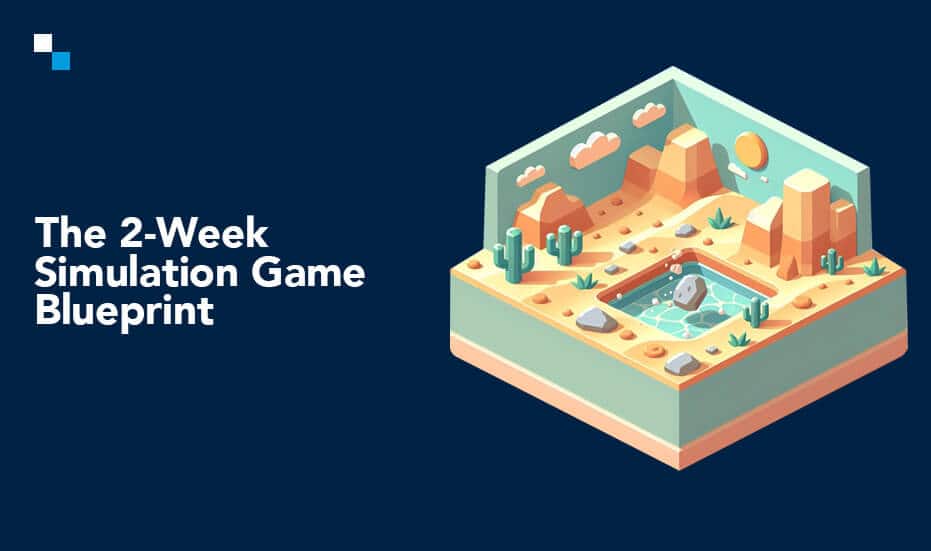
- Discover the captivating world of simulation games where you can manage bustling cities, pilot planes, or master farming from the comfort of your home.
- Dive into vivid virtual worlds that challenge your creativity and strategic thinking.
- With the global simulation game market projected to reach US$25.85 billion by 2029, the potential for innovation is limitless.
- Why create a simulation game?
- Unleash your imagination, learn new skills, join a thriving community, and experience the satisfaction of achievement.
Simulation games have captured the imagination of everyone around the world. One can easily manage a busy city, fly a commercial airliner, and run a thriving farm with human fingers and fingerprints from far away at home.
The games provide not only quality entertainment but also involve players in vivid worlds that challenge their creativity and strategic thinking. The vast potential for simulation game development is boundless, and with the advancement of technology, that is only going to be open to more creativity and innovation.
Why Create a Simulation Game?
Total revenue in the simulation game space is expected to show an annual growth rate (CAGR 2022-2029) of 7.28%, resulting in a projected market volume of US$25.85bn by 2029.
- Let Your Imagination Go Wild: Gameplay simulation games can be built on any imagination. You may design your future cities, historical periods, or whole worlds out of nothing.
- Get Learning New Skills: It may turn out to be a very rewarding activity to work on a game. You will gain the ability to program, design, and solve various complex problems, which will definitely support you in other areas of your life.
- Join a Community: Well, the gaming community is actually quite big and rather enthusiastic about their hobby. The excitement of sharing your creation will connect you with like-minded individuals and foster valuable connections.
- Sense of Achievement: Completing a game in a given timeframe is an achievement par excellence. As a game development company, we understand the satisfaction that comes from seeing your vision materialize.
- Experiment and Iterate: Simulation games are amazing places for experiments. Ideas could be tried quickly, feedback gathered, and the game could be fine-tuned according to reactions.
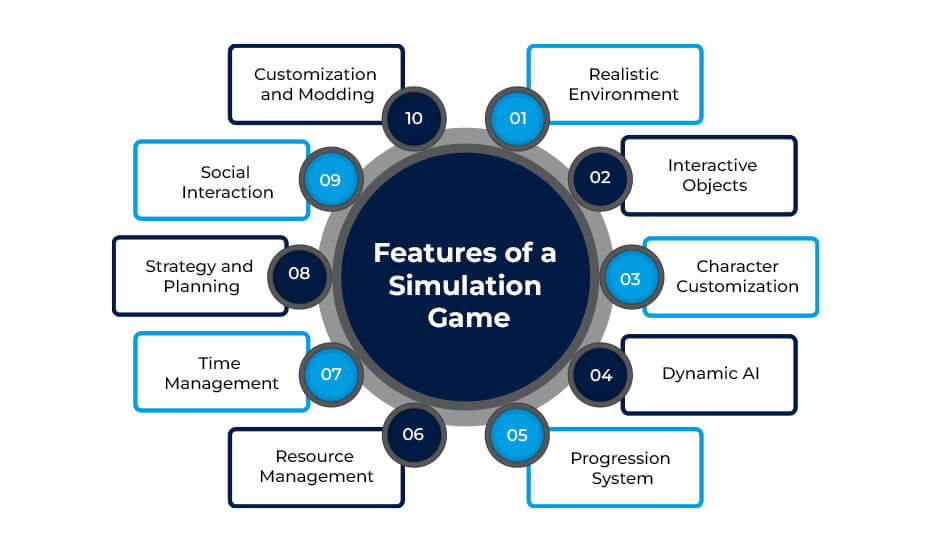
Features of a Simulation Game
Popular Examples and Genres
Simulation games are extremely diverse – from building busy cities to commanding large armies. Understanding how to create a simulation game involves identifying the core mechanics and design elements that make these games engaging. The following is an expanded list with some popular examples and genres.
GENRE- City-Building and Management
Examples:
- SimCity
- Cities: Skylines
- Transport Fever
GENRE- Economic Simulation
Examples:
- Anno 1800
- Capitalism
- RollerCoaster Tycoon

GENRE- Historical Simulation
Examples:
- Europa Universalis IV
- Total War Saga: Troy
- Civilization VI
GENRE- Sports Simulation
Examples:
- FIFA
- NBA 2K
- MLB The Show
GENRE- Life Simulation
Examples:
- The Sims
- Animal Crossing: New Horizons
- Harvest Moon
GENRE- Vehicle Simulation
Examples:
- Euro Truck Simulator 2
- Flight Simulator
- Gran Turismo
GENRE- Military Simulation
Examples:
- Arma III
- War Thunder
- Steel Division 2
GENRE- Educational Simulation
Examples:
- Kerbal Space Program
- Minecraft: Education Edition
- The Incredible Machine
Steps to Simulation Game Development
Building a simulation game requires one to understand not only the distinct traits of the genre but also the overall process of making a game. Simulation games allow the reality of very real activities such as running cities or flying planes in a game experience. The complexity of these games can often be an art of a balancing act between mechanics, user experience, and engaging gameplay. Below are steps to the simulation game development process.
1. Concept Development
Start brainstorming ideas for your simulation game. Decide what you want to simulate (like farming, city-building, or life simulation), and outline core mechanics.
Create a Game Design Document (GDD) detailing your game’s vision- gameplay mechanics, story elements, target audience, and visual style. This document serves as a blueprint throughout development.
2. Pre-Production
Finalize your game concept with detailed character, environment, and gameplay system designs.
If you are planning to scale up, consider partnering with a game development company to assemble a team and define roles for each member, such as designer, programmer, artist, and sound engineer.
Prototype core mechanics for testing purposes, to ensure that the game is engaging and fun. It’s at this point that funding/authorization to fully produce your game will be secured or not.
3. Production
Start building the game using a suitable game engine (Unity or Unreal Engine, for example). This step requires
- Programming of the game mechanics and systems according to the GDD.
- Art creation of the graphics and animations that are in line with your game’s aesthetic.
- Audio Design: Creation of audio assets that create a perfect gaming experience.
Test your game constantly to make sure there is no bug and that the game is smooth and enjoyable. These include alpha testing during production for major issues that can be caught early on.
4. Testing
Conduct very wide and rigorous testing phases to ensure success in how to create a simulation game:
- Alpha Testing: Testing performed in-house to identify bugs and game malfunctions.
- Beta Testing: This is testing that is carried out outside with real users to obtain information about the gaming experience and each bug left in the game.
Feedback from testers should be utilized to enhance gamers’ experiences by revising gameplay mechanics, correcting bugs, and improving GUI elements.
5. Launch
Launch prep: finalize marketing strategies and prepare promotional materials.
Release your game on preferred platforms – PC, consoles, and mobile – and follow up on the game’s performance following the launch.
Interact with your player community for feedback and support.
6. Post-Launch Support
Supporting the game after launch in simulation game development entails the following: releasing updates, debugging the game, and potentially adding new content based on players’ feedback.
Analyze the player data to show engagement and areas that need improvement or expansion.
Hire a Top-Notch Game Development Company
Engage one of the world’s best game development companies to offer a blend of technical brilliance and innovative design for your gaming project. Our highly trained and focused team of seasoned developers uses the latest technology and industry best practices in bringing your vision to life so that gameplay and graphics integrate seamlessly.
All this is made possible through a rigorous hiring process, connecting you to professionals who have the right skill for your project-whether it is mobile games or AR/VR experiences. Enjoy flexible engagement models adapted to your requirement; whether you are looking for a dedicated team or specialized developers for specific tasks. Partner with our game development company and make project execution simple, minimize risks, and bring out the potential you had with your game, all the while delivering such experience that has a global impact for your audience.