




AI Summary
- The blog post delves into the evolution of the play-to-earn (P2E) model in Web3, highlighting the potential for building real digital economies but also the common pitfalls leading to the failure of P2E games.
- Issues such as token inflation, bot exploitation, infrastructure stress, and smart contract vulnerabilities are discussed as key challenges that can disrupt game economies.
- The post emphasizes the importance of scalability, sustainable tokenomics, secure smart contracts, scalable backend systems, anti-fraud mechanisms, and ongoing economic management for successful P2E game development.
- It also outlines the essential traits to look for in a reliable P2E game development company, stressing deep tokenomics expertise, blockchain security maturity, growth-oriented architecture, LiveOps capability, and proven Web3 gaming experience.
- Enterprises are advised to ask pertinent questions before hiring a development partner and opt for specialized P2E game development companies for better outcomes.
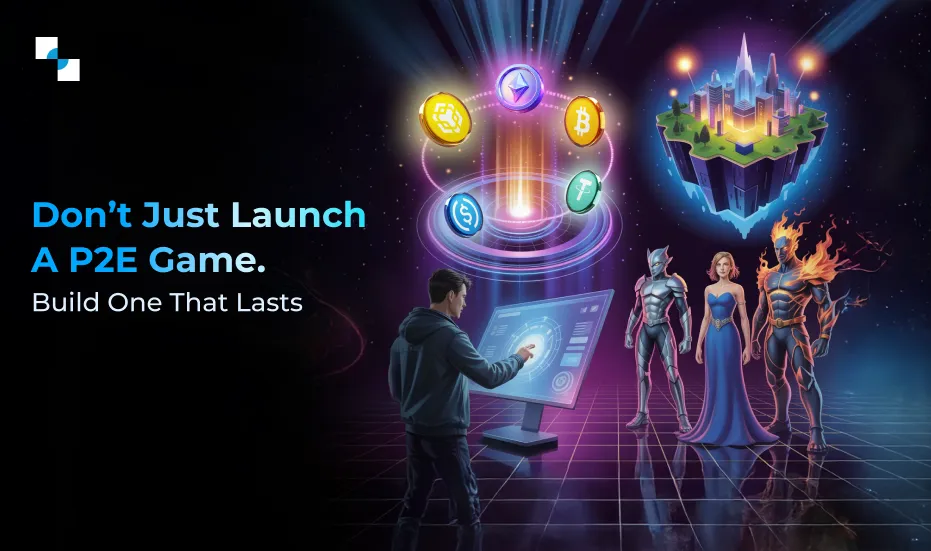
The play-to-earn or P2E model has matured. It is no longer a novelty in Web3; it is an economic model capable of building real digital economies, attracting millions of users, and generating meaningful revenue for enterprises.
Yet the reality is uncomfortable. A number of P2E games tend to fail within a few months after launch. The reason behind the failure is not that the idea was weak or that the market lacks demand. It is due to the fact that the foundation wasn’t built to scale.
It is to be kept in mind that P2E games are not just entertainment. It is:
- A financial ecosystem
- A token economy
- A live service platform
- A community-driven marketplace
- A security-sensitive environment
Choosing the wrong P2E game development company does not just delay your project, it can result in collapsing the entire ecosystem. For enterprises, the real decision isn’t “Should we build a P2E game?” It’s “Who can build one that survives real-world scale?”
Why Scaling Breaks Most P2E Games
Early growth can hide structural weaknesses. Many P2E games look successful in the first few months because token rewards attract players very quickly. However, cracks tend to appear at the time when real activity begins, cracks appear.
1. Token Inflation Spiral
If rewards are not balanced, token supply floods the market, resulting in value dropping, players losing incentive, and speculators exit. A P2E game developer without tokenomics expertise often overlooks long-term supply dynamics.
2. Bot Exploitation
Reward systems attract bots. Without detection systems, automated farming drains value from real players and destabilizes the economy. Scaling securely requires anti-bot logic, behavioral analytics, and exploit monitoring.
3. Infrastructure Stress
P2E games involve constant transactions, such as claims, trades, staking, and marketplace activity. Poor backend planning leads to lag, failures, or downtime. A crash during growth damages credibility instantly.
4. Smart Contract Vulnerabilities
A single exploit can drain funds or freeze assets. Enterprises cannot afford trial-and-error blockchain coding. Security must be engineered from day one.
At the time when these issues come up, user trust disappears, and in GameFi, trust is everything. Thus, when trust breaks, game economies tend to crumble.
What “Scalable” Actually Means in P2E Game Development
A number of P2E game developers claim scalability. However, only a few define it properly. True scalability includes:
1. Sustainable Tokenomics
Sustainable tokenomics is not just token creation, but economic design that survives growth cycles, user behavior changes, and market fluctuations. It includes emission schedules, sinks, staking models, and value loops that keep demand alive.
2. Secure Smart Contract Frameworks
Contracts must be modular, auditable, and optimized. Security architecture must assume adversarial behavior. Enterprises need experienced developers who build for resilience, not just functionality.
3. Scalable Backend Systems
P2E combines gaming servers and financial systems. Infrastructure must support thousands and sometimes millions of concurrent actions. Cloud scalability, database design, and API efficiency are matters of immense importance in this regard.
4. Anti-Fraud & Anti-Exploit Mechanisms
Fraud detection systems must monitor unusual behaviors, repeated farming patterns, and suspicious wallet interactions. Without this, economies can be manipulated quite easily.
5. LiveOps & Economy Tuning
P2E is not static. Rewards, sinks, and incentives need constant balancing. Developers must support real-time adjustments. Scaling requires ongoing economic management.
Planning to Build a P2E Game That Succeeds and Scales?
Key Traits of a Reliable P2E Game Development Company
At the time of choosing a P2E game development company for your project, here are some of the key traits to watch out for to make the right selection.
1) Deep Tokenomics Expertise
Tokenomics is closer to financial engineering than game design. A strong P2E game development company:
- Models supply-demand dynamics
- Simulates user growth scenarios
- Designs burn and sink systems
- Balances rewards against inflation
They think like economists, not just developers.
2) Blockchain Security Maturity
A credible P2E game developer prioritizes:
- Contract audits
- Multi-layer security
- Wallet safety flows
- Compliance awareness
Security protects reputation and user confidence.
3) Architecture for Growth
Scaling is planned, not patched later. A mature developer designs:
- Load-ready backend systems
- Efficient indexing for transactions
- Modular architecture for upgrades
This, in turn, helps reduce long-term technical debt.
4) LiveOps Capability
P2E success depends on iteration. Events, reward cycles, and engagement mechanics must evolve. A capable P2E game developer supports:
- Economy monitoring
- Event design
- Seasonal content
- Reward recalibration
Without LiveOps, engagement tends to decline.
5) Proven Web3 Gaming Experience
Experience reduces risk. A P2E game development company that has shipped Web3 games understands pitfalls like inflation cycles and bot waves. Past execution matters more than promises.
Questions Enterprises Must Ask Before Hiring
Here are a few important questions to ask your chosen P2E game development company before finalizing the hiring process in order to avoid costly mistakes later.
- How do you simulate token economies?
- How do you prevent bot farming?
- What scalability architecture do you use?
- What is your smart contract audit process?
- How do you support LiveOps post-launch?
Once you get all the answers with clarity and evidence, finalize the hiring.
Why Enterprises Prefer Specialized P2E Game Development Companies
The P2E model sits at the intersection of: Gaming + Blockchain + Finance.
Only a few development partners master all three internally.
A specialized P2E game development company provides:
- Cross-domain expertise
- Pre-tested frameworks
- Faster development cycles
- Lower risk exposure
- Long-term ecosystem support
For enterprises, this translates into predictable outcomes.
Closing Thoughts
It is always to be kept in mind that in the P2E model, launching is easy, but sustaining is hard. Scaling is where winners are decided.
A real P2E game developer doesn’t just build gameplay; they engineer economies.
The real question for enterprises is simple: Are you building a short-term hype cycle, or a long-term digital economy? The right partner determines the answer.
Antier, an experienced P2E game development company, works with enterprises to build P2E ecosystems designed for sustainability. Support includes:
- Advanced tokenomics modeling
- Smart contract architecture
- Blockchain and wallet integration
- Scalable backend systems
- Security-first development
- LiveOps and ecosystem tuning
The objective isn’t just launch, it’s longevity. Let’s work on your next P2E project to make it successful.
Frequently Asked Questions
01. What is the play-to-earn (P2E) model in Web3?
The P2E model is an economic framework that allows users to earn real value through gameplay, creating digital economies that attract millions of users and generate revenue for enterprises.
02. Why do many P2E games fail shortly after launch?
Many P2E games fail due to a lack of scalable foundations, which leads to issues like token inflation, bot exploitation, infrastructure stress, and smart contract vulnerabilities.
03. What does true scalability mean in P2E game development?
True scalability in P2E game development refers to the ability to handle growth without compromising the game's economy or user trust, ensuring robust systems for tokenomics, security, and infrastructure.