


AI Summary
- Get ready to dive into the world of fintech across Central, Southern Asia, and Oceania with the potential to impact millions through digital payments and savings.
- This blog post explores the key considerations for building crypto wallets that cater to local nuances, regulatory requirements, and user behavior.
- Discover the challenges hindering crypto adoption in the region, from regulatory uncertainties to security risks and limited financial literacy.
- Learn about different types of crypto wallets, including non-custodial mobile wallets, hardware wallets, Web3/DeFi wallets, and hybrid fiat-crypto wallets, each designed to address specific pain points in the CSAO region.
- Gain insights into user archetypes and investment strategies for successful crypto wallet development in this high-adoption market.
Ready to be part of the next fintech renaissance across Central, Southern Asia and Oceania? Imagine millions suddenly able to send earnings home, accept low-cost digital payments, or access new savings and credit, but only if the wallet you build understands local realities, regulatory nuance, and human behavior. For founders and investors this is more than a product decision; it’s a judgement about market empathy, technical resilience, and capital stewardship. Which corridors will you prioritize? How will you balance compliance with inclusion? This blog walks you through practical crypto wallet development archetypes, high-impact features, and the governance playbook that turns wallet concepts into trusted, revenue-generating platforms, so you can decide where to place your next bet with clarity and conviction.
Market snapshot
- Chainalysis treats CSAO as a high-adoption region and showed it leading adoption metrics in recent geography reports, making it one of the most dynamic crypto markets globally. This makes CSAO a strategic region for wallets and payment rails.
- In 2025, APAC/adjacent markets continued to see fast growth in on-chain activity (substantial YoY increases in value received), meaning demand for robust wallet infrastructure is accelerating.
Pain Points in Crypto Wallet Adoption for CSAO Regions
As we already know, the CSAO region leads global crypto adoption in 2025. Despite this growth, several persistent pain points hinder broader and sustainable adoption, particularly in emerging markets. These challenges stem from economic, regulatory, and infrastructure factors that affect users’ ability to securely store, transact, and integrate cryptocurrency into their daily lives.
- Regulatory Uncertainty and Compliance Hurdles : Many CSAO countries have evolving or restrictive regulations, such as India’s 30% tax on crypto gains and mandatory reporting, or Indonesia’s licensing requirements for exchanges. This creates barriers for users and platforms, resulting in bans on certain activities and concerns about enforcement. In 2025, 74% of emerging markets have consumer protection rules, but inconsistent implementation slows adoption.
- Security Risks and Frequent Hacks : With high grassroots usage, personal wallets are prime targets. Over $2 billion in crypto was stolen globally in early 2025, with CSAO seeing rapid growth in victims due to phishing and poor device security. Low awareness exacerbates this, especially in regions with high mobile usage but limited cybersecurity education.
- Limited Financial Literacy and Accessibility for Unbanked Populations : About 40-50% of CSAO residents are unbanked, and crypto’s complexity (e.g., private keys, volatility) deters beginners. In countries like the Philippines and Vietnam, where adoption is high (13-20% ownership), many users struggle with wallet setup and DeFi navigation.
- Infrastructure and Economic Challenges : Poor internet connectivity in rural areas (e.g., parts of Pakistan or Papua New Guinea) and high remittance fees (up to 7% via traditional channels) push users toward crypto, but volatility and lack of fiat on-ramps limit usability. Merchant acceptance remains low, creating a “circular adoption challenge” where limited spending options discourage holding.
- Liquidity and Scalability Issues : In DeFi-heavy markets such as Vietnam and Indonesia, network congestion on chains such as Ethereum results in high gas fees, while liquidity pools for local stablecoins remain underdeveloped.
These pain points contribute to uneven growth; while urban users in India and Singapore thrive, rural or low-income groups are excluded, potentially capping the region’s estimated 300 million+ crypto users by the end of 2025. However, it is very important to solve the above challenges, and this can only be achieved by bringing in impactful cryptocurrency wallet development solutions into the scene.
Crypto Wallet Development Types That Address These Pain Points
In the CSAO region, the primary types of Crypto Mobile wallet development solutions are used to overcome challenges. Let us know about the different types of wallets suitable for different regions:
- Non-Custodial Mobile Wallets
Why ? Dominant due to high Android penetration (60%+ in CSAO). They address accessibility for unbanked populations and infrastructure challenges (e.g., poor internet connectivity) with lightweight apps that support low-data modes. Self-custody enhances security against hacks, while fiat-to-crypto ramps (e.g., UPI, VND) tackle economic barriers and volatility via stablecoin support.
Key Features : Seed phrase backups, multi-currency support, QR-based remittances, and beginner-friendly interfaces.
- Hardware Wallets (Cold Storage)
Why ? Preferred for security-conscious users to combat rising hacks (e.g., $2B+ stolen in 2025). They store assets offline, addressing cybersecurity gaps in regions with low awareness. Popular in urban CSAO (e.g., India, Singapore) for high-value holdings like Bitcoin.
Key Features : Encrypted storage, compatibility with mobile wallets, and recovery options.
- Web3/DeFi Wallets
Why ? Prevalent in DeFi-heavy markets (e.g., Vietnam, Indonesia) to overcome scalability issues via Layer 2 integrations (e.g., Polygon) for low fees. Web3 crypto wallet enable staking and NFT storage, addressing challenges related to liquidity and merchant acceptance. Educational tools aid low literacy.
Key Features : dApp browsers, cross-chain swaps, and portfolio trackers.
- Hybrid Fiat-Crypto Wallets
Why ? Tackle regulatory compliance and economic barriers by integrating with local payment systems (e.g., PHP in the Philippines). They support remittances and merchant payments, reducing reliance on volatile crypto. Popular for urban and semi-urban users.
Key Features : Stablecoin support, P2P transfers, and compliance with local KYC/tax rules.
These wallet types prioritize mobile-first designs, self-custody, and local integrations to address CSAO’s unique pain points, driving adoption toward 300M+ users by late 2025.
Build Your CSAO-Ready Wallet With Our Experts Today
Antier Capabilities of CSAO Crypto Wallet Development
Looking for a crypto wallet development company that truly understands CSAO’s regulatory maze and local user needs? Choose a firm to lower launch risk, accelerate market entry, and make a confident, future-ready investment in blockchain infrastructure. Here are the most in-demand, trending wallet features for CSAO that we can design:
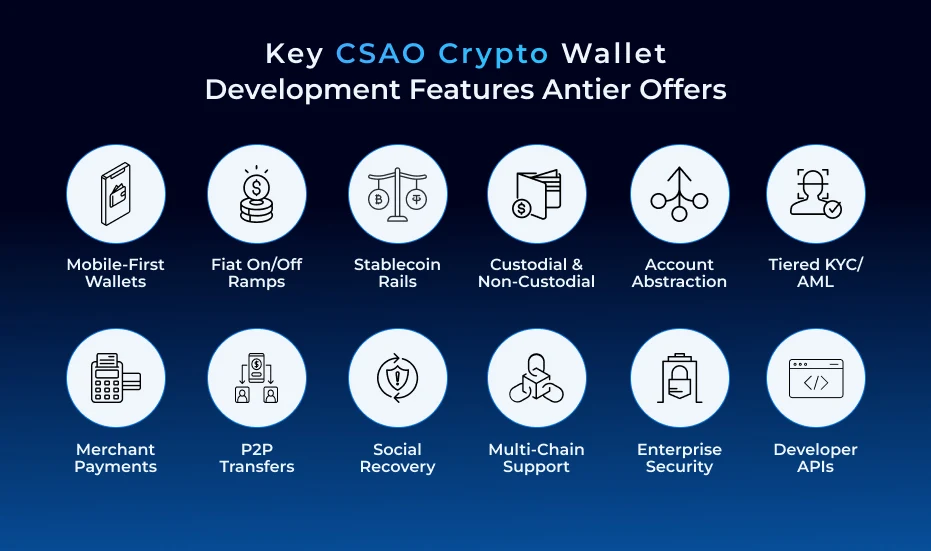
- Mobile-first UX with USSD/SMS support and a lightweight PWA
- Built-in fiat on-ramps and off-ramps with local PSP and bank integrations
- Native stablecoin support and FX/hedging rails for remittances
- Account abstraction/smart contract wallet support for gasless transactions
- Hybrid custody options (custodial, non-custodial, MPC)
- Tiered KYC and AML tooling for progressive verification
- Multi-chain support with auto-routing and DEX aggregation
- Merchant QR and POS payments with developer SDKs
- Social-recovery or guardian-based account recovery
- Enterprise-grade security (HSM, hardware wallet support, key rotation)
Crypto Wallet Development Solution User Archetypes in CSAO
Investors and businesses must analyze user archetypes before cryptocurrency wallet development because this insight shapes product-market fit, pricing, compliance needs, and go-to-market strategy. Overall, this analysis reduces risk, accelerates adoption, and ensures capital deploys where real demand and sustainable growth exist and regulatory constraints exist.
Remitters – Cross-border workers and families. Needs: low-fee fast transfers, stablecoins, and easy fiat payout rails. Investor signals: transfer volume, corridor retention, and payout success.
Unbanked & Underbanked Populations – Large segments with limited access to traditional banking but high smartphone penetration, relying on wallets for financial inclusion.
Institutional & High-Value Users – Local funds, family offices, and early institutional players are exploring digital assets as inflation hedges or alternative investments.
Youth & Gen-Z Users – Digital-native, mobile-first users are adopting wallets for micro-investing, NFTs, and play-to-earn gaming ecosystems.
Merchants & SMEs – Small businesses and e-commerce sellers needing cheaper payment rails, faster settlements, and protection from chargebacks.
Retail traders – Individual buyers/speculators. Needs: simple fiat on-ramps, good liquidity, and custody options. Investor signals: active traders, trades per user, take-rate.
Gig workers – Freelancers and delivery partners. Needs: instant micro-payouts, scheduled payouts, and low-data UX. Investor signals: payout frequency, payout latency, and employer integrations.
CSAO Crypto Wallet Cross-cutting Strategy for Investors
Successful CSAO crypto wallet development solutions are modular and corridor-aware, supporting stablecoins and local fiat rails, providing hybrid custody, optimizing for low-bandwidth devices, and offering tiered KYC to balance inclusion and compliance. For investors, the winning signal is a product that can monetize multiple archetypes without reinventing core rails, e.g., a single payments ledger that serves remitters, merchants, and gig payrolls while offering trading rails for retail users.
Some Important Investor Takeaways
- Prioritize wallets with strong fiat on/off-ramp partnerships and stablecoin liquidity; these unlock remittance and merchant revenue quickly.
- Look for hybrid custody and AA (account abstraction) features such as social recovery and gas sponsorship; they reduce customer support costs and lower churn for novice users.
- Evaluate unit economics by archetype (take rate, CAC, retention); a wallet that monetizes across remitters, merchants, traders, and gig workers is inherently more defensible.
Hire 100% Certified Crypto Wallet Development Experts Today!
The CSAO opportunity rewards speed, specificity, and regulatory smarts. A successful crypto wallet is not a one-size-fits-all widget but a carefully tuned instrument: designed for real people, aligned with local rules, and engineered for operational clarity. If you are an investor or product leader, treat wallet development as strategic infrastructure, test corridors tightly, prioritize user trust, and measure economics by archetype.
Are you ready to move from insight to action? Connect with Antier. We are an experienced cryptocurrency wallet development company boasting a vast team of blockchain experts who are efficient in designing and delivering impactful and business-tailored wallet solutions. Apart from this, if you are a visionary investor who wishes to get faster market entry in this highly competitive Web3 market, then you must opt for white label crypto wallet development. Our team customizes wallet solutions as per your needs in just a few weeks. Connect today!