




AI Summary
- Discover how DeFi is advancing with platforms like Pyra, offering on-chain credit lines where users can access liquidity against their collateral that continues to earn yield.
- Unlike traditional DeFi platforms, decentralized credit lines allow borrowing against personal collateral, leading to safer credit systems.
- This guide explores essential features, blockchain selection (Solana, Ethereum, or others), and development costs for creating on-chain credit models.
- Key features include over-collateralized loans, yield-earning collateral, low-cost transactions, automated risk management, institutional integrations, flexible repayment methods, multi-collateral support, token utility, cross-chain collateralization, and insurance funds.
- The blog also discusses blockchain comparisons, costs of building a similar platform to Pyra, revenue streams, and why enterprises should consider on-chain credit lines.
DeFi is evolving beyond the simple pool-based lending and borrowing platforms. Platforms like Pyra are introducing on-chain credit lines that allow users to access liquidity against their collateral that continues to earn yield for them. Unlike conventional DeFi lending platforms such as Aave or Compound, where users borrow from a shared lending pool, decentralized credit lines let users borrow against their own collateral.
But before you build your own on-chain credit model like Pyra, three critical questions arise:
- What are the features required for building on-chain credit lines like Pyra?
- Which blockchain should you choose to build your decentralized credit lines: Solana, Ethereum, or others?
- What will it cost to develop and launch such a platform?
This guide answers both, helping enterprises understand the business, technical, and financial considerations.
What is a DeFi Credit Line Platform?
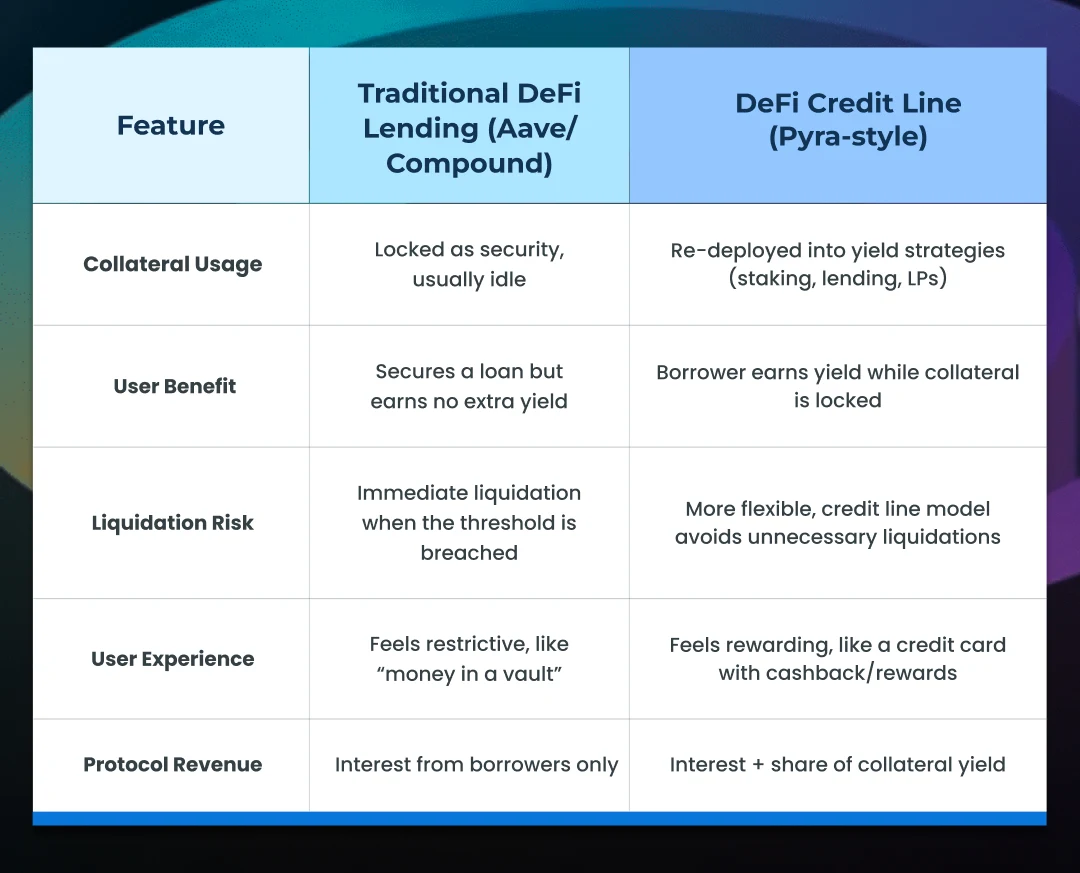
A DeFi credit platform, or on-chain credit line, is not like the traditional DeFi lending platforms where users put money into a big pool and others borrow from that pool and pay interest, while collateral just sits there to secure the loan. In decentralized credit lines, users borrow against their own deposit, while their assets locked as security earn yield in the background.
What are the Key Features of a Decentralized Credit line?
If you’re planning a DeFi lending platform development like Pyra, you must learn about the features that make it stand out from the rest.
- Over-collateralized credit lines:
Borrowers lock in more collateral than the amount they borrow. This ensures that even if the market drops, the platform stays protected, creating a safer credit system with predictable risk exposure. For traders, these loans bring peace of mind as there are very less chances of forced liquidations.
- Yield-earning collateral:
Unlike in traditional lending platforms, where the collateral sits idle for users and generates yield for the lenders (mostly), on-chain credit lines put deposits to work for the borrowers. Locked assets can be staked or deployed to other yield strategies, generating passive income and liquidity for borrowers at the same time.
- Low-cost transactions:
Credit lines require frequent collateral checks, interest accrual, liquidation triggers, etc. Running on a chain with low fees (Solana or Ethereum L2s) ensures that operations remain affordable and profitable for enterprises, and borrowing is accessible for retail users.
- Automated risk management:
Smart contracts automate collateral monitoring, interest application, and liquidation triggers, while oracles supply price data in real time. Working in synchronization, these both reduce reliance on intermediaries, ensuring that the system runs smoothly and remains solvent, even at scale.
- Institutional integrations:
Building these unconventional DeFi lending and borrowing platforms may also require support for APIs, optional KYC modules for regulated markets, and flexible onboarding for fintechs. This on-chain credit lines features make the platform attractive for liquidity providers, institutional investors, and enterprises.
- Flexible Repayment Method
Unlike pool lending, where repayment schedules are rigid, credit lines allow users to pay at their own pace since the collateral covers more than the loan amount. This improves user experience and widens adoption rates at the same time.
- Multi-Collateral Support
Since the cryptoscape has evolved and crypto isn’t the only digital asset that people can collateralize or borrow, on-chain credit lines must support multi-collateral support for NFTs, crypto, tokenized RWAs, stablecoins, etc. This reduces protocol risks and attracts a broader user base.
- Token Utility and Incentives
Native token integration unlocks fee discounts, staking rewards, and governance for the borrowers while driving ecosystem engagement and a sustainable revenue model for enterprises.
- Cross-Chain Collateralization
Cross-chain capabilities and multi-chain deployments attract more liquidity, user base, and institutional adoption. Users get to lock assets on one chain while borrowing on another. With bridges or layer-xero style solutions, your DeFi lending platform development company can help you unlock these benefits.
- Insurance Fund
A reserve fund or slashing-backed pool covers bad debts and protects users during extreme volatility. This feature not only reduces any systemic risk but also reassures institutional investors.
- Credit Scoring:
This is a common feature in TradFi lending models. DeFi lending platforms can integrate this to top up their over-collateralized lending model. On-chain user reputation or decentralized identity systems can help businesses further secure profitable partnerships while being a standout user-facing feature for the lending platform.
Blockchain Comparison For Building On-Chain Credit Lines Like Pyra: Solana vs Ethereum vs Others
Picking the right blockchain for DeFi lending platform development is critical as it defines the user experience and the platform’s capabilities. Those seeking to build these unconventional DeFi lending platforms known as decentralized credit lines must consider the following chains.
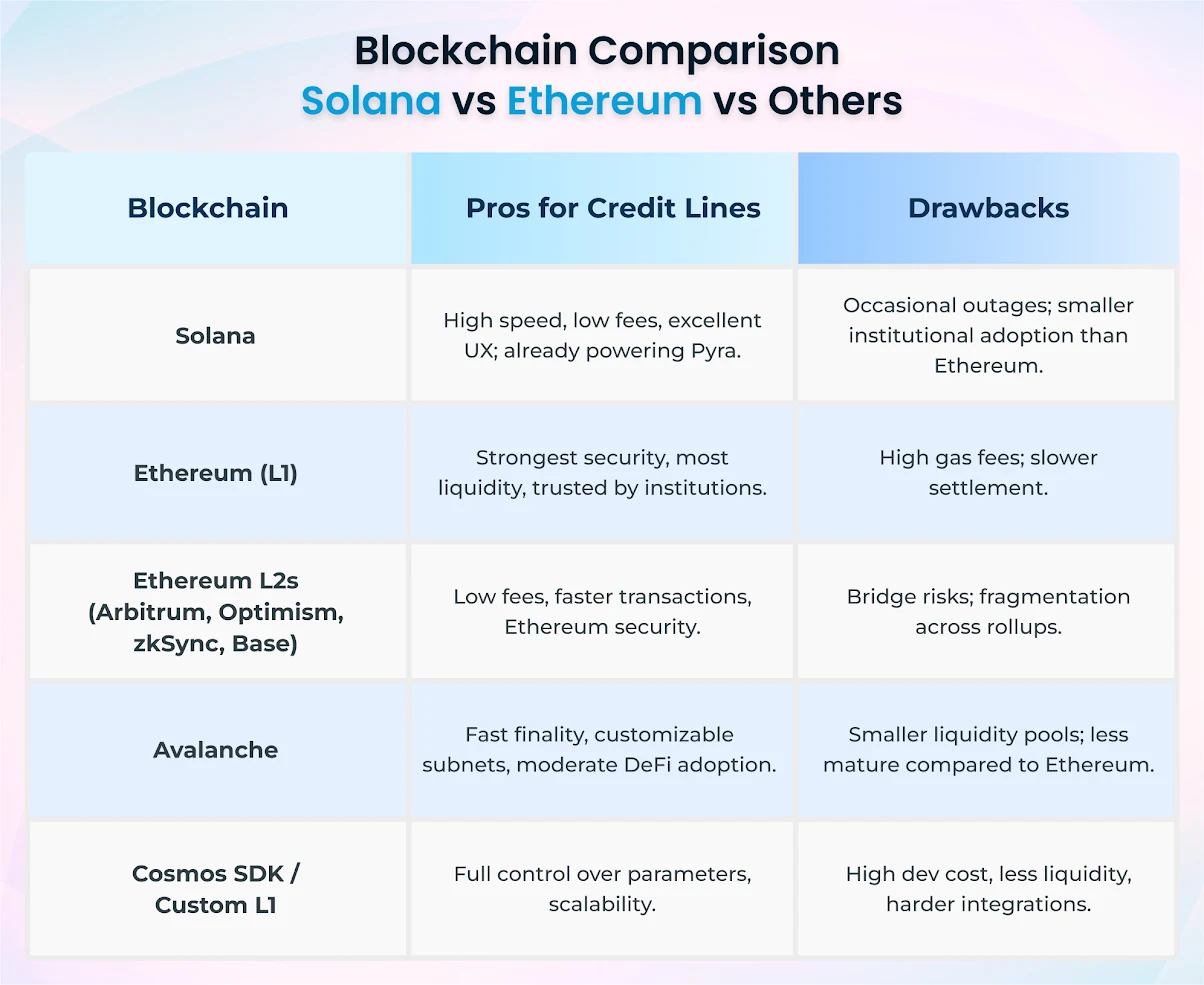
Those looking for retail-focused, UX-driven DeFi credit lines must pick Solana, while those looking to target enterprises and institutions can go for Ethereum plus L2s, as it ensures trust, liquidity, and security. However, custom layer 1s are best suited for long-term control, but they require higher upfront investment during DeFi lending and borrowing platform development.
How much does it cost to build a DeFi Lending Platform That Replicates Pyra’s On-Chain Credit Lines?
Building an unconventional DeFi lending platform that replicates Pyra’s decentralized credit lines may cost anywhere around $200K–$400K with separate funds for liquidity seeding, if you choose Solana or Ethereum L2s. For an enterprise-grade, multichain, and well-audited mobile app with an on-chain credit lines module, you may have to spend anywhere from $500 to $1.5M.
The following are the cost components of DeFi lending platform development with Pyra’s on-chain credit lines:
1. Development Costs
Your DeFi lending platform development services provider will be responsible for creating;
- Smart contracts with lending logic, collateral management, liquidation, and oracles.
- Frontend and mobile app development and wallet integrations
- Backedna and APIs for user management, notifications, and analytics.
2. Infrastructure Costs
DeFi lending platform development companies also charge for:
- Node setup and blockchain integrations
- Cloud hosting and scaling infrastructure
3. Security and Compliance
Apart from the above two costs, your tech partner will also offer you the following services, adding to your DeFi lending platform cost:
- Smart contract audits
- Bug bounty programs
- Legal structuring (jurisdictional and compliance)
4. Liquidity and Incentives
At last, you’d need to spend on initial liquidity pool seeding as per your scale. It may be anywhere around $500K–$2M. You may also keep separate funds for user rewards and yield farming, for which 5-15% of initial liquidity is enough.
Build your Decentralized Credit Lines with Lines
Why Enterprises Should Consider Building On-Chain Credit Lines Now?
- First-mover advantage: There are very few DeFi credit lines operating as of now. Those who build these unconventional DeFi lending platforms can get the early bird advantages.
- Investor appeal: Coinbase, a leading exchange, offers such services, validating its profitability. These platforms with a stronger risk-managed borrowing model, therefore, attract investors.
Who Would Want to Build or Integrate On-Chain Credit Lines Like Pyra?
- Pyra is a neobank offering decentralized credit lines. Similar Fintechs and Neobanks that want to launch blockchain-based credit services without traditional bank intervention can build such unconventional DeFi lending and borrowing platforms.
- Cryptocurrency exchange software or wallets that want to go beyond leverage and offer users an instant borrowing against deposits option.
- DeFi platforms that want to blaze the trail and expand beyond the pool-based lending mechanisms with flexible credit products.
- Institutional Lenders and Funds that want to tap into collateralized DeFi lending with automated risk controls can build such DeFi lending platforms.
- Payment and Card providers looking to issue crypto-backed credit cards powered by on-chain credit lines can profit from such DeFi lending platform development.
What are Revenue Streams for Those Setting Up On-Chain Credit Lines Like Pyra?
Building your unconventional DeFi lending platform with on-chain credit lines can bring your business revenue in the following ways:
- Borrowing interest as per protocol-set APR
- Credit line fees charged for setup, maintenance, or withdrawals
- Liquidation penalties, which are a small percentage slashed from the liquidated collateral
- Staking rewards or governance token economics
- Fees charged for institutional integration (API access or white-labelling)
Final Word
On-chain credit lines are something beyond the traditional DeFi lending platforms, and it is not a sweeping DeFi trend as it bridges the TradFi and DeFi models. Users get liquidity without selling their digital assets, while the same collateralized asset generates passive income for the borrowers. Isn’t it a compelling model for customers?
If you’re planning to build your own unique DeFi lending platform with decentralized credit lines like Pyra, you can get in touch with a leading blockchain development company like Antier. They can help you select the right blockchain for building a secure and scalable DeFi lending and borrowing platform while suggesting strategic initiatives to balance cost with revenue streams.
Ready to tap the next billion-dollar opportunity before it reaches its scale?
At Antier, we enable enterprises to build DeFi lending and credit line platforms. Our services include:
- Smart Contract Development
- Blockchain Integration
- White label solutions for a faster go-to-market
- Liquidity and Tokenomics Design for sustainable revenue and investor-ready pitch
- Security and audit services for enterprise-grade protection and compliance
Share your project requirements today!
Frequently Asked Questions
01. What is a DeFi credit line platform?
A DeFi credit line platform allows users to borrow against their own collateral while their assets earn yield, unlike traditional lending platforms where collateral sits idle in a shared pool.
02. What are the key features of a decentralized credit line?
Key features include over-collateralized credit lines for risk protection, yield-earning collateral that generates passive income for borrowers, and low-cost transactions to ensure affordability and accessibility.
03. Which blockchain is recommended for building decentralized credit lines?
It is recommended to choose blockchains with low transaction fees, such as Solana or Ethereum L2s, to ensure affordable operations and profitability for enterprises.