





AI Summary
- Tokenized real estate offers a transformative opportunity for ownership restructuring in property investments.
- Success for platform builders hinges on legally enforceable ownership structures, protocol-level compliance, and robust custody and auditability.
- Prioritizing these capabilities can lead to converting pilots into profitable enterprise deals.
- The blog post emphasizes the importance of meeting institutional demands by focusing on legal clarity, operational reproducibility, auditability, and counterparty risk mitigation.
- It outlines key strategies for platform development, including legal structuring, smart contract design, identity management, custody, operational processes, data handling, and liquidity mechanisms.
Tokenized real estate represents an opportunity to restructure ownership, liquidity, and governance of property investments. For platform builders, success requires three aligned capabilities: legally enforceable ownership structures, protocol-level compliance, and enterprise-grade custody and auditability. Platforms that prioritize these capabilities will convert pilots into recurring enterprise deals; those that emphasize marketing narratives over operator-grade controls will remain experiments. For teams building platforms, the technical, legal, and operational bar is high and specific. This guide is for those who want to design and operationalize a tokenization platform that withstands audits, satisfies regulators, and meets institutional procurement criteria.
The problem statement: what institutions demand, and why most pilots fail
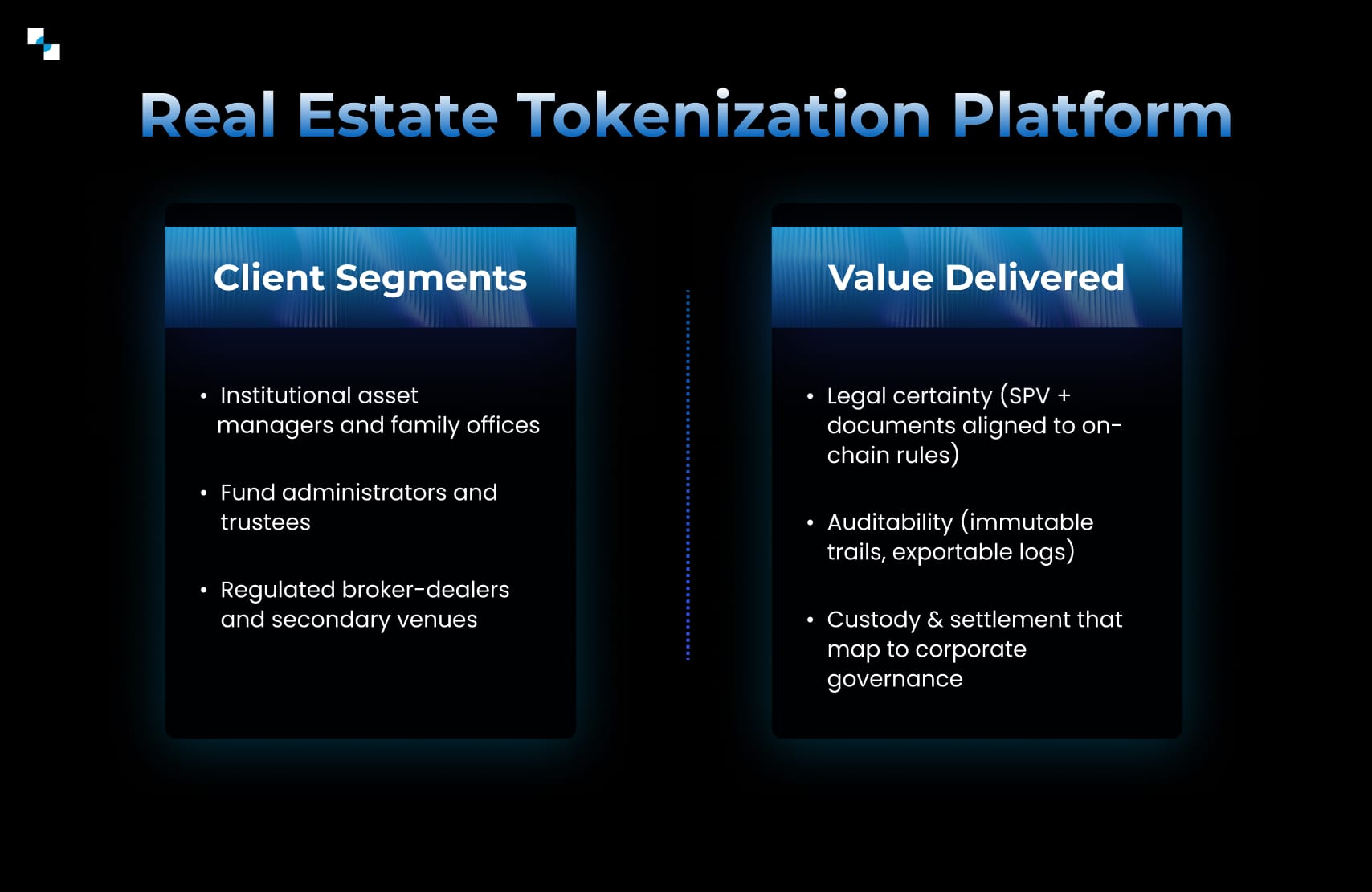
Institutional buyers evaluate tokenization initiatives through the same lenses they use for traditional fund platforms: legal certainty, operational reproducibility, auditability, and counterparty risk. Common reasons pilots fail to scale:
- Governance is phrased as marketing rather than enforceable corporate mechanics.
- Custody is treated as an implementation detail instead of a legal and operational dependency.
- Identity and transfer controls are engineered off-chain, creating reconciliation gaps.
- Absence of audit-grade event trails and tax reporting exports.
A platform intended for institutional adoption must make compliance, custody, and legal enforceability its product priorities.
Real Estate Tokenization Platform Development: Core architectural principle
Proptechs must focus on designing the platform as a stack of composable, auditable layers that map to real-world legal responsibilities. Each layer must be independently verifiable and replaceable.
1. Legal layer
Legal structure is primary: tokens are contractual interests, not titles. Platform design must force alignment between on-chain state and SPV law so token-holder rights are enforceable in courts, directors can act on votes, and regulators can reconcile code with corporate records.
- SPV as holder of record: Keep title, leases, and local obligations inside an SPV or regulated vehicle; tokens represent beneficial interests only.
- On-chain-to-legal mapping: Insert explicit clauses in Articles/shareholder agreements that recognize on-chain artifacts and define how votes convert into director instructions.
- Quorum & emergency rules: Specify thresholds, notice periods, supermajorities, and emergency veto/override powers in the constitutional documents.
- Fallback flows: Define arbitration, escrow, and emergency director powers that interact with smart contract states (who signs what, and when).
- Legal opinions: Obtain jurisdictional legal opinions pre-issuance, document interpretations for securities, fiduciary duties, and tax consequences.
- Regulatory playbook: Maintain jurisdiction mappings and a playbook for pre-issuance confirmations, no-action letters, and regulator engagements.
2. Protocol & Smart-Contract Strategy
Smart contracts must enforce transfer rules, capture auditable events, and provide controlled upgrade paths so legal counsel and auditors can treat protocol behavior as operationally binding, testable, and remediable.
- Permissioned token model: Use a permissioned security-token spec that enforces eligibility, jurisdictional blocks, and transfer approvals at the protocol level.
- Deterministic transfers: Implement transfer gating on-chain to avoid off-chain reconciliation races and ambiguous ownership states.
- Governance primitives: Encode proposal lifecycle, timelocks, quorum rules, execution hooks, and signed event emissions that map to corporate minutes.
- Upgrade controls: Require multisig + timelock for upgrades; document rollback and emergency procedures in a deployment playbook.
- Audit discipline: Mandate formal verification where practical, multiple independent security audits, staged testnets, and a public disclosure/vuln program.
- CI/CD provenance: Produce immutable deployment artifacts (signed manifests) that auditors can trace to each production contract.
Deploy a Scalable Real Estate Tokenization Platform
3. Identity, KYC & Investor Lifecycle
Identity links legal status to wallet behavior. Build a canonical registry that ties KYC attestations to addresses, enforces accreditation and jurisdiction rules programmatically, preserves privacy when required, and provides regulator-grade logs for every identity state change.
- Canonical registry: Access a single source of truth mapping legal IDs, KYC documents, attestations, and wallet addresses.
- Programmatic gating: Run accreditation and jurisdiction checks at issuance and on all secondary transfers; auto-block failing flows.
- Privacy controls: Use hashed attestations or zk-proofs where required so auditors can verify eligibility without exposing PII.
- Continuous screening: Integrate sanctions/PEP/adverse-media feeds and automated remediation (suspend/restrict/escalate).
- Audit trail: Persist immutable, timestamped logs of identity changes, attestations, and remediation actions for regulator exports.
- Onboarding UX: Collect only regulator-required data and produce signed attestations that map to on-chain permissions.
4. Custody & settlement
Custody is a commercial control. An approved token transfer must synchronize with SPV registers and produce signed records that auditors and tax authorities accept as proof of beneficial change.
- Custody abstraction: Provide an API layer to plug regulated custodians or MPC providers without platform rework.
- Key segregation: Separate admin keys from transaction keys; require threshold signatures for critical operations.
- Settlement atomicity: Define atomic flows where approved token transfers update SPV shareholder registers and produce signed settlement receipts.
Reconciliation: Reconcile on-chain triggers with fiat rails; record bank-statement matches and exceptions.
Redundancy & failover: Support multi-custodian redundancy and disaster-recovery plans for key compromises or provider outages. - Insurance & indemnity: Negotiate custody insurance and spell indemnities/limits in commercial agreements.
5. Operational layer
UX design must deliver legal outputs. Build issuer and investor portals that generate compliance artifacts, automate SPV orchestration, and produce downloadable packs auditors can consume.
- Issuer orchestration: Automate SPV creation, document intake, due diligence checklists, and issuance workflows that generate signed artifacts.
- Wallet onboarding: Map KYC to wallets, issue signed attestations, and capture provenance for every investor action.
- Distribution engine: Trigger distributions from chain events but reconcile to fiat; store signed reconciliation reports linking events to bank statements.
- Transfer clearance logs: Record approvals/denials with authorizers, timestamps, and rationale for every transfer.
- Auditor exports: Bundle signed logs, PDFs, and raw event feeds into standard compliance packs for auditors and regulators.
- Operational SLAs: Define acceptance criteria and SLAs in pilot contracts (response times, dispute handling, settlement windows).
6. Data & oracle layer
Oracles drive money. Source valuations, rent events, and FX via multiple trusted feeds require provenance, sanity checks, and failover playbooks so automated payouts and compliance triggers stand up to audit and legal scrutiny.
- Multi-feed architecture: Ingest data from multiple reputable providers; apply sanity bounds and variance checks before automated actions.
- Signed provenance: Persist cryptographic proof of each feed snapshot and link it to downstream financial events.
- Failover & pause logic: Define SLA-backed failover feeds, automated pause rules, and manual reconciliation paths for anomalies.
- Operational KPIs: Track latency, feed variance, and data quality; include metrics in post-mortems and SLAs.
- Auditability: Keep full feed lineage for every distribution or compliance decision to support regulator queries.
- Dispute process: Provide a clear manual reconciliation and dispute workflow when Oracle inputs are contested.
7. Secondary markets & liquidity mechanics
Build compliant transfer approvals, integrate regulated secondary channels where possible, and onboard market makers with clear custody, margin, and settlement terms to create predictable, auditable liquidity pathways
- Regulated venues first: Prefer integrations with regulated secondary markets to reduce legal friction for institutional participants.
- Internal approval flows: Enforce accreditation and jurisdictional constraints with approval logs for peer-to-peer trades.
- Market-maker terms: Onboard makers with custody access, margin mechanics, incentives, and settlement guarantees documented contractually.
- Delisting & buyback rules: Define orderly delisting, buyback, and unwind procedures to protect investors and SPV obligations.
- Credit overlays: Allow lending/collateralization only after legal, custodial, and settlement mechanics are proven.
- Stress playbooks: Prepare temporary halts, controlled buybacks, and supervised unwind procedures for market stress events.
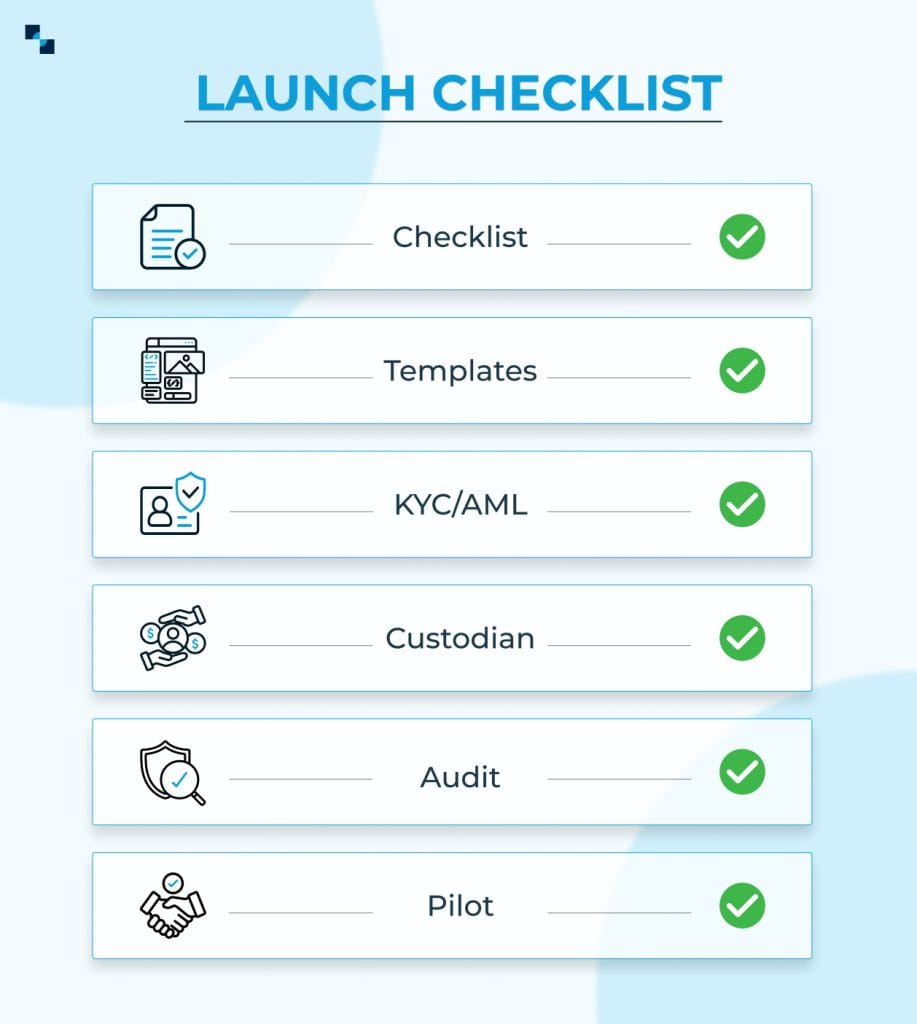
Product Priorities: What to Build First
Institutional adoption depends on a narrow set of capabilities. Prioritize these for the initial product release.
- Issuer intake and SPV orchestration. Document intake, due diligence checklist, template SPV creation, and legal packaging.
- Permissioned issuance engine. Deterministic minting process, synchronized off-chain register, and audit logs.
- Investor onboarding and wallet mapping. Verified KYC pipeline, wallet creation/mapping, and eligibility attestation.
- Distribution engine. Configurable payment rails, automated distributions, and reconciliations.
- Compliance reporting exports. FATCA/CRS-style extracts, local tax reporting formats, and operational logs.
- Smart contract governance primitives. Voting module, timelocks, and signed director instruction outputs.
Launch pilots with a controlled investor list and a single asset class that minimizes title complexity (stabilized commercial portfolios or institutional residential assets).
Real-Estate Tokenization Platform Implementation Roadmap
- Phase 0: Legal and regulatory foundations (0–2 months). Draft SPV templates, obtain initial legal opinion, and map target jurisdictions.
- Phase 1: Core platform and compliance (1–4 months). Build issuer portal, permissioned issuance engine, and KYC integration.
- Phase 2: Audit and custody integrations (3–6 months). Complete smart contract audits, integrate at least one regulated custodian, and operationalize distribution rails.
- Phase 3: Controlled pilot (6–9 months). Execute the first institutional issuance with a closed investor list, validate distributions and reporting.
- Phase 4: Secondary and scaling (9–18 months). Integrate regulated secondary, engage market makers, and onboard additional custodians and jurisdictions.
Each phase must conclude with documented acceptance criteria tied to legal, operational, and technical checkpoints.
Deploy a Customized White-Label Real-Estate Tokenization Platform in Just 7 Days
Pitfalls that Compromise Tokenization Platform Functioning (and how to avoid them)
1. Problem: Selling retail before proving institutional rails.
- Solution: Prove issuance + custody + reporting first.
2. Problem: Single custodian lock-in.
- Solution: Custody abstraction and at least two partners.
3. Problem: Governance theater (votes no one can execute).
- Solution: Design votes that produce legally binding director instructions.
4. Problem: Treating oracles as optional.
Solution: Multi-feed oracles and sanity check for income and FX data.
5. Problem: Assuming liquidity without market-makers.
- Solution: Plan incentives and regulated secondary access from day one.
Avoid shortcuts; regulators and auditors penalize creativity without documentation.
Takeaway
Businesses planning to launch a Real Estate Tokenization Platform prioritize legal certainty, protocol-level controls, custody plurality, and auditability. Convert technical capabilities into documented assurances that procurement, compliance, and legal stakeholders can evaluate. This will help the proptech industry convert enterprise adoption and recurring revenue.
Institutional adoption demands legal clarity, custody resilience, and compliance-grade controls. Antier integrates all three into every build. Partner with a Real-Estate Asset Tokenization Platform Development Company to ensure your platform withstands regulatory review, meets enterprise procurement standards, and establishes your leadership in real estate tokenization.
Frequently Asked Questions
01. What is tokenized real estate and why is it important?
Tokenized real estate restructures ownership, liquidity, and governance of property investments, providing a way for institutional buyers to engage with real estate through legally enforceable ownership structures and compliance.
02. What are the common reasons for the failure of tokenization pilots?
Common reasons include governance being treated as marketing rather than enforceable mechanics, custody being overlooked as a legal dependency, off-chain identity controls creating gaps, and lack of audit-grade event trails.
03. What should be prioritized in a platform designed for institutional adoption?
A platform must prioritize compliance, custody, and legal enforceability, ensuring that its architecture is built on auditable layers that align with real-world legal responsibilities.