





AI Summary
- Blockchain innovation has revolutionized global transactions by enhancing transparency, but it has also uncovered a significant issue: the loss of privacy.
- This blog delves into how privacy coin development is addressing this challenge by implementing cryptographic layers that protect identities while maintaining trust.
- The post explores the surge in privacy coin usage and the technologies driving this trend, such as Zero-Knowledge Proofs, Ring Signatures, and Stealth Addresses.
- It highlights the top beneficiaries of privacy-oriented blockchain solutions, including fintech startups, large enterprises, governments, institutional investors, DeFi platforms, and cross-border remittance providers.
- The blog emphasizes the importance of hiring a privacy coin development company in 2026 to navigate regulatory requirements, enhance security, and stay competitive in the digital finance landscape.
Blockchain innovation has brought transparency to global transactions, yet that same feature has exposed its biggest weakness: the loss of privacy. With every transaction permanently visible, sensitive financial data is open to analysis. Businesses handling regulated or high-value transfers cannot operate securely under such conditions. Privacy coin development addresses this challenge by incorporating cryptographic layers that safeguard identities without compromising trust.
This blog explains how privacy coin development restores confidentiality to blockchain, and explores key technologies driving it.
Inside the Privacy Coin Boom: What You Need to Know in 2026
Public blockchains such as Bitcoin and Ethereum have reshaped global finance through transparency, but that very openness is now a major drawback. Every wallet and transaction can be traced, leaving no room for financial confidentiality. While such visibility helps regulators, it’s a deal-breaker for enterprises handling sensitive transfers or proprietary transactions that demand discretion.
Recent data confirms this privacy shift.
- As of early 2025, 11.4% of all cryptocurrency transactions involve privacy coins, up from 9.7% in 2024.
- Global privacy-based transaction volumes now exceed $250 billion, proving this trend is driven by genuine user demand, not speculation.
- Monero alone processes more than 50% of all private crypto transactions, despite being delisted from Binance, Coinbase, and Kraken, showing that user-driven privacy adoption is unstoppable.
In a world where information equals power, transparency without confidentiality leads to exposure. Studies now show that blockchain’s immutability directly conflicts with GDPR’s right to erasure and correction, risking penalties of up to €20 million or 4% of global revenue. For enterprises, this is not just a legal challenge; it’s a business vulnerability that needs technological intervention.
This is where crypto development, focused on privacy architecture, is changing the story. Using Zero-Knowledge Proofs, Ring Signatures, and Stealth Addresses, privacy coins enable verification without exposing the user. “Monero leads the market with 58% share and Zcash follows with 21%, both proving the scalability of private transactions in a compliant framework.” Asia-Pacific now drives 29% of global privacy coin usage, while Africa’s adoption is growing 37% year over year due to increasing demand for anonymous remittances.
Even as regulations tighten, privacy innovation is booming. Regulatory crackdowns rose 34% in 2024, yet adoption surged. FINMA’s “Privacy Coin Sandbox in Switzerland” and growing institutional interest, with 24% of new privacy wallets now belonging to enterprises, show that privacy is being redefined as a compliance feature, not a flaw. The data speaks clearly: global markets want confidentiality, and modern crypto development solutions are making it possible to achieve it securely and legally.
Discuss your goals with Antier and build a compliant, privacy-first solution.
Who Needs Privacy Coin Development the Most?
Below are the top six groups that benefit most from privacy-oriented blockchain solutions.
- Fintech Startups and Digital Payment Platforms
Fintech founders and digital payment innovators are at the front line of blockchain adoption. They handle user onboarding, instant settlements, and cross-border transactions that demand confidentiality. Privacy coins give them the ability to secure customer data, comply with KYC and AML regulations, and protect transaction histories. Many such ventures collaborate with specialists in crypto development to integrate privacy layers directly into their remittance and payment systems.
- Large Enterprises and Corporations
Enterprises dealing with mergers, vendor payments, and global financial operations need a way to move funds without exposing transaction patterns. Privacy coin frameworks provide an effective shield against financial intelligence gathering by competitors. Organizations are increasingly investing in privacy coin development solutions that enable internal settlements, inter-company payments, and confidential supply chain transactions within auditable, private blockchain environments.
- Governments and Central Banks
Governments exploring central bank digital currencies and digital identity systems are realizing the importance of confidentiality in public finance. Privacy coins allow controlled transparency, where transactions remain verifiable yet secure from public exposure. Several government pilots are testing blockchain-powered payment architectures designed to enhance privacy controls and ensure compliance with financial and data protection laws.
- Institutional Investors and Family Offices
High-net-worth individuals, investment funds, and family offices demand discretion for asset movements and portfolio diversification. Privacy coins give them the flexibility to move capital securely while maintaining verifiable transaction proofs. Many institutional investors are now working with experts to implement private wallet architectures and custom transaction layers that meet security and reporting standards.
- DeFi Platforms and Web3 Protocols
Decentralized finance platforms often struggle to balance transparency with user privacy. Privacy coins solve this by offering shielded smart contracts and confidential DeFi operations. Privacy-integrated DeFi protocols attract more liquidity from users who value anonymity and security. This is why project founders are partnering with crypto development companies that build privacy-enabled DEXs, lending markets, and yield systems to enhance user trust and adoption.
- Cross-Border Remittance Providers
Remittance firms that handle millions of international payments require systems that guarantee transaction confidentiality and compliance. Privacy coins make it possible to maintain anonymity while fulfilling KYC and AML requirements through selective disclosure. Service providers are turning to coin development experts to launch privacy-powered stablecoin remittance platforms that protect sender and receiver data, reduce costs, and enable seamless global money movement.
What Are the Key Technologies Behind Privacy Coin Development?
Privacy coins rely on advanced cryptographic tools that secure data while keeping transactions verifiable. These technologies make it possible to validate ownership and authenticity without exposing transaction details, creating a trust framework that combines transparency with confidentiality.
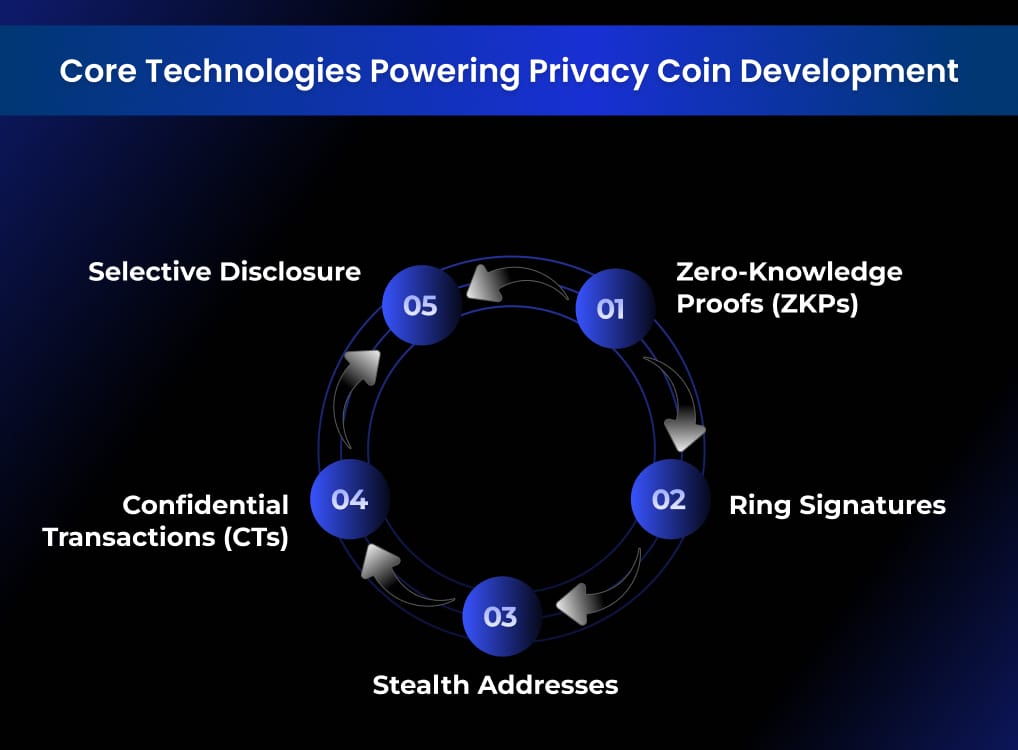
- Zero-Knowledge Proofs (ZKPs): ZKPs let users prove a transaction’s validity without revealing any private information. They’re the foundation of privacy networks like Zcash, which use zk-SNARKs to confirm transactions securely. ZKPs are now being applied in enterprise crypto development projects to ensure compliance, privacy, and scalability within financial and identity verification systems.
- Ring Signatures: Ring Signatures merge multiple digital signatures so observers cannot identify which participant authorized a transaction. Monero popularized this approach, giving users complete sender anonymity. For enterprises, it’s a practical way to keep financial flows confidential while maintaining blockchain integrity.
- Stealth Addresses: Stealth Addresses create one-time wallet addresses for each transfer, making it impossible to link different transactions to the same user. This protects financial behavior from tracking and data mining, a feature increasingly demanded in modern privacy coin development solutions.
- Confidential Transactions (CTs): Confidential Transactions encrypt the transaction amount so that only the sender and receiver know the value being exchanged. The network still verifies validity through cryptographic proofs. CTs are ideal for businesses needing private high-value transfers or internal settlements across decentralized systems.
- Selective Disclosure: Selective disclosure allows users to share only the data required for regulatory or audit purposes. This bridges privacy and compliance, ensuring privacy coins remain usable in regulated environments.
Together, these privacy mechanisms turn blockchain into a secure, trust-driven financial infrastructure. Organizations are now adopting privacy crypto development services that integrate these privacy frameworks into wallets, payment platforms, and DeFi protocols, ensuring every transaction remains confidential, compliant, and verifiable.
Book a free strategy session with our experts and explore your privacy coin roadmap.
Why Hiring a Privacy Coin Development Company Is a Strategic Move in 2026
- Expertise – Get access to specialists in cryptography, privacy protocols, and blockchain security.
- Compliance – Build systems aligned with GDPR, FATF, and AML standards.
- Speed – Launch faster using tested privacy coin frameworks.
- Customization – Tailor solutions for fintech, DeFi, or enterprise use.
- Security – Ensure scalable, secure, and high-performance infrastructure.
- Integration – Connect seamlessly with existing systems and wallets.
- Efficiency – Reduce downtime and long-term maintenance costs.
- Advantage – Gain trust, attract investors, and stay ahead in digital finance.
Hiring a professional team ensures precision, security, and innovation throughout your blockchain journey. Partnering with experts in coin development helps you build scalable privacy solutions that meet global standards.
Ready to Build Your Privacy Coin?
Enterprises worldwide are recognizing that privacy is not just a feature but a strategic advantage. Developing your own privacy coin can help you strengthen user trust, ensure compliance, and create secure financial ecosystems. Privacy coin integration allows your organization to manage sensitive transactions with transparency, accountability, and control.
Collaborating with specialists in privacy crypto development gives you access to frameworks that deliver compliance-ready privacy infrastructure. Antier, a leading cryptocurrency development company, empowers businesses to design and deploy privacy-enabled blockchain systems that redefine digital trust. With Antier, your privacy coin vision becomes an enterprise-grade success story.
Frequently Asked Questions
01. What is the main challenge that privacy coin development addresses in blockchain technology?
Privacy coin development addresses the challenge of loss of privacy in blockchain transactions, which exposes sensitive financial data due to the transparency of public blockchains.
02. How has the adoption of privacy coins changed from 2024 to early 2025?
The adoption of privacy coins increased from 9.7% to 11.4% of all cryptocurrency transactions between 2024 and early 2025, indicating a growing demand for confidential transactions.
03. What technologies are driving the development of privacy coins?
Key technologies driving privacy coin development include Zero-Knowledge Proofs, Ring Signatures, and Stealth Addresses, which allow for transaction verification without revealing user identities.