




AI Summary
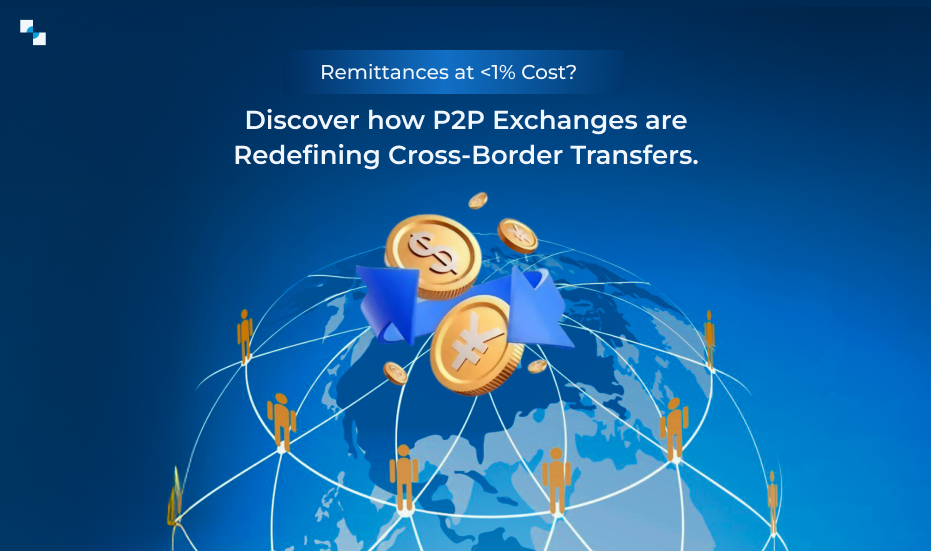
- Discover how P2P crypto exchange software revolutionizes cross-border remittances, cutting costs to 1% or less and settling payments in minutes.
- Say goodbye to traditional remittance platforms with high fees and delays.
- Through blockchain technology, P2P exchanges empower users to transfer funds directly, without intermediaries like banks.
- These platforms offer secure, trustless transactions, making remittances efficient and accessible globally.
- While legacy providers charge hefty fees and have long settlement times, P2P crypto exchanges deliver lightning-fast settlements and drastically lower fees.
Over 280 million migrant workers send money home across 70+ countries, fueling a $905 billion remittance economy. Yet average fees of 6.5% and multi-day settlement times inflict the outdated system on which the lifeline of thousands of families depends.
Peer-to-Peer or P2P crypto exchange software, the decentralized marketplaces that enable users to transfer value directly via blockchain, are emerging as an ideal alternative to the age-old remittance platforms. By leveraging stablecoins and escrow-backed trades, these platforms are cutting remittance costs to 1% or less, enabling payment settlements in minutes, and extending global access to the unbanked.
Let’s explore how P2P crypto exchange development transforms cross-border remittances.
What is P2P Crypto Exchange Software and How Does It Work For Remittances?
P2P crypto exchange software connects buyers with sellers, removing middlemen like banks or money transfer operators. No matter where you’re from and where you need to send the money, you can seamlessly transfer the funds without involving any correspondent banks. On top of it, there’s no wire delay or hidden FX markups.

The traditional remittance workflows involve manual interventions, banks, and MTOs, making them lengthy, exposed, and overly complicated. P2P exchanges, on the other side, rely on blockchain and escrow smart contracts for secure, auditable, and trustless transactions.
A typical middleman-free remittance transaction on P2P crypto exchange software will involve the following steps:
- A sender in the U.S. buys USDT (Tether) on a P2P platform.
- They transfer it instantly to a recipient in Nigeria.
- The recipient sells USDT for local currency via escrow-protected trade, usually at competitive rates.
“Remittances are an artefact of our current financial system. They divide payments into domestic vs. cross-border. Crypto transfers do away with this two-tier system as all transfers are executed at the same speed and cost, regardless of the recipient’s location.”
Zeeshan Feroz, Former Coinbase UK CEO and MoonPay’s Chief Growth Officer
What are the Pain Points of the Traditional Remittance Market?
P2P crypto exchange development offers the best solution to remittance blues. But legacy remittance providers such as Western Union, MoneyGram, Ria, etc. still dominate. At what costs?
- 6.5% average fee on a $200 transfer = $13 lost every time.
- That’s over $50 billion in annual leakage, which is more than the GDP of several small countries.
- In sub-Saharan Africa, fees exceed 10%, with 3–5 day settlement times.
For the families that rely on remittances for food, rent, or education, that delay and charge is devastating.
Additionally, over 70 countries depend on remittances for more than 4% of their GDP. That money is highly valuable as more than half of it is received by people in rural households, where 75% of the world’s poor population lives. Now, imagine how grave the problem of long settlement period and high charges is.
Migration expert at Inter American Dialogue summed it up best when Western Union suspended its services in Cuba and Afghanistan.
“The problem isn’t just Western Union’s closure — it’s that Western Union is often the only provider.”
Millions were stranded. This is a stark reminder of how fragile the centralized remittance systems are and how urgent the shift to P2P crypto exchange software is.
How P2P Crypto Exchange Development Addresses the Issues with Centralized Remittance Systems?
1. Lightning-Fast Settlements
Blockchain rails settle transfers in under 10 minutes and are available 24/7, unlike traditional banking, which takes 1–5 business days.
In Southeast Asia, 76% of remittance users already prefer crypto for this reliability.
2. Drastically Lower Fees
P2P crypto exchange software eliminates intermediaries and enables users to negotiate directly, resulting in costs of 1–3%. This brings a 70% fee drop in high-cost regions.
“Stablecoins make remittances instant, direct, and inclusive. Fewer fees mean more money where it belongs.”
- Ripple’s Reece Merrick
3. Financial Inclusion for the Unbanked
All that’s needed is a smartphone for a remittance transfer over P2P crypto exchange software. In 2025, 15% of unbanked adults now use crypto for transfers, up from almost zero five years ago. In Nigeria, 80% of crypto activity is P2P-based, fueling informal yet vital economies.
4. Stability and Transparency
Stablecoins like USDT and USDC are pegged 1:1 to fiat, eliminating volatility and ensuring clarity.
In the Philippines, remittance fees fell from 6% to 1%, with 85% of recipients using mobile wallets for instant access.
The result? P2P crypto remittances grew 50% year-over-year in Latin America and Africa in 2024 alone.
| Metric | Traditional Transfer | P2P Crypto Exchange |
| Speed | 1–5 days | Minutes |
| Average Fee | 6.5% | 1–3% |
| Availability | Banking hours | 24/7 |
| Access | Bank account required | Smartphone |
| Transparency | Opaque intermediaries | On-chain traceability |
What are the Challenges Involved In Remittance Transfers Through P2P Crypto Exchange Development?
- Regulation: AML/KYC compliance remains a major barrier for global rollout.
- Volatility: Non-stable crypto assets deter mainstream adoption, though stablecoins mitigate much of it.
- Education & Infrastructure: Awareness gaps and unreliable internet access slow rural participation.
The Future of Remittance is P2P Crypto Exchange Development
P2P crypto exchange development redesigns the global money movement. By enabling low-cost, borderless, auditable transfers, P2P crypto exchange software are returning billions to households and empowering financial inclusion at scale.
For fintechs, exchanges, and developers, this is the moment to build:
Integrate P2P modules, tailor remittance UXs, support stablecoin remittances, and bridge fiat gateways for compliant, high-volume corridors.
Ready to explore P2P Crypto Exchange Development?
Antier, a global leader in P2P crypto exchange development, builds regulatory-ready, white-label platforms equipped with:
- Escrow-backed P2P trade engines
- Stablecoin and fiat gateway integration
- Compliance modules (KYC/AML, transaction monitoring)
- Liquidity APIs for remittance corridors
- Mobile-first UX for emerging markets
Whether you aim to transform your exchange into a remittance hub or launch a new P2P remittance platform, Antier’s custom and white label P2P exchange development solutions help you go to market faster and at a fraction of conventional development cost.
Frequently Asked Questions
01. What is P2P crypto exchange software and how does it improve remittances?
P2P crypto exchange software connects buyers and sellers directly via blockchain, eliminating middlemen like banks and money transfer operators. This allows for lower fees, faster settlements, and greater access for unbanked individuals.
02. How do P2P crypto exchanges reduce remittance costs?
P2P crypto exchanges leverage stablecoins and escrow-backed trades, reducing remittance costs to 1% or less compared to the average 6.5% charged by traditional remittance services.
03. What are the main advantages of using P2P crypto exchanges over traditional remittance methods?
The main advantages include lower fees, instant payment settlements, and the ability to conduct transactions without the delays and complexities associated with banks and money transfer operators.