



AI Summary
- In 2025, the rise of smart contracts is revolutionizing how companies govern exchanges and collaborations, offering automation, transparency, and efficiency.
- With a projected global market size exceeding USD 12 billion by 2032, enterprises are investing in smart contract development services to enhance security and streamline workflows.
- Smart contracts eliminate intermediaries, reduce costs, ensure compliance, boost transparency, and provide a competitive advantage.
- Real-world examples in various industries showcase the impact of smart contracts, from supply chain optimization to energy trading and financial services innovation.
- To succeed, enterprises must focus on high-impact use cases, prioritize security audits, maintain regulatory alignment, ensure interoperability, adopt modular architecture, and educate stakeholders.
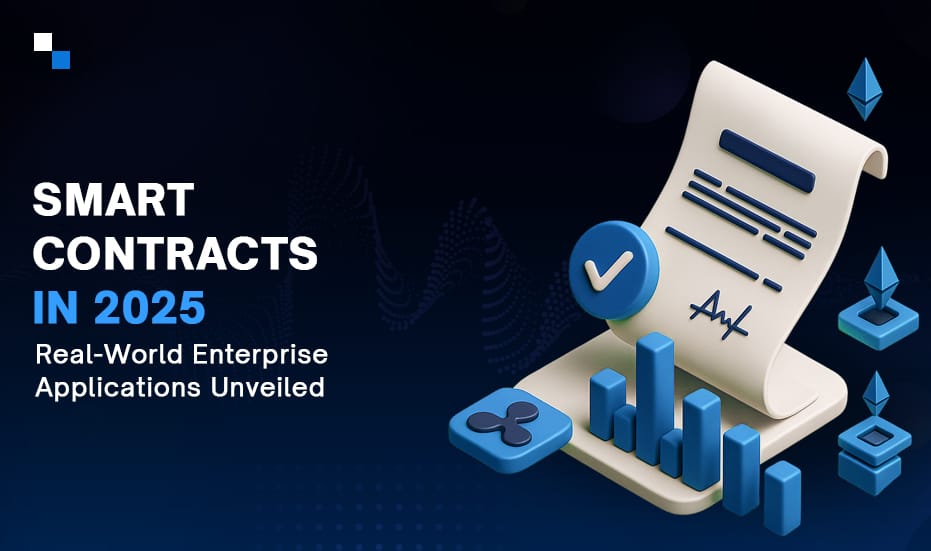
In 2025, companies across various sectors are undergoing a fundamental transformation in how they govern exchanges and multi-party collaborations through smart contracts. Once only a far-off promise, these self-executing, tamper-resistant agreements based on blockchain technology are now a present-day necessity. As companies demand more automation, transparency, and trust these days, smart contracts are considered a pivotal solution that reduces human error, lowers costs, and increases operational efficiency.
Whether it is supply chain, finance, healthcare, or real estate, smart contracts are redefining how enterprises manage digital relationships. According to Fortune Business Insights, the global smart contracts market size is projected to surpass USD 12.07 billion by 2032. Several companies from various industry verticals have started investing in smart contract development services in 2025 to enhance security and efficiency in their workflows.
In this blog, we’ll explore why developing smart contracts for enterprises is a strategic move, examining their cross-industry applications and outlining key best practices to ensure long-term success in today’s rapidly evolving decentralized digital economy.
A Quick Overview of Smart Contracts
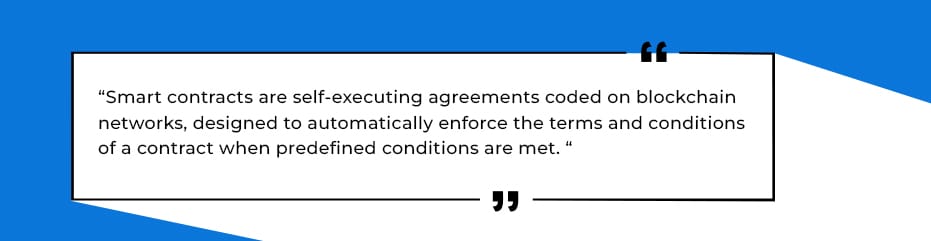
Unlike traditional contracts, smart contracts function without the involvement of intermediaries, and this is what helps these contracts to enable fast, transparent, and trustless transactions. Additionally, smart contracts are immutable. Once deployed, they can’t be alerted, and this is what helps eliminate the risk of tampering and makes these contracts secure.
Smart contracts for enterprises have emerged as a vital tool, as today, enterprises can use them for automating procurement, payment, compliance, and even complex multi-party workflows and processes while reducing delays, operational costs, and disputes across global supply chains.
Why Enterprises Are Embracing Smart Contracts in 2025
The following are the key reasons highlighting why enterprises are actively embracing smart contracts. Take a look-
1. Automation of Business Workflows
Today, enterprises are embracing smart contracts, and the major reasons behind this shift are their capability of automating repetitive and manual processes. This automation reduces the manual intervention to a great extent and streamlines end-to-end business processes.
2. Cost Savings
Smart contract eliminates the need for intermediaries, such as legal advisors, brokers, & auditors, which drastically reduces administrative and transaction costs. Smart contracts ensure direct, secure & efficient execution of agreements without the overhead.
3. Streamlined Regulatory Compliance
Compliance requirements are embedded into the smart contract logic. This allows business activities to automatically comply with all legal and regulatory obligations, minimizing the risk of fines, mistakes, and disputes.
4. Increased Transparency & Trust
Smart contracts operate on a distributed ledger, where all parties in the network gain access to the real-time data. This transparency plays a crucial role in building trust and accountability, especially in financial and supply chain networks, where multiple parties are involved.
5. Strategic Competitive Advantage
Smart contracts for enterprises will no longer be just a technology in 2025. They have become a business strategy. Companies are using smart contracts to create scalable, secure, and future-ready interoperable systems that encourage innovation based on faster transaction outcomes in a decentralized economy.

Real World Examples Showing How Enterprises Are Leveraging Smart Contracts in 2025
Below are concrete examples of how leading organizations are leveraging smart contracts for real-world impact.
1. Supply Chain & Procurement
Trust Your Supplier (IBM Collaboration)
Challenge: Supplier onboarding and verifying supplier data were both slow and expensive.
Solution: Trust Your Supplier (TYS), a patented blockchain-based supplier information network developed as a collaboration between IBM and Chainyard, where supplier data is certified by trusted third parties and stored as a digital passport.
Impact: Onboarding times have been reduced by 67%, resulting in cost savings of approximately $500 per supplier for purchasing organizations.
2. Hitachi
Challenge: Hitachi’s case study indicates that even though the company’s procurement divisions use paper-based processes for contracts with over 3,500 companies, procurement cycles take too long to process, creating inefficiencies and, in some cases, creating security issues.
Solution: Hitachi adopted a blockchain-based, paperless procurement system using Hyperledger Fabric, which automates contract management and eliminates fraud to a great extent.
Impact: Improved efficiency, reduced risk, & secure digital signatures for contract execution.
3. Trade Finance
Marco Polo Network
Challenge: Traditional trade finance requires costly, slow, and error-prone manual processes.
Solution: The Marco Polo Network utilizes Azure and Corda blockchain, which allows faster, more secure trade finance and related activities, such as receivables financing, payables financing, and payment commitments.
Impact: Increased working capital cycles and reduced manual errors for exporters, importers, and banks.
4. Energy Sector
Power Ledger + Google Cloud
Challenge: Traditional energy markets rely on centralized intermediaries, which makes it difficult for small producers to trade energy transparently without losing an inch of operational efficiency.
Solution: With Google Cloud, Power Ledger is delivering a blockchain-powered energy platform, which enables peer-to-peer energy trading with blockchain smart contracts, allowing households to sell excess solar energy directly.
Impact: Compared to Power Ledger’s old cloud service, Google Cloud helped cut infrastructure costs by 30%. Global scalability, Real-time insights, and greater adoption of renewables.
5. Gaming
Axie Infinity
Challenge: Axie Infinity needed a decentralized approach to establish true ownership and trustless transactions in its gaming ecosystem.
Solution: It used smart contracts on Ethereum and the Ronin sidechain to facilitate its assets, gameplay, and marketplace.
Impact: This created a secure play-to-earn model, equipped users with real-to-real asset ownership and economic empowerment.
6. Financial Services
JPMorgan Onyx
Challenge: Traditional interbank settlement is slow, involves multiple intermediaries, and lacks real-time transparency, especially with cross-border transactions.
Solution: Uses smart contracts to automate real-time settlements for cross-border payments, avoiding the need for third-party reconciliation.
Impact: Faster, more secure, and transparent financial transactions to reduce operational costs and risks around settlement time.
Key Smart Contract Development Practices for Enterprises to Consider in 2025
The following are best practices businesses should take into consideration to unlock the full potential of smart contracts.
1. Start with High-Impact Use Cases
Enterprises nowadays focus on pain points that could be addressed through automation. Instead of deploying smart contracts across all platforms, they prefer to fit where it is most required. Some of the examples include supply chain traceability, compliance tracking, payments, and more.
2. Emphasize Security Audits
As blockchain transactions are known for their irreversible nature, hence, businesses should conduct rigorous audits on smart contracts using automated tools, third-party assessments, and continuous monitoring to ensure vulnerabilities are addressed proactively.
3. Maintain Legal & Regulatory Alignment
Enterprises should consult legal experts to ensure that smart contracts comply with global and local regulatory requirements. Hybrid models are used, where human arbitration is needed for dispute resolution alongside coded rules.
4. Interoperability from Day One
Smart contracts for enterprises are intended to function not just on one blockchain, but also interact with other platforms and traditional IT systems. Integration of APIs, oracles, or interoperability layers is essential to facilitating seamless and frictionless data movement.
5. Adopt Modular & Upgradable Architecture
Enterprises focus on creating upgradable smart contracts using modular frameworks and proxy patterns. This gives enterprises the agility to enhance or improve contract logic without redeploying the whole system.
6. Educate Internal Stakeholders
The successful development & implementation of smart contract applications in enterprises involves many departments, including IT, finance, legal, & operations. Regular training sessions can help all departments recognize the implications & advantages of the new system.
The above-listed practices allow enterprises to ensure scalable, seamless, secure, and future-ready smart contract deployments.

Conclusion
Smart contracts for enterprises are an integral part of business processes. Their ability to create seamless workflows, generate less friction between stakeholders, and build trust signals a new chapter in the world of secure, programmable, and transparent enterprise processes. However, at the same time, choosing the right technology as well as a smart contract development company is also crucial for its successful implementation.
Antier leverages deep experience in dealing with security protocols, Web3 development, and with a consultative philosophy to ensure the enterprise can design, audit, and deploy smart contracts that fit their unique operations. We provide end-to-end smart contract development services that can help enterprises to embrace a world of automation and decentralization.
In an age where trust is digital and execution is code, smart contracts and digital partners like Antier are changing the way the enterprise world operates.