


AI Summary
- In this dynamic blog post, discover how Human Resources is transitioning from a traditional administrative role to a strategic powerhouse within organizations.
- As HR operations become more complex due to global expansion and diverse talent models, the limitations of traditional automation systems are highlighted.
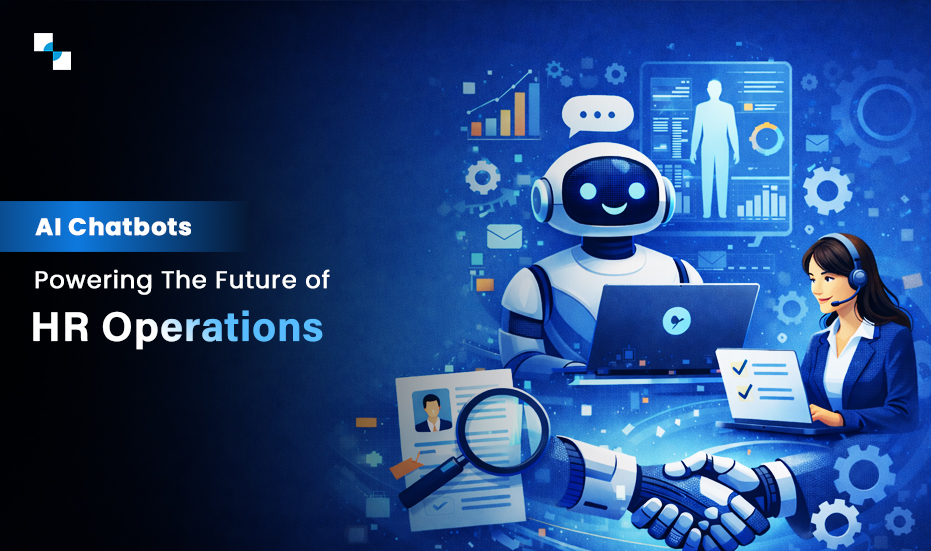
- Enter AI chatbots in HR, revolutionizing how businesses automate, scale, and modernize HR functions.
- These intelligent chatbots, powered by AI, offer intent-based understanding, context-aware conversations, and direct integration with HR systems.
- They excel in employee self-service, workflow automation, recruitment processes, onboarding, payroll, compliance, and internal HR support.
Human Resources has evolved from an administrative function into a strategic driver of organizational performance. Yet, despite this shift, many HR teams remain burdened by manual processes, fragmented systems, and reactive workflows that do not scale with modern workforce demands. As organizations grow across geographies, compliance frameworks, and talent models, the complexity of HR operations increases exponentially. Traditional HR automation tools, built on rigid workflows and static portals, fail to deliver the responsiveness and intelligence required today.
This is where AI chatbots in HR are redefining how organizations automate, scale, and modernize HR operations. By partnering with an experienced AI Chatbot Development Company, enterprises can implement conversational interfaces powered by artificial intelligence to unlock a new era of HR process automation – one that is proactive, context-aware, and deeply integrated into core business systems.
The Limitations of Traditional HR Automation Systems
Before understanding the impact of AI chatbots, it is critical to examine why legacy HR automation approaches fall short.
Key Challenges in Traditional HR Operations
- HR systems operate in silos (HRMS, ATS, payroll, compliance tools)
- Employees struggle to navigate complex portals for simple queries
- Most HR workflows rely on email-based approvals
- Policy interpretation remains manual and inconsistent
- HR teams spend the majority of their time on repetitive support tasks
Despite digitization, HR remains process-heavy but intelligence-light. Automation exists, but decision-making and interpretation still require human intervention. This operational gap has created the need for HR automation using AI, where systems can understand, decide, and act without constant manual oversight.
Talk to an Expert About Automating your HR Processes
How AI Chatbots Enable HR Workflow Automation at Enterprise Scale
Unlike traditional rule-based systems that rely on fixed keywords, modern AI chatbots are built to understand how employees naturally communicate. Powered by advanced language intelligence and enterprise integrations, they play an active role in automating HR operations rather than simply responding to queries.
Key Differentiators of AI Chatbots in HR
- Intent-based understanding, not keyword matching
AI chatbots use Natural Language Processing to accurately interpret employee intent even when questions are informal, incomplete, or phrased differently. - Context-aware conversations
By retaining conversation history and employee context such as role, location, and policy eligibility, chatbots deliver consistent and personalized responses without repetition. - Direct integration with HR systems
AI chatbots connect seamlessly with HRMS, payroll, ATS, and compliance platforms to retrieve real-time data and perform actions securely. - Built-in workflow execution
Beyond answering questions, chatbots can initiate and complete HR workflows, including leave applications, approvals, and record updates. - Active participation in HR operations
These capabilities allow AI chatbots to move beyond static FAQs and function as intelligent, action-driven components of end-to-end HR process automation.
Together, these capabilities form the intelligence layer that differentiates AI-powered HR solutions from traditional, rule-based HR software.
AI Chatbots for Employee Self-Service: Redefining HR Accessibility
One of the most impactful and widely adopted use cases of AI chatbots in HR is employee self-service automation. As organizations scale, HR teams are increasingly overwhelmed by repetitive, high-volume queries that do not require human intervention but still consume significant time and resources.
The Employee Experience Challenge
Employees regularly reach out to HR for routine requests such as:
- Leave balances and approval status
- HR policy explanations and clarifications
- Payroll and salary-related questions
- Benefits eligibility and coverage details
- Tax documents and compliance information
While these queries are essential, they are largely repetitive and manual, leading to slower response times, employee frustration, and reduced HR productivity.
How AI Chatbots Enable Self-Service at Scale
When integrated with core HRMS and payroll systems, AI chatbots for employee self-service can:
- Securely authenticate employees
- Retrieve real-time, role-specific HR data
- Interpret policies contextually based on eligibility
- Deliver instant, conversational responses
This approach significantly reduces dependency on HR support tickets while ensuring employees receive accurate, consistent, and timely information—anytime they need it.
HR Workflow Automation Using AI Chatbots
The true power of AI chatbots lies in their ability to execute HR workflows, not just provide information.
Examples of Automated HR Workflows
- Leave requests and approvals
- Attendance regularization
- Shift and roster management
- Policy acknowledgment tracking
- Employee exit and clearance processes
How Workflow Automation Works
Instead of navigating forms or sending emails, employees interact naturally:
Employee: “Apply for three days of leave starting Monday.”
AI Chatbot:
- Validates leave balance
- Checks policy rules
- Routes approval to the manager
- Updates HRMS automatically
This is HR workflow automation driven by conversation, fast, accurate, and scalable.
AI Chatbots for Recruitment: Automating Talent Acquisition at Scale
Recruitment is one of the most resource-intensive HR functions, making it an ideal candidate for automation.
AI Chatbots for Recruitment and Candidate Engagement
AI chatbots assist recruitment teams by:
- Engaging candidates 24/7
- Answering role-specific queries
- Screening candidates based on predefined criteria
- Scheduling interviews automatically
- Sending follow-ups and reminders
This improves both recruiter efficiency and candidate experience.
Intelligent Candidate Screening
Chatbots can evaluate:
- Skill relevance
- Experience thresholds
- Availability and location preferences
- Role alignment
By automating early-stage screening, recruiters focus on high-quality candidates instead of manual filtering.
AI Chatbots for Onboarding: Accelerating Time-to-Productivity
Once a candidate is hired, onboarding becomes the next critical HR challenge.
How AI Chatbots Improve Onboarding
AI chatbots guide new employees through:
- Document submission and verification
- Policy walkthroughs
- IT and access requests
- Training module assignments
- First-week task coordination
This structured, guided onboarding experience improves retention, engagement, and early productivity.
Payroll and HR Compliance Automation with AI Chatbots
Payroll and compliance processes involve high risk, strict regulations, and minimal tolerance for errors.
1. Payroll Automation Use Cases
AI chatbots can:
- Explain salary structures
- Break down tax deductions
- Track reimbursements
- Answer bonus and incentive queries
2. HR Compliance Automation
Chatbots assist with:
- Labor law interpretation
- Location-specific compliance rules
- Policy enforcement consistency
- Audit-ready interaction logs
This enables payroll and HR compliance automation with reduced manual dependency and lower risk exposure.
AI Chatbots for Internal HR Support and Knowledge Management
HR knowledge often exists in scattered formats, such as PDFs, intranets, shared drives, and emails.
Centralized HR Knowledge Access
AI chatbots for internal HR support act as a unified interface that:
- Retrieves policy documents instantly
- Interprets complex policy queries
- Escalates sensitive issues appropriately
- Provides role-specific guidance to managers and employees
This transforms HR from a reactive support function into a structured, intelligent service layer.
Enterprise Architecture for AI-Powered HR Solutions
Enterprise-grade HR chatbots require a robust technical foundation.
Key Components:
- Conversational AI and LLMs
- Secure HR data retrieval (RAG pipelines)
- HRMS, ATS, and payroll integrations
- Workflow orchestration engines
- Role-based access control (RBAC)
- Compliance logging and audit trails
Because of this complexity, most enterprises partner with an experienced AI Chatbot Development Company to design, build, and maintain these systems.
Schedule a Demo of Our AI HR Chatbot Solution
Data Privacy, Security, and Compliance Considerations
HR data includes sensitive personal and financial information. Any AI-driven HR system must prioritize security.
Best Practices
- End-to-end data encryption
- On-premises or private cloud deployment
- Zero data retention for AI models
- Access control by role and hierarchy
- Compliance with GDPR and regional labor laws
Without these safeguards, HR automation introduces operational risk.
The New Standard for HR Operations
As workforce structures grow more complex and distributed, organizations must move beyond basic digitization and embrace intelligent, AI-driven automation. AI chatbots are no longer optional add-ons; they are becoming the backbone of modern HR operations and a core component of enterprise HR workflow automation solutions. By enabling employee self-service, automating recruitment and onboarding, streamlining payroll and compliance, and strengthening internal HR support, AI chatbots deliver faster execution, consistent governance, and significantly improved employee experiences. The future of HR belongs to organizations that invest early in scalable, secure, and AI-powered HR solutions, setting new benchmarks for efficiency, agility, and workforce engagement.
Antier empowers enterprises to build next-gen AI-driven HR ecosystems as a trusted AI Chatbot Development Company, delivering secure, enterprise-grade chatbot solutions tailored for complex HR environments. With deep expertise in AI, automation, and system integration, Antier helps organizations transform HR into a strategic, future-ready function.
Frequently Asked Questions
01. How have HR operations evolved in recent years?
HR operations have shifted from being purely administrative to becoming a strategic driver of organizational performance, although many teams still face challenges with manual processes and fragmented systems.
02. What are the limitations of traditional HR automation systems?
Traditional HR automation systems often operate in silos, require manual intervention for decision-making, and rely on outdated workflows, making them less responsive to modern workforce demands.
03. How do AI chatbots improve HR workflow automation?
AI chatbots enhance HR workflow automation by using Natural Language Processing to understand employee intent, enabling proactive and context-aware interactions that streamline HR operations.