



AI Summary
- The blog post emphasizes the importance of hiring experienced NFT game developers for building successful NFT-powered ecosystems.
- It discusses common failure points in NFT game development, the core capabilities to look for in developers, and the benefits of partnering with a specialized NFT game development company.
- The post highlights the need for expertise in blockchain engineering, game design, backend infrastructure, and security management to create sustainable NFT games.
- It also provides insights on cost considerations, long-term partnership value, and a decision framework for selecting the right development partner.
- Antier is recommended as a suitable development partner due to its expertise in gaming and understanding of technical complexity and economic sustainability in NFT game development.
The NFT gaming market is no longer experimental. Enterprises, gaming studios, & Web3 startups are building NFT-powered ecosystems that combine ownership, interoperability, and tokenized economies. However, while the opportunity is significant, failure rates remain high. The difference rarely lies in the idea. It lies in execution.
Planning to hire experienced NFT game developers is not about adding blockchain functionality to a game. It is about building secure, scalable, economy-driven digital ecosystems that can sustain users, transactions, and growth.
Before choosing a partner, enterprises must understand what truly defines experience in NFT game development and what separates a capable vendor from the best NFT game development company.
Why NFT Games Fail Without the Right Development Team
Many NFT games fail not because of market conditions, but because of technical and architectural weaknesses. Common failure points include:
- Poorly designed tokenomics
- Smart contract vulnerabilities
- Scalability bottlenecks
- Weak backend architecture
- Lack of analytics integration
- Inadequate live-ops planning
NFT games operate at the intersection of blockchain, game design, and economic modeling. A team lacking expertise in even one of these areas creates long-term instability. Enterprises that hire inexperienced NFT game developers often face post-launch issues that require expensive fixes.
What “Experienced” Really Means in NFT Game Development
Experience in NFT game development goes beyond coding smart contracts. True experience includes:
- Designing sustainable in-game economies
- Building secure NFT minting mechanisms
- Implementing gas-efficient smart contracts
- Integrating wallet systems seamlessly
- Managing multi-chain compatibility
- Planning for high transaction throughput
Experienced NFT game developers have in-depth understanding of how blockchain constraints affect gameplay. They design mechanics that account for transaction costs, confirmation delays, and network performance. This level of foresight is critical for long-term success.
Core Capabilities Enterprises Should Look For
When evaluating NFT game developers, enterprises should assess technical depth across multiple domains.
1. Blockchain Engineering Expertise
Developers should demonstrate:
- Smart contract architecture knowledge
- Multi-chain deployment experience
- Security audit readiness
- Token standard implementation expertise
- NFT marketplace integration skills
Weak blockchain engineering creates permanent vulnerabilities.
2. Game Design and Mechanics Understanding
NFT games are still games first and hence developers must understand:
- Player psychology
- Reward loops
- Progression systems
- Competitive balancing
- Retention mechanics
Without strong game design, NFT ownership alone does not drive engagement.
3. Backend Infrastructure and Scalability
A scalable NFT game requires:
- High-performance backend servers
- Real-time gameplay synchronization
- Load balancing systems
- Database optimization
- Analytics pipelines
Scalability issues damage user trust quickly.
4. Security and Risk Management
NFT games involve real asset ownership. Security cannot be optional. Teams should have:
- Smart contract security practices
- Penetration testing workflows
- Fraud prevention systems
- Anti-bot mechanisms
- Wallet security protocols
Security failures often result in irreversible damage.
Planning an NFT Game? Let’s Discuss Your Strategy
Things to Keep in Mind When Hiring NFT Game Developers
Enterprises should be cautious of:
- Teams that focus only on smart contracts
- Lack of scalable backend planning
- No documented delivery process
- Unrealistic timelines
- No post-launch support strategy
A vendor that promises rapid NFT integration without discussing infrastructure and tokenomics likely lacks experience.
In-House vs Hiring a Specialized NFT Game Development Company
Some enterprises consider building internal NFT game teams. While this provides control, it introduces significant hiring and operational challenges. Building an in-house team requires:
- Blockchain engineers
- Backend developers
- Game designers
- UI/UX designers
- DevOps specialists
- Security experts
However, recruiting and coordinating such a team is expensive and time-consuming.
On the other hand, hiring a specialized NFT game development company provides:
- Cross-functional expertise
- Proven frameworks
- Faster time-to-market
- Reduced hiring risk
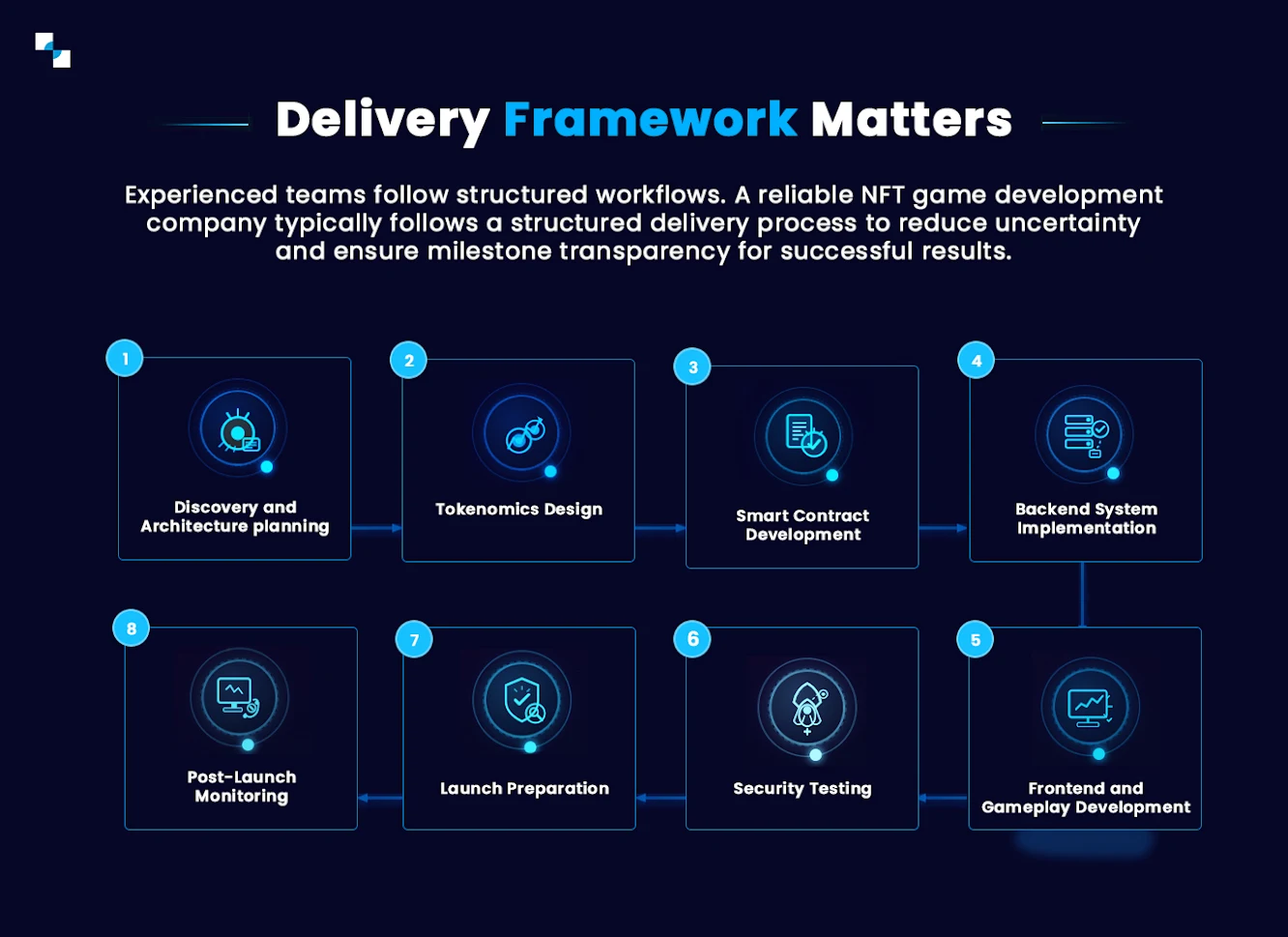
- Structured delivery models
For most enterprises, partnering with experienced NFT game developers reduces execution risk.
What the Best NFT Game Development Company Offers
The best NFT game development company provides more than technical services. It offers strategic guidance. This typically includes:
- Concept validation
- Tokenomics design consultation
- Architecture planning
- Blockchain selection strategy
- UX optimization
- Monetization alignment
- Compliance considerations
A true development partner aligns technical execution with business objectives.
Cost Considerations When Hiring NFT Game Developers
The cost of hiring NFT game developers tends to vary on the overall scope and complexity. Enterprise NFT games typically range from mid-five to six-figure budgets, depending on:
- Blockchain selection
- Feature depth
- Smart contract complexity
- Backend infrastructure scale
- Integration requirements
Choosing based solely on cost often results in higher long-term expenses due to rework and scalability issues. Investment should be evaluated against long-term platform sustainability.
Long-Term Partnership Value
NFT games evolve continuously. Economy tuning, feature updates, and network upgrades require ongoing technical involvement. Enterprises benefit from partners that provide:
- Continuous optimization
- Performance monitoring
- Economy balancing
- Feature expansion
- Infrastructure scaling
NFT game development is not a one-time project; it is an evolving ecosystem.
Final Decision Framework
Prior to hiring NFT game developers, enterprises should ask:
- Does the team understand both blockchain and game mechanics?
- Can they demonstrate scalable architecture experience?
- Do they provide structured delivery processes?
- Can they support long-term growth?
- Do they align technical execution with business goals?
Antier, with its high level expertise & expertise in gaming, happens to be the most suitable development partner to make sure that the NFT game becomes a sustainable ecosystem and not a short-lived experiment.
Enterprises looking forward to building secure, scalable NFT games should work with the best NFT game development company that understands both technical complexity and economic sustainability. The difference between a functioning NFT game and a thriving NFT ecosystem lies in execution, and execution begins with hiring Antier as the right development partner.
Frequently Asked Questions
01. Why do many NFT games fail despite having a good idea?
Many NFT games fail due to technical and architectural weaknesses, such as poorly designed tokenomics, smart contract vulnerabilities, and scalability bottlenecks, rather than market conditions.
02. What should enterprises look for when hiring NFT game developers?
Enterprises should seek developers with experience in designing sustainable in-game economies, building secure NFT minting mechanisms, and managing multi-chain compatibility, among other technical capabilities.
03. How does experience in NFT game development impact long-term success?
Experienced NFT game developers understand blockchain constraints and design mechanics that account for transaction costs and network performance, which is critical for creating stable and successful digital ecosystems.