




AI Summary
- Real-world asset tokenization platforms are revolutionizing Banking and Fintech by enhancing liquidity in illiquid markets and reducing intermediaries.
- Tokenized real-world asset markets have surged to $15.2 billion and are projected to surpass $16 trillion by 2030.
- This comprehensive guide outlines the core steps for banks and fintechs to develop a compliant and scalable RWA tokenization platform.
- It covers defining use cases, selecting suitable blockchain infrastructure, building secure smart contracts, embedding regulatory compliance, implementing secure custody and settlement, launching secondary market capabilities, providing data integration and analytics, focusing on technical architecture and scalability, and exploring future trends like AI-powered asset pricing, investor risk profiling with machine learning, tokenized credit products, smart compliance architecture, and smart contract anomaly detection.
- Investing in RWA tokenization platform development offers financial institutions a strategic advantage in a rapidly evolving market landscape.
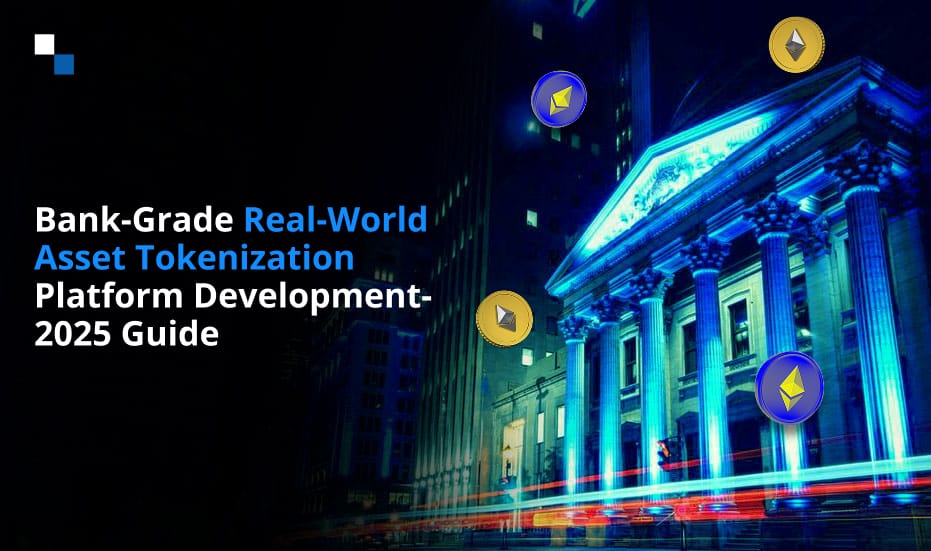
Real-world asset tokenization platforms for Banking and Fintech are now powering liquidity in illiquid markets, cutting intermediaries, and giving institutions programmable finance capabilities. As of 2024, tokenized RWA markets, excluding stablecoins, have grown to $15.2 billion, driven by real estate, private credit, and tokenized U.S. Treasury securities. The Boston Consulting Group projects that tokenized real-world assets may exceed $16 trillion by 2030, with institutional infrastructure playing a central role.
This guide walks you through how banks and fintech’s can develop a compliant, scalable RWA tokenization platform tailored to today’s regulatory, security, and technological realities.
What Does RWA Tokenization Mean in Practice?
RWA Tokenization converts assets into digital tokens on blockchain networks. Each token represents legal ownership or entitlement to revenue streams from the underlying asset. This approach offers efficiency, transparency, and broader investor participation.
The Fractional ownership offered by RWA tokenization allows investors to acquire small portions of high‑value assets. This drives liquidity in markets that traditionally lack it.

RWA Tokenization in Finance: Core Steps for Platform Development
1. Define Scope and Use Cases
The first step is to define which asset segment to support, such as cash, bond, treasury, and the target investor type. Each asset class has different compliance, custody, and valuation challenges. Banks must also define the investor segment, such as retail, HNIs, or institutional, since onboarding workflows and risk scoring vary significantly.
2. Select Appropriate Blockchain Infrastructure
Not all chains are built for tokenization. Choose the one that meets performance, security, and regulatory needs. Following are some premium blockchains to consider:
- Ethereum: Most used, EVM-compatible, deep tooling ecosystem.
- Solana: High throughput, lower costs, growing institutional traction.
- Hedera: Strong for permissioned environments and compliance-heavy use cases.
The blockchain selection must prioritize:
- Regulatory integration (support for KYC/AML)
- Transaction scalability and low latency
- Interoperability with on-chain oracles (e.g., Chainlink)
- Enterprise identity frameworks
Bank of America’s report explicitly mentions Ethereum as the dominant chain for tokenized instruments due to its network effects and legal tooling.
3. Build Secure Smart Contracts
Smart contract integration in tokenization platforms helps to perform token issuance, investor whitelisting, rule-based transfers, dividend distribution, and ownership updates. For RWA platforms, use standards such as:
- ERC-3643: Purpose-built for permissioned assets, includes compliance logic
- ERC-1400: Modular and extensible for enterprise-grade tokenization
- ERC-721 or ERC-1155: For tokenizing unique, non-fungible assets like art
Every contract must be:
- Audited by security firms
- Upgradeable via proxy patterns
- Tested for gas efficiency, edge-case handling, and tamper-proof logic
4. Embed Regulatory Compliance
The RWA Platforms must integrate identity verification, anti‑money‑laundering checks, and securities‑law compliance. Legal documentation must clearly define token holder rights. Settings must support multi‑jurisdictional rules, including SEC, MAS, MiCA, or DFSA standards. Tokenization platforms must include:
- KYC/KYB checks via APIs (e.g., Sumsub, Veriff)
- AML flagging with automated transaction monitoring
- Whitelisting/blacklisting of wallets and jurisdictions
- Digital identity mapping to ensure traceability
- On-chain attestations of compliance data for audits
5. Implement Secure Custody and Settlement
Platforms must provide secure custody of cryptographic keys using multi-signature or MPC solutions, ideally supported by insurance. Custody must comply with institutional-grade standards. The platform must integrate fiat and crypto settlement channels seamlessly.
6. Launch Secondary Market Capabilities
Provide Token holders with access to trading channels, regulated marketplaces, or permissioned DEXes. Platforms should offer peer-to-peer order matching and integration with reliable oracle systems to ensure accurate pricing at all times. Without secondary markets, tokenization is just digitization. Platforms should enable:
- On-platform secondary trading with internal order books
- Integration with DEXs or security token exchanges.
- Liquidity pools to enable continuous pricing
- Cross-chain bridges for accessing external capital
7. Provide Data Integration and Analytics
Real‑time data enhances transparency. Platforms should include market feeds, ownership records, performance dashboards, and analytics tools. Investors require direct access to valuation history and transaction records to make informed decisions.
8. Technical Architecture and Scalability
Financial institutions must employ modular, API-driven architectures that support layering and future enhancements. Layer‑2 avalanche or roll‑up chains reduce costs and improve throughput. Infrastructure must support high transaction volumes while maintaining integrity and performance through smart caching or indexing.
The security protocols must include:
- Regular contract audits
- Zero‑trust frameworks
- Multi‑party encryption models

Future Trends: AI, Tokenized Credit, and Smart Compliance in RWA Tokenization Platforms
The RWA tokenization in Finance is entering a new phase, where technology integration is no longer limited to blockchain. Artificial intelligence, tokenized credit markets, and modular compliance architecture will change how banks and fintechs approach asset tokenization. These developments will become central to how tokenization platforms are designed, operated, and scaled in regulated financial ecosystems. The future key offerings include:
1. AI-Powered Asset Pricing
Banks and fintechs are embedding AI models to assess real-time fair value for illiquid RWAs like real estate or private credit. These models pull from market data, credit scores, macro indicators, and historical trends to deliver more accurate pricing during token issuance. For regulated institutions, this reduces underwriting risk and improves investor confidence by adding data-driven transparency to asset valuation.
2. Investor Risk Profiling with Machine Learning
AI automates investor segmentation based on financial behavior, wallet history, asset interaction, and market exposure. This allows banks and fintechs to offer custom portfolio limits, risk-tiered access to tokenized assets, and suitability screening aligned with compliance requirements. The result: more intelligent onboarding, better fraud detection, and reduced regulatory exposure.
3. Tokenized Credit Products
Platforms are moving beyond tokenized real estate to tokenize yield-generating credit instruments like invoice receivables, SME loans, and private debt. These on-chain assets offer programmable repayments and real-time yield distribution. Fintechs use this for rapid capital deployment, while banks gain access to liquid, tradable credit markets without the manual bottlenecks of traditional loan syndication.
4. Smart Compliance Architecture
Compliance logic is shifting from rigid code to modular, rules-based engines. Platforms now embed dynamic KYC, AML, and jurisdictional restrictions directly into smart contracts. This enables cross-border compliance, jurisdiction-specific investor onboarding, and automatic enforcement of token transfer rules. It reduces legal risk for banks and helps fintech’s scale across regulatory environments without constant manual intervention.
5. Smart Contract Anomaly Detection
AI models are being used to monitor smart contract behavior for risks like reentrancy, abnormal token flows, or front-running. For banks and large fintechs, this means early detection of exploits before they compromise assets or investor funds. It adds a real-time risk layer to tokenized finance, crucial for protecting institutional-grade platforms from manipulation.
Takeaway
Financial institutions that invest in RWA tokenization platform development will gain a strategic advantage. By building a compliant RWA tokenization platform, banks can deliver scale-ready platforms aligned with institutional expectations.
Recent developments provide clear signals of how Institutions that initiate platform development now position themselves as leaders in a market projected to reach trillions in tokenized value.
Planning to launch a Real-World Asset Tokenization Platform? Partner with Antier to build a scalable and compliant solution.