




AI Summary
- In a rapidly evolving technological landscape, enterprise systems must now prioritize trust, privacy, and verifiability at scale, especially with the increasing influence of AI systems in critical decision-making processes.
- The emergence of ZK Layer 2 presents a groundbreaking solution that combines privacy, scalability, and reliability to bridge the gap between traditional intelligence and blockchain transparency.
- This new architectural paradigm allows enterprises to process sensitive data securely while mathematically verifying outcomes.
- By integrating AI with zero-knowledge proofs, organizations can ensure data privacy, compliance, and scalability in their systems.
- CTOs and technology leaders are urged to adopt this innovative approach to not only modernize but future-proof their enterprise stacks.
Enterprise technology is no longer just about performance or cost efficiency. It is about trust, privacy, and verifiability at scale. AI systems are making decisions that impact financial flows, medical outcomes, and operational strategies. At the same time, enterprises are under increasing pressure to ensure that these decisions are secure, explainable, and compliant across jurisdictions.
This creates a critical gap. Traditional systems can deliver intelligence. Blockchain systems can deliver transparency. But neither alone can deliver private, verifiable intelligence. ZK Layer 2 closes that gap and introduces a new architectural paradigm that combines scalability with confidentiality. It allows enterprises to process sensitive data without exposing it, while still proving the correctness of outcomes in a mathematically verifiable way. This is why forward-looking organizations are actively evaluating a reliable dApp development company to design systems that are not just functional today, but resilient for the next decade. This playbook is built for CTOs and technology leaders who are not experimenting. They are architecting production-grade systems.
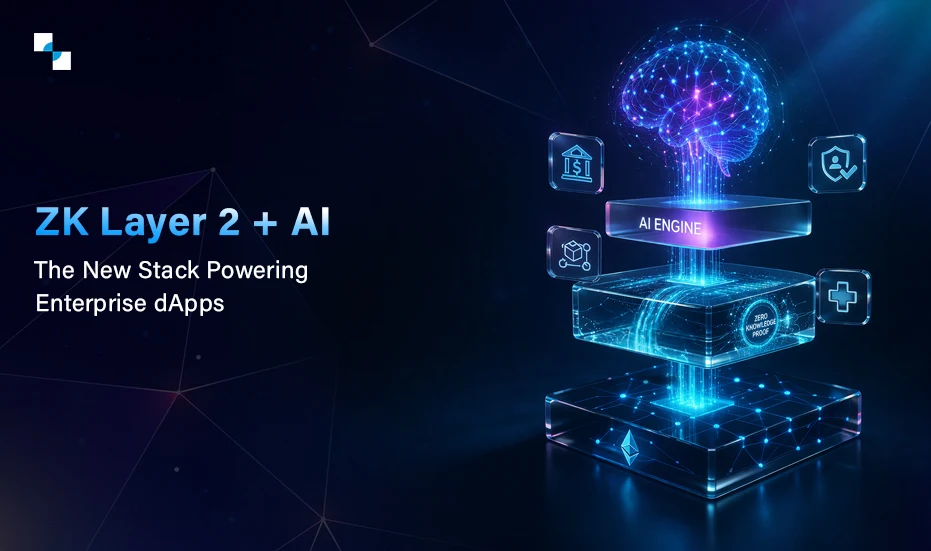
The Convergence of AI and Zero-Knowledge: A New Enterprise Stack
To understand the shift, you need to look at how enterprise stacks are evolving in response to both technological innovation and regulatory pressure. What was once acceptable in centralized, opaque systems is now being challenged by the need for verifiability, privacy, and decentralized trust.
Traditional vs Emerging Enterprise Stack
| Layer / Capability | Traditional Stack | Emerging AI + ZK Stack |
|---|---|---|
| Data Infrastructure | Centralized databases with restricted access | Distributed data layers with encrypted access and control |
| Integration Model | API-driven integrations across siloed systems | Composable, decentralized execution layers |
| AI Systems | Black-box AI models with limited transparency | Verifiable AI with provable outputs using ZK proofs |
| Trust Model | Trust is dependent on internal governance and controls | Trust enforced through cryptographic verification |
| Privacy Handling | Data exposure risks during processing | Privacy-preserving computation with zero data leakage |
| Scalability | Limited by infrastructure and intermediaries | High scalability through Layer 2 rollups and batching |
| Compliance Readiness | Reactive compliance with audit challenges | Built-in auditability with verifiable records |
| Automation | Rule-based workflows | AI-driven autonomous execution via smart contracts |
This evolution is being accelerated by increasing demands for auditability, transparency, and data sovereignty. Enterprises can no longer afford opaque systems that cannot be independently verified or scaled securely.
As a result, technology leaders are actively exploring Blockchain dApp Development approaches that integrate privacy-preserving computation with decentralized execution. This shift is not just about modernization. It is about building systems that are secure by design, intelligent by default, and verifiable at every layer.
Get a Custom Roadmap for Your AI + ZK dApp Deployment
Deep Dive: How ZK Layer 2 Enables Enterprise-Grade AI
ZK Layer 2 is not just about scaling transactions. It is about enabling confidential computation with verifiable outcomes.
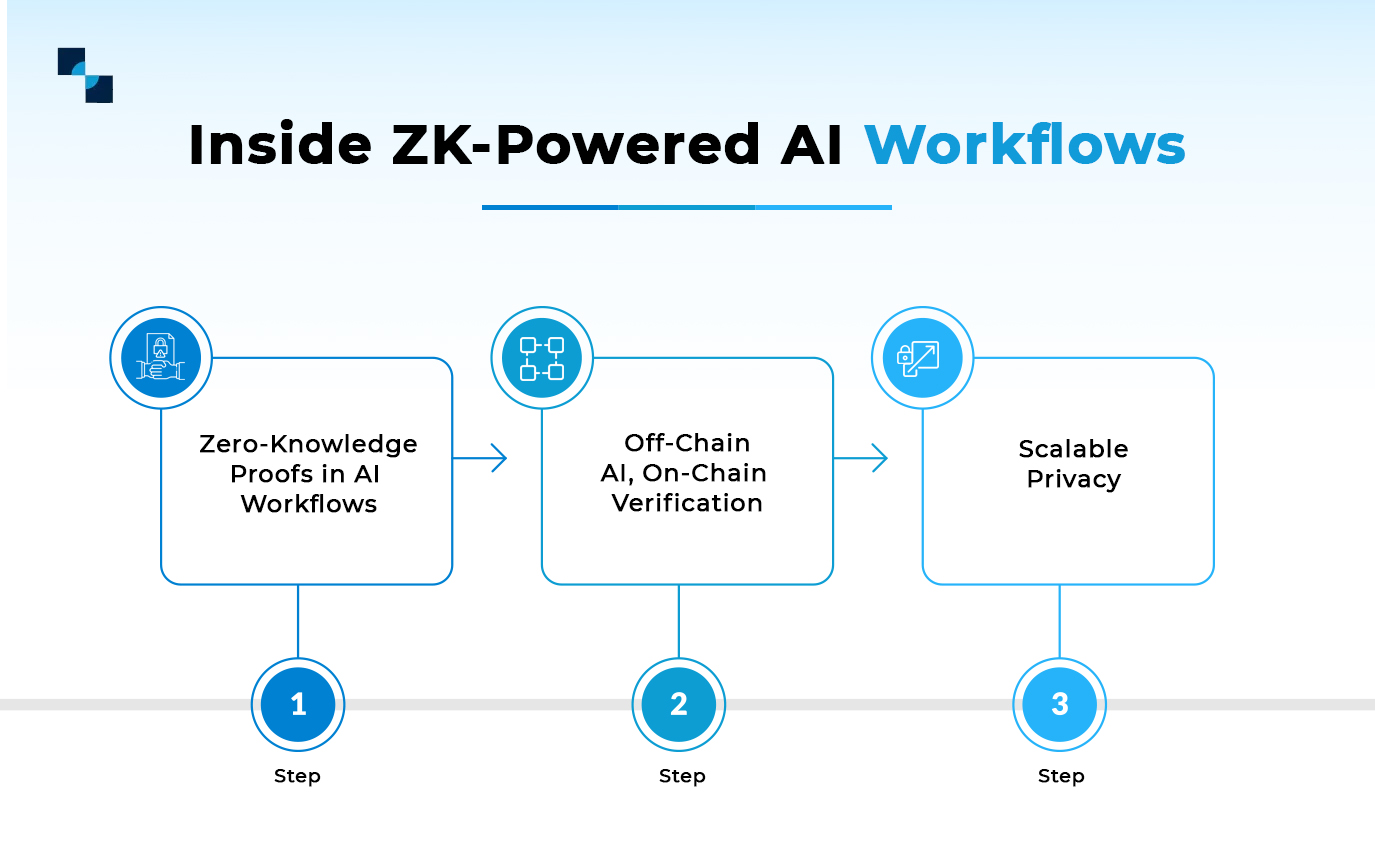
- Zero-Knowledge Proofs in AI Workflows
ZK proofs allow a system to prove that a computation is correct without revealing the underlying data.
In an AI context, this means:
- A model can generate predictions
- A proof confirms correctness
- No sensitive input data is exposed
This unlocks new possibilities for regulated industries where data sensitivity is critical.
- Off-Chain AI, On-Chain Verification
AI models typically run off-chain due to computational demands.
ZK Layer 2 enables:
- Off-chain model execution
- On-chain proof verification
- Immutable audit trails
This hybrid model ensures both efficiency and trust, allowing enterprises to scale without compromising on integrity.
Organizations adopting dApp Development strategies are increasingly leveraging this model to bridge the gap between high-performance AI systems and secure blockchain validation.
- Scalable Privacy
Unlike traditional blockchain systems, where data visibility can be a limitation, ZK ensures:
- Data confidentiality
- Selective disclosure
- Regulatory compliance
This makes it possible to deploy enterprise-grade systems without exposing critical information.
6 Layer Enterprise Architecture Blueprint for AI dApps
Building enterprise AI dApps on ZK Layer 2 requires more than integration. It demands a layered, modular architecture that balances performance, privacy, and verifiability across the entire system lifecycle.
Below is a production-ready blueprint that CTOs can use to design scalable and future-proof infrastructure.
- Data Ingestion Layer
This layer ensures secure and structured entry of enterprise data into the system.
- Secure API gateways for controlled data access
- End-to-end encryption applied at the source
- Role-based and attribute-based access control
- Data validation and normalization pipelines
- AI Execution Layer
The intelligence engine where models process enterprise data securely.
- Containerized AI/ML environments for flexibility
- Distributed compute support for large-scale workloads
- Secure enclaves or trusted execution environments
- Model versioning and lifecycle management
- ZK Proof Generation Layer
The core of trust where computations become verifiable without exposing data.
- Custom ZK circuits tailored for AI computations
- High-performance proof generation engines
- Parallelization and batching for scalability
- Optimization for reduced latency and cost
- Verification Layer
This layer ensures that every computation is provably correct.
- Smart contracts validating ZK proofs on-chain
- Automated triggers based on verified outcomes
- Immutable logging of verification results
- Integration with decentralized networks
- Application Layer
The interface where enterprise users interact with the system.
- Enterprise-grade dashboards and control panels
- API and SDK integrations with existing systems
- Real-time analytics and reporting tools
- Workflow automation interfaces
- Governance and Compliance Layer
The control system that ensures regulatory alignment and operational integrity.
- Policy enforcement frameworks
- Continuous compliance monitoring
- Audit trails with tamper-proof records
- Identity and permission management systems
Enterprises aiming for scalable and secure deployment typically partner with specialized dApp Development Services providers to ensure that each layer is engineered for interoperability, resilience, and long-term maintainability across evolving business and regulatory environments.
Start Your Enterprise dApp Journey with Proven ZK Infrastructure.
4 High-Impact Enterprise Use Cases
AI dApps on ZK Layer 2 are moving from experimentation to real-world deployment across industries where privacy, trust, and compliance are essential. Enterprises are using this architecture to build systems that deliver secure, verifiable, and intelligent outcomes at scale.
- Financial Systems: Financial institutions are leveraging AI dApps to detect fraud with verifiable outputs, validate transactions securely, and run confidential risk assessments without exposing sensitive data. This enables stronger security while maintaining compliance and auditability.
- Healthcare Platforms: Healthcare providers are adopting privacy-preserving AI systems for diagnostics, secure patient data processing, and reliable clinical data validation. These solutions ensure sensitive medical information remains protected while improving accuracy and trust.
- Supply Chain: In supply chains, organizations are enabling provenance tracking, real-time risk analysis, and secure logistics coordination. This allows transparency across stakeholders without revealing critical business data.
- Digital Identity: Enterprises are building decentralized identity systems with privacy-first authentication and compliance-ready frameworks. These solutions give users control over their data while ensuring secure and scalable verification.
These use cases highlight a clear shift. Enterprises are deploying AI dApps that combine intelligence, security, and trust to drive measurable business outcomes.
Performance Considerations CTOs Must Evaluate
ZK systems introduce new performance factors that require careful planning to ensure scalability, efficiency, and reliability in enterprise environments.
- Latency vs Security: Proof generation can impact response time, so optimizing circuits and processing is essential to maintain both speed and strong security.
- Cost Efficiency: Operational costs depend on how efficiently proofs are generated. Techniques like batching and optimized design help reduce compute expenses.
- Throughput: Scalability relies on handling high volumes of transactions smoothly, supported by rollups and efficient processing mechanisms.
- Infrastructure: Hybrid and cloud-native setups provide the flexibility and scalability needed for enterprise-grade deployment.
Addressing these factors early ensures smoother implementation and better overall ROI.
Final Thoughts: Architecture Defines Leadership
The future of enterprise systems will not be determined by features alone. It will be defined by trust, intelligence, and scalability.
AI delivers intelligence → ZK ensures trust → dApps enable execution.
Together, they form the foundation of next-generation enterprises. For high-value decision-makers like CTOs and enterprise leaders, the goal is clear. They are not looking for experimental solutions. They want production-ready architecture, data privacy assurance, seamless scalability, and long-term strategic advantage.
In this evolving landscape of Web3 and dApps, the demand is shifting toward robust, enterprise-grade dApp development services that go beyond prototypes. They need systems that are secure by design, compliant by default, and capable of evolving with future demands.
This is where partnering with an experienced technology provider like Antier becomes a strategic advantage. With deep expertise in AI, blockchain, and zero-knowledge systems, we help enterprises design and deploy scalable, enterprise-grade dApps that align with real business objectives. If you are planning to build intelligent, secure, and future-ready systems, now is the time to take action. Connect with Antier to architect your enterprise AI dApp on ZK Layer 2 and lead the next wave of digital innovation.
Frequently Asked Questions
01. What is the significance of trust and privacy in enterprise technology today?
Trust, privacy, and verifiability are crucial in enterprise technology as AI systems increasingly impact financial, medical, and operational decisions, necessitating secure and compliant decision-making processes.
02. How does ZK Layer 2 address the limitations of traditional and blockchain systems?
ZK Layer 2 combines scalability with confidentiality, allowing enterprises to process sensitive data securely while proving the correctness of outcomes through mathematically verifiable methods.
03. What are the key differences between traditional and emerging enterprise stacks?
Traditional stacks rely on centralized databases and black-box AI models, while emerging stacks utilize distributed data layers, verifiable AI, and cryptographic verification to enhance privacy, scalability, and compliance.