




AI Summary
- The blog post discusses the evolution from traditional smart contracts to AI-Driven Smart Contracts, which integrate artificial intelligence with blockchain technology to enable autonomous decision-making in real time.
- It highlights the limitations of traditional smart contracts such as lack of intelligence, adaptability, and difficulty handling real-world data, and explains how AI-enhanced contracts can address these challenges.
- The post emphasizes the convergence of artificial intelligence and blockchain to create Intelligent Smart Contracts that can analyze complex data, detect anomalies, optimize transactions, and adapt contract logic dynamically.
- It also explores the benefits of AI-Driven Smart Contracts in enhancing security, enabling data-driven decisions, and powering autonomous applications in various industries.
- Enterprises are increasingly investing in AI-Driven Smart Contracts services to automate business processes, enhance security, make data-driven decisions, and move towards autonomous digital ecosystems.
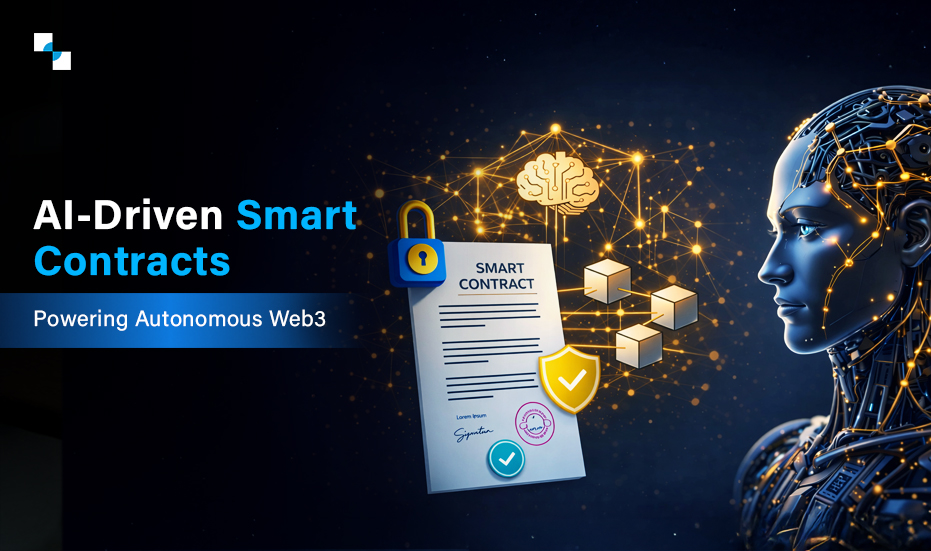
The next phase of digital transformation will move beyond simple automation to create autonomous digital systems capable of making intelligent decisions in real time. While blockchain smart contracts introduced trustless execution and transparency, they remain limited by rigid “if–then” logic that cannot analyze complex data, adapt to changing market conditions, or learn from past patterns. AI-Driven Smart Contracts address this limitation by integrating artificial intelligence with blockchain infrastructure. Through advanced AI Development Services, organizations can build Intelligent Smart Contracts that analyze real-time data, detect anomalies, optimize transactions, and dynamically adjust contract logic. These AI-powered contracts function as autonomous digital agents, enabling Decentralized AI Automation and forming the foundation of next-generation decentralized applications and intelligent Web3 ecosystems.
Why Traditional Smart Contracts Are No Longer Enough
Traditional smart contracts execute predefined instructions exactly as they are coded. A basic contract might contain a rule such as:
1. If Condition X Occurs → Execute Transaction Y
This deterministic automation introduced a major innovation in industries such as finance, insurance, and supply chain management. However, enterprises deploying smart contracts at scale have discovered several structural limitations.
2. Lack of Intelligence
Traditional smart contracts cannot interpret context or analyze complex datasets. They simply execute the logic embedded in their code and have no capability to evaluate broader business conditions. For example, a decentralized lending contract may automatically liquidate collateral during a market dip even if the dip is temporary because the contract cannot analyze broader market signals. Without artificial intelligence, contracts remain static systems that cannot reason, predict, or interpret external data patterns.
3. No Adaptability
Once deployed on a blockchain, smart contracts become immutable. While this immutability enhances security and trust, it also prevents contracts from adapting to new conditions. Business environments constantly evolve, yet traditional smart contracts cannot modify their rules based on emerging data or operational insights. In contrast, AI-driven systems can continuously learn from new inputs, allowing contracts to evolve and improve over time.
4. Difficulty Handling Real-World Data
Smart contracts rely on oracles to import external information such as market prices or sensor data. However, most oracles simply deliver raw data without interpreting it. When information becomes complex, such as supply chain analytics, financial indicators, or behavioral patterns, traditional contracts lack the analytical capabilities needed to process it. As a result, decentralized systems struggle to integrate real-world intelligence into their decision-making processes.
5. Limited Risk Awareness
Smart contracts cannot detect fraud, identify anomalies, or predict system vulnerabilities. Over the past decade, blockchain ecosystems have witnessed billions of dollars in losses due to contract vulnerabilities and exploits. Static contracts lack the intelligence needed to recognize suspicious activity or respond dynamically to emerging threats. These limitations create operational risks across industries, including finance, healthcare, digital commerce, and logistics. To overcome these challenges, organizations are increasingly adopting AI-Driven Smart Contracts Services that integrate artificial intelligence directly into decentralized execution environments.
The Convergence of AI and Blockchain
Artificial intelligence and blockchain represent two of the most powerful technological forces shaping the modern digital economy. Individually, each technology solves different problems.
Blockchain provides:
- Immutable transaction records
- Decentralized governance
- Transparent audit trails
- Secure data sharing
- Trustless execution of agreements
Artificial intelligence provides:
- Predictive analytics
- Pattern recognition
- Real-time decision intelligence
- Anomaly detection
- Automated optimization
When combined, these capabilities create Intelligent Smart Contracts capable of autonomous decision-making. AI enhances blockchain networks by enabling contracts to interpret data and adjust their behavior dynamically. Blockchain, in turn, strengthens AI systems by providing transparent and verifiable data sources. This synergy unlocks powerful new possibilities.
For example:
- AI algorithms can analyze decentralized finance markets and automatically adjust lending parameters.
- Smart contracts can monitor supply chain data and predict potential disruptions.
- Blockchain ledgers can provide verifiable training datasets for AI models, improving transparency and trust.
Together, these technologies form the foundation of Decentralized AI Automation, where distributed networks operate with minimal human intervention.
Why Enterprises Are Investing in AI-Driven Smart Contracts
Global enterprise adoption of AI-powered blockchain infrastructure is accelerating rapidly. Organizations are recognizing that combining artificial intelligence with decentralized systems enables new levels of automation, efficiency, and security. Several major trends are driving this shift.
- Intelligent Automation of Business Processes
Combining blockchain with AI dramatically reduces manual overhead. Multi-party business processes such as trade finance, insurance verification, and digital asset management can be automated through intelligent smart contracts. AI algorithms continuously analyze operational data while blockchain ensures transparent and secure execution. The result is faster transactions, reduced costs, and improved efficiency.
- Enhanced Security and Fraud Detection
Security remains one of the most critical challenges in decentralized ecosystems. AI introduces advanced threat detection capabilities that significantly strengthen the resilience of blockchain platforms. Machine learning models can analyze large volumes of historical blockchain data to identify abnormal transaction patterns and detect early indicators of potential exploits. By recognizing unusual behavioral signals, these systems can warn developers or automatically restrict suspicious activity before damage occurs.
In addition, AI systems can continuously monitor decentralized networks to detect vulnerabilities in smart contract logic, identify anomalous activity, and prevent fraudulent transactions in real time. This proactive intelligence layer greatly enhances the trustworthiness of AI-Driven Smart Contracts Services and strengthens the overall security of Web3 infrastructure.
- Data-Driven Decision Making
Modern digital economies rely on real-time data. AI-driven smart contracts can analyze financial signals, logistics data, user behavior, and market trends to make optimized decisions automatically. For example, A decentralized lending protocol can adjust interest rates based on predicted liquidity trends. An insurance platform can automatically trigger payouts when AI models detect qualifying environmental conditions.
- Transition Toward Autonomous Systems
The ultimate vision of Web3 is autonomy. AI-Driven Smart Contracts enable decentralized platforms to operate as self-governing digital ecosystems.
These contracts can:
- Update governance rules
- Trigger transactions automatically
- Rebalance digital economies
- Optimize operational workflows
This shift toward autonomous systems is one of the key drivers behind Decentralized AI Automation.
What Is AI-Driven Smart Contracts?
AI-Driven Smart Contracts are blockchain-based programs enhanced with artificial intelligence capabilities. Instead of executing rigid instructions, these contracts incorporate machine learning models, predictive analytics, and intelligent decision engines.
They can:
- Analyze complex data streams
- Detect anomalies and risks
- Dynamically modify contract conditions
- Optimize transaction execution
- Trigger automated workflows
In essence, these contracts function as autonomous digital agents operating within decentralized networks. By integrating AI models with blockchain infrastructure, developers can create decentralized applications that continuously adapt to new information and optimize their behavior. This evolution transforms Web3 platforms from passive systems into intelligent digital economies.
Solving Real Enterprise Challenges with AI-Driven Smart Contracts
Organizations adopt emerging technologies when they solve real operational problems. AI-Driven Smart Contracts address several major enterprise challenges.
- Eliminating Operational Inefficiencies
Many enterprise processes still rely on fragmented systems and manual verification. AI-enabled smart contracts automate these workflows by:
- Verifying conditions automatically
- Analyzing operational data
- Executing transactions instantly
This significantly reduces delays and operational overhead in complex multi-party transactions.
- Preventing Fraud and Security Vulnerabilities
Blockchain networks frequently manage high-value digital assets and mission-critical business operations, making risk management essential. AI-powered analytics help enterprises mitigate these risks by continuously monitoring decentralized environments. These systems can identify suspicious transaction behavior, flag abnormal patterns across blockchain networks, and detect vulnerabilities within smart contract architectures.
Unlike traditional static contracts, AI-enhanced systems can adapt to emerging threat patterns and respond dynamically to potential attacks, significantly improving platform resilience. As a result, enterprises implementing AI-Driven Smart Contracts Services gain a stronger security framework capable of protecting digital assets, operational workflows, and decentralized applications.
- Enabling Data-Driven Decisions
Traditional contracts execute predefined rules but lack the analytical capabilities required to process complex multi-source data. Because of this limitation, they struggle to interpret insights derived from financial markets, logistics systems, customer behavior, and operational analytics.
AI-Driven Smart Contracts overcome this limitation by integrating advanced data intelligence directly into decentralized execution environments. These contracts can analyze diverse data sources in real time, identify patterns, and trigger optimized actions automatically.
For example, an AI-enabled contract can evaluate liquidity trends in decentralized finance markets, assess supply chain performance metrics, or monitor customer activity patterns to determine when a transaction should be executed. By transforming raw data into actionable intelligence, Intelligent Smart Contracts enable decentralized systems to operate with far greater efficiency, accuracy, and strategic decision-making capabilities.
- Powering Autonomous Applications
The long-term vision of Web3 extends beyond automation toward self-optimizing decentralized applications that require minimal human intervention. AI-Driven Smart Contracts play a critical role in enabling this transformation. By combining artificial intelligence with blockchain execution, decentralized platforms can evolve into intelligent systems capable of continuously analyzing operational data and optimizing their behavior automatically.
These systems can:
- Adjust operational parameters dynamically
- Trigger transactions based on predictive insights
- Optimize digital asset flows within decentralized ecosystems
- Coordinate complex multi-party workflows without centralized control
Through these capabilities, Autonomous Smart Contracts Solutions are enabling the development of decentralized applications that can operate, adapt, and evolve independently.
Real-World Industry Applications
AI-Driven Smart Contracts are already being explored across multiple sectors.
- Decentralized Finance
AI models analyze borrower risk and market volatility to automatically adjust lending conditions.
- Supply Chain Networks
Smart contracts verify logistics data and automatically release payments once delivery conditions are confirmed.
- Insurance Platforms
AI algorithms analyze environmental data and trigger automated payouts when policy conditions are met.
- Real Estate Transactions
Blockchain contracts automate escrow management and property verification processes.
- Digital Identity Systems
AI enhances identity verification through biometric and behavioral analytics while blockchain ensures secure credential storage.
Explore the Future of Autonomous Smart Contracts Today!
The Role of an AI Development Company
Implementing AI-powered decentralized infrastructure requires deep expertise across multiple domains. A specialized AI Development Company provides the technical capabilities required to design, deploy, and scale intelligent blockchain ecosystems. Such organizations combine expertise in artificial intelligence, blockchain engineering, cybersecurity, and data architecture to deliver advanced decentralized solutions. Through comprehensive AI Development Services, enterprises can:
- Design intelligent decentralized applications
- Build Autonomous Smart Contracts Solutions
- Integrate AI decision engines with blockchain networks
- Secure smart contract infrastructure against evolving threats
By partnering with an experienced AI Development Company, organizations can accelerate the deployment of AI-Driven Smart Contracts Services and unlock powerful new opportunities across Web3 ecosystems.
Challenges Enterprises Must Solve
Despite their potential, implementing AI-driven smart contracts presents several technical challenges.
- Scalability
AI models require significant computational resources, which can strain blockchain infrastructure.
- Data Integrity
AI decision accuracy depends on reliable data sources. Ensuring trustworthy inputs remains critical.
- Governance
Autonomous systems must still comply with regulatory frameworks and organizational policies.
- Security
AI models themselves must be protected from manipulation or adversarial attacks.
Advancements in decentralized compute networks and AI infrastructure are gradually addressing these challenges.
The Future: Autonomous Digital Economies
The next evolution of Web3 will move beyond decentralized applications toward fully autonomous digital economies. These ecosystems will include:
- AI-driven financial systems
- Self-governing decentralized organizations
- Intelligent supply chain networks
- Autonomous digital marketplaces
Within these environments, AI-Driven Smart Contracts will function as the decision-making layer of Web3. They will continuously analyze data, optimize operations, and coordinate distributed resources without centralized control.
Smart Contracts Were the Beginning. AI-Driven Autonomous Systems Are the Future.
The convergence of artificial intelligence and blockchain is redefining the future of decentralized technology. What started as programmable automation is now evolving into Intelligent Smart Contracts capable of learning, adapting, and making autonomous decisions in real time. For enterprises building next-generation digital infrastructure, adopting AI-Driven Smart Contracts Services is becoming a strategic necessity. Through advanced AI Development Services, organizations can unlock the power of Autonomous Smart Contracts Solutions, Intelligent Smart Contracts, and Decentralized AI Automation.
As Web3 ecosystems mature, platforms that combine blockchain’s trust with AI’s intelligence will lead the next wave of innovation. Antier, a leading AI Development Services provider, helps enterprises build secure, scalable, and intelligent decentralized systems powered by AI-driven smart contracts.