



AI Summary
- In the blog post, the importance of cross-chain UX in Web3 crypto wallets is emphasized, highlighting the shift towards unified experiences across multiple blockchain networks.
- Users now expect seamless movement and management of assets without the hassle of bridge hops or repetitive prompts.
- The post explains the significance of cross-chain UX in modern wallet infrastructure, emphasizing coherence and simplicity for both novice users and institutional teams.
- It delves into the benefits of cross-chain UX wallets compared to traditional wallets and bridge-first flows, emphasizing user-friendly experiences and increased security measures.
- The post also outlines the key industries that can benefit from investing in cross-chain UX wallets and provides valuable insights on selecting the right development company.
Cross-chain UX is no longer a “nice to have” in Web3; it is now the difference between a crypto wallet app that feels powerful and one that feels painful. As blockchains multiply, users expect one account, one flow, and one clear path to move, swap, sign, and settle across networks without getting lost in bridge hops or repetitive prompts. That expectation is rising alongside a broader shift toward multichain accounts, passkeys, smart accounts, and simpler onboarding patterns that reduce the friction of seed phrases and repeated setup steps. The real opportunity is not just connectivity but coherence: making complex on-chain activity feel intuitive enough for first-time users and efficient enough for institutional teams that demand speed, control, trust, and long-term scale now.
What Are Cross-Chain UX Crypto Wallets?
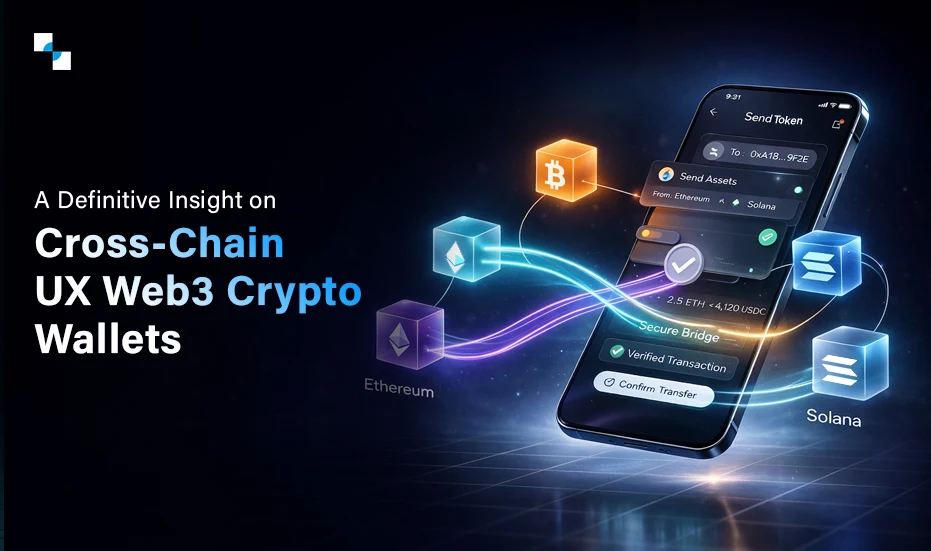
Cross-chain UX Web3 crypto wallets are built to make blockchain activity feel unified, even when the assets and actions live across different networks. Instead of forcing users to think chain by chain, they present one coordinated experience for connecting, signing, moving assets, and managing balances across ecosystems. That idea aligns with the direction of modern wallet infrastructure: multichain APIs, multichain accounts, and one connection flow for multiple chains rather than a separate setup for each network.
In practical terms, this means the cryptocurrency wallet development solution becomes the experience layer, while the user simply sees a cleaner journey. For enterprise teams, that is important because the wallet is no longer only a vault; it is a conversion surface, a retention tool, and the first serious trust checkpoint in the product journey.
Why Does Cross-Chain UX Matter in Web3?
The cross-chain world is powerful, but it is also fragmented. Coinbase notes that cross-chain transactions are inherently asynchronous and carry technical overhead, which is exactly why poor UX can slow adoption even when the underlying technology is sound. Users do not care how elegant the architecture is if every interaction feels like a workaround.
A strong cross-chain UX crypto mobile wallet removes that friction by hiding unnecessary complexity behind guided actions, smart permissions, and simplified session handling. In the current market, this matters even more because users are no longer satisfied with “wallet support”; they expect a wallet to behave like a platform.
Cross-Chain UX Wallet vs Traditional Wallet vs Bridge-First Flow
| Experience layer | Cross-chain UX wallet | Traditional single-chain wallet | Bridge-first flow |
|---|---|---|---|
| User journey | One guided experience across networks | Separate actions per chain | Move first, use later |
| Complexity | Hidden behind smart flows | Moderate, but chain-limited | High, because routing is manual |
| Security posture | Can add passkeys, smart accounts, delegated permissions | Usually simpler, but less flexible | Often fragmented across apps and steps |
| Best fit | Enterprises, multichain apps, modern consumer onboarding | Narrow chain-specific use cases | Users who already know the bridge and chain sequence |
The pattern is simple: cross-chain UX wallets are designed to reduce cognitive load, while bridge-first journeys often increase it. That is why modern wallet development stacks are moving toward multichain accounts and one-prompt flows, rather than asking users to repeatedly re-learn the same system.
Why Do Cross-Chain UX Wallets Have the Upper Hand?
Cross-chain UX rich crypto wallet platforms have the upper hand because they match how users actually think. Most people do not wake up wanting to “bridge”; they want to buy, move, pay, trade, mint, or interact without friction. A wallet that removes unnecessary chain management becomes a conversion engine, not just a storage tool.
They also win because security and usability no longer have to fight each other. Consensys noted that a significant share of users do not back up seed phrases, which is a real onboarding and recovery problem. Passkeys, smart accounts, and backup signer approaches are being used to close that gap while keeping the experience smoother.
Finally, cross-chain UX wallets are better aligned with the broader Web3 security reality. Chainalysis has repeatedly highlighted that blockchain threats evolve quickly, including cross-chain bridge hacks and wallet-draining phishing campaigns, which makes safer onboarding and cleaner permission design more than a convenience feature.
Start Building a Scalable Cross-Chain Wallet Now!
Who Must Invest in a Cross-Chain UX Crypto Wallet?
Being familiar with the pros and cons is okay, but knowing who should invest is more important.
- Web3 & Multichain Startups
Building across chains? You need a unified wallet UX to reduce drop-offs and simplify user journeys. - Crypto Exchanges & Trading Platforms
Faster onboarding + seamless asset movement = higher conversion and retention. - Fintech & Payment Companies
To offer frictionless crypto payments without exposing users to chain complexity. - DeFi & Liquidity Platforms
Cross-chain UX minimizes friction in swaps, bridging, and yield flows. - Gaming & Consumer dApps
Smooth onboarding and session continuity are critical for mass adoption. - Enterprises & Institutions
Need advanced security (smart accounts, passkeys) with operational control. - Investors & Infrastructure Builders
Wallet UX is a high-impact layer driving adoption, retention, and long-term value. - Web2 Brands Entering Web3
To deliver familiar, intuitive experiences while transitioning users on-chain.
Bottom line: If your business depends on user onboarding, transactions, or multichain interaction, a cross-chain UX blockchain wallet is a strategic investment, not a feature.
Security, Recovery, and Compliance Cannot Be Treated as Add-Ons
For enterprise-grade cross-chain crypto wallets, these are not optional enhancements. They are the foundation of trust, usability, and scale.
- Security must be built into every transaction flow, permission layer, and signature process from the start. A wallet that handles assets across chains must reduce risk, not introduce it.
- Recovery must be simple enough for real users to rely on. Seed phrases alone are no longer enough for mainstream adoption. Passkeys, backup methods, and smart recovery options are now critical.
- Compliance must be considered early, especially for businesses operating in regulated markets.
Audit readiness, identity controls, and policy alignment help the wallet scale without creating legal or operational friction.
In short: a cross-chain wallet is only enterprise-ready when security, recovery, and compliance are built into the architecture—not added later as fixes.
How to Choose the Right Cross-Chain Crypto Wallet Development Company?
- Start with product thinking, not just tech claims- The right team should understand your use case—payments, DeFi, gaming, or enterprise—not just offer generic wallet features.
- Validate real cross-chain capability- Look for proven experience in handling multiple chains, transaction flows, and seamless UX—not just “multi-chain” as a buzzword.
- Assess security as a core discipline- A credible partner will design permissions, signing flows, and risk controls from the ground up—not treat security as an afterthought.
- Check their approach to user recovery- Modern web3 crypto wallets require more than seed phrases. Ensure they can implement practical recovery mechanisms like passkeys or multi-layer backups.
- Evaluate compliance readiness (if applicable)- If your business touches regulated markets, the team should be capable of aligning with KYC, AML, and audit requirements.
- Demand customization flexibility- Your wallet should reflect your product strategy. Avoid teams that push rigid, one-size-fits-all solutions.
- Review their delivery maturity- Look for a structured process, clear timelines, defined milestones, testing rigor, and post-launch support.
- Think beyond launch- The right partner builds for scale- new chains, higher user loads, and evolving features, without requiring a rebuild later.
Choose a wallet development team that combines product understanding, technical depth, and long-term thinking, not just one that promises fast delivery.
Make Cross-Chain UX Your Strongest Product Advantage With Antier
Cross-chain UX is no longer a secondary feature in Web3; it is becoming the core interface through which users judge the value of a cryptocurrency wallet, a platform, and ultimately a brand. The projects that will lead this market are not the ones that merely support multiple chains on paper but the ones that make multi-network activity feel seamless, intuitive, and almost invisible to the user. In today’s landscape, simplicity, guided flows, secure recovery, and frictionless movement across chains are not decorative enhancements. They are the product advantages that shape adoption, retention, and long-term commercial success.
That is exactly where Antier stands out. For businesses that want to build beyond basic wallet functionality and create a truly enterprise-ready cross-chain experience, our certified team brings the depth, structure, and specialization needed to turn vision into execution. With a legal-aware team, certified experts, and strong command over AI and blockchain, our firm is built to help businesses move confidently from Web2 into Web3 without unnecessary complexity or delays. Our white label wallet modules, customization-first approach, and end-to-end delivery model make it possible to launch faster, align the product with exact business needs, and deliver a wallet experience that is not only technically robust but also ready for scale from day one.
Frequently Asked Questions
01. What is Cross-Chain UX in crypto wallets?
Cross-Chain UX refers to the design of Web3 crypto wallets that create a unified experience for users, allowing them to connect, sign, move assets, and manage balances seamlessly across different blockchain networks without the need for separate setups.
02. Why is Cross-Chain UX important in Web3?
Cross-Chain UX is crucial because it simplifies complex blockchain interactions, reducing friction for users and enhancing adoption. A strong UX ensures that users can navigate the wallet easily, making it feel like a cohesive platform rather than a fragmented experience.
03. How does Cross-Chain UX differ from traditional wallets?
Unlike traditional wallets that may require separate setups for each blockchain, Cross-Chain UX wallets provide a coordinated experience across multiple networks, streamlining user interactions and making the wallet a central tool for both individual and enterprise users.