



AI Summary
- The blog post discusses the current liquidity issues in the global financial system and how digital asset tokenization is revolutionizing traditional markets.
- It highlights the benefits of tokenizing assets, such as increased liquidity, fractional ownership, and 24/7 trading capabilities.
- The post emphasizes the importance of a high-performance tokenization infrastructure model, compliance, and regulatory considerations.
- It also mentions the rapid growth of tokenized assets and the need for enterprises to adapt quickly to the changing landscape.
- The blog concludes by emphasizing the importance of staying ahead in the tokenization race and highlights Antier as a trusted digital asset tokenization development company.
The global financial system has liquidity issues and most businesses haven’t fully felt it yet. Trillions of dollars in real estate, private equity, commodities, art, and infrastructure are stuck in illiquid, siloed markets.
You have a $40 million commercial property, and a serious buyer in Germany wants 20% of it. Now, you need to call a lawyer, who will call a notary, and then you need to render an apostille. Many times, the wire transfer hits a compliance hold, and to add to the complexity, your investor’s accreditation paperwork may expire mid-process.
Why?
It’s not because the deal isn’t real, not because the money isn’t there, but because the infrastructure connecting willing buyers to willing sellers was designed decades before the internet existed.
What has changed?
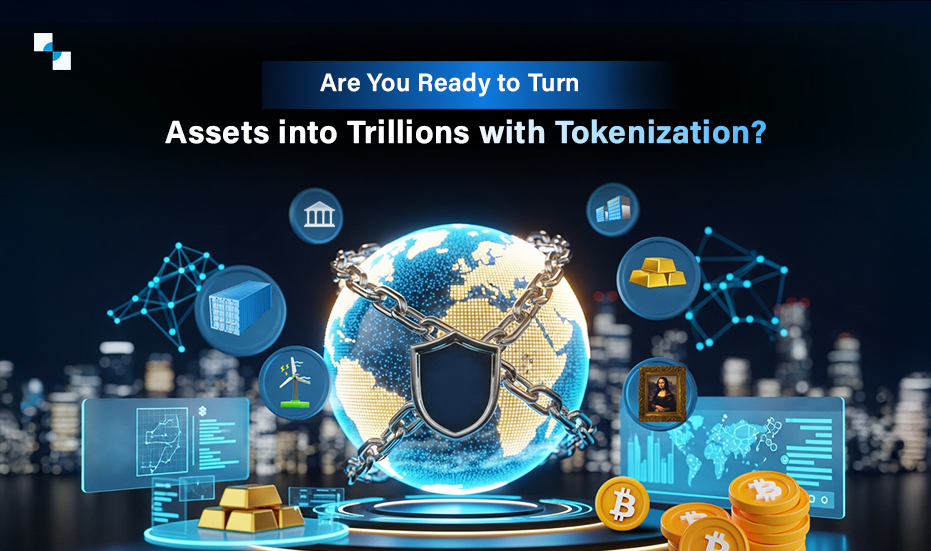
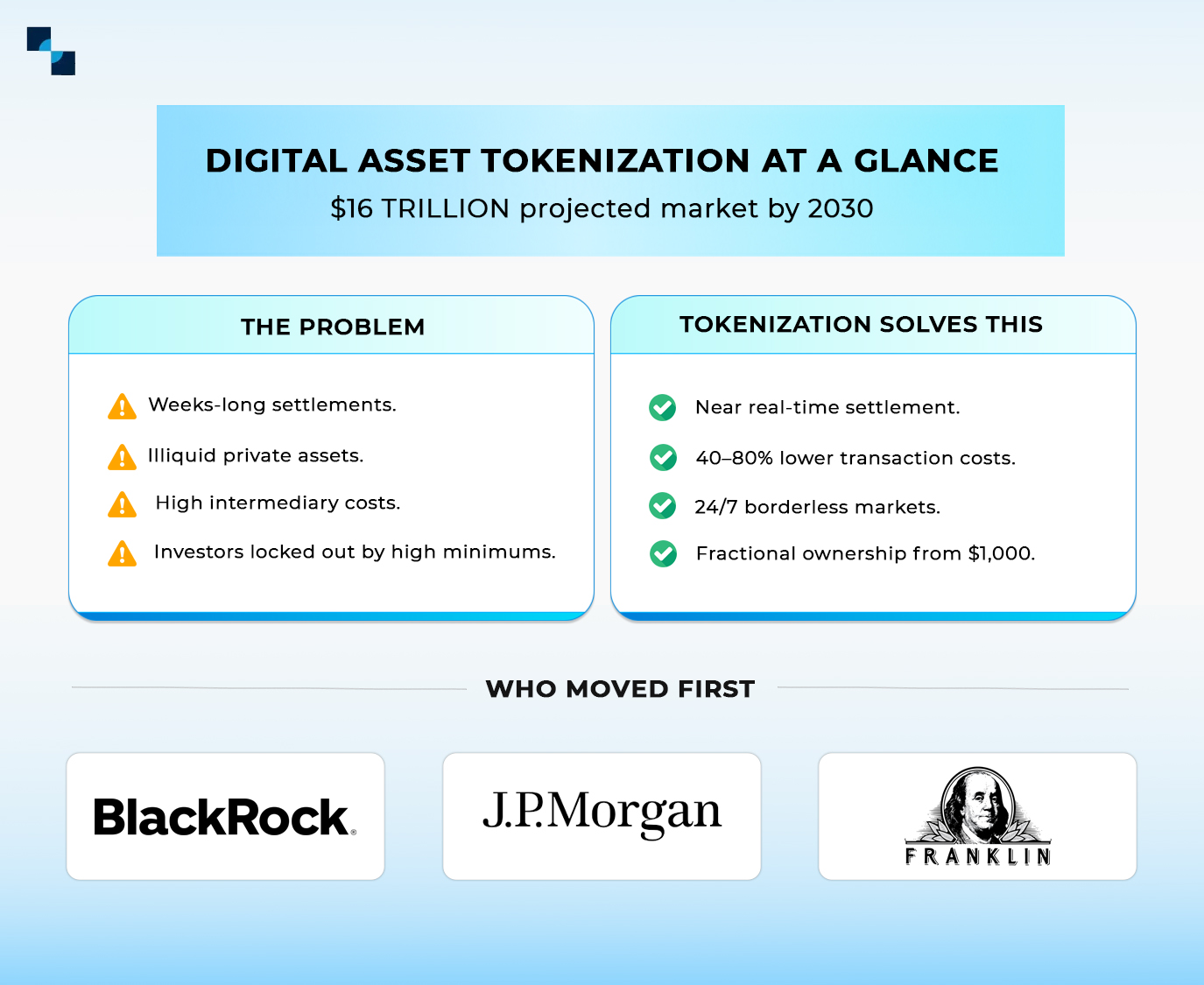
Digital asset tokenization is dismantling that infrastructure and replacing it with something faster, smarter, and genuinely global. BlackRock, JPMorgan, and Franklin Templeton didn’t pour resources into tokenization because it was trendy. They did it because the numbers are undeniable, a projected $16 trillion in tokenized assets by 2030, per BCG and ADDX. The race is already on. The only question is how to write your success story.
What If Every Asset Could Be Traded Like a Stock?
REITs (Real Estate Investment Trusts) get credit for democratizing real estate, and fair enough. They opened up an asset class that was previously closed to most investors. However, what you’re buying with a REIT is a fund. You’re two layers away from the actual property, paying management fees for the privilege, and accepting that someone else decides what goes in and what comes out of the portfolio.
Digital asset tokenization goes straight to the asset level. A portfolio manager can hold a direct fractional position in a Mumbai cold-chain facility, a Nairobi infrastructure bond, and a São Paulo residential development, each one distributing yields automatically, each one tradeable, all of it visible in one place. That’s not a fiction. Structures like this are live in enterprise deployments today.
Investment minimums that used to start at $250,000 or more can drop to $1,000 without any compromise to deal structure or regulatory compliance. Your investor pool doesn’t grow incrementally; it expands by an order of magnitude.
Instead of four or five large fund allocations, you can hold fractional stakes across dozens of assets and sectors, all managed through a single digital asset infrastructure. Rather than the 3–7 year lockups that make private fund units feel like a one-way door, tokenized fractions transfer in minutes. That changes the calculus for allocators who’ve historically avoided private markets because they couldn’t afford to be stuck.
The caveat, and it’s an important one, is that fractional tokenization is only as good as the structure underneath it. A good digital asset tokenization development company doesn’t just write smart contracts. It architects token structures that account for the real legal, tax, and regulatory environment of the underlying asset. That’s the difference between a tokenization strategy that scales and one that quietly creates problems down the line.
Is Digital Tokenization the Key to 24/7 Markets?
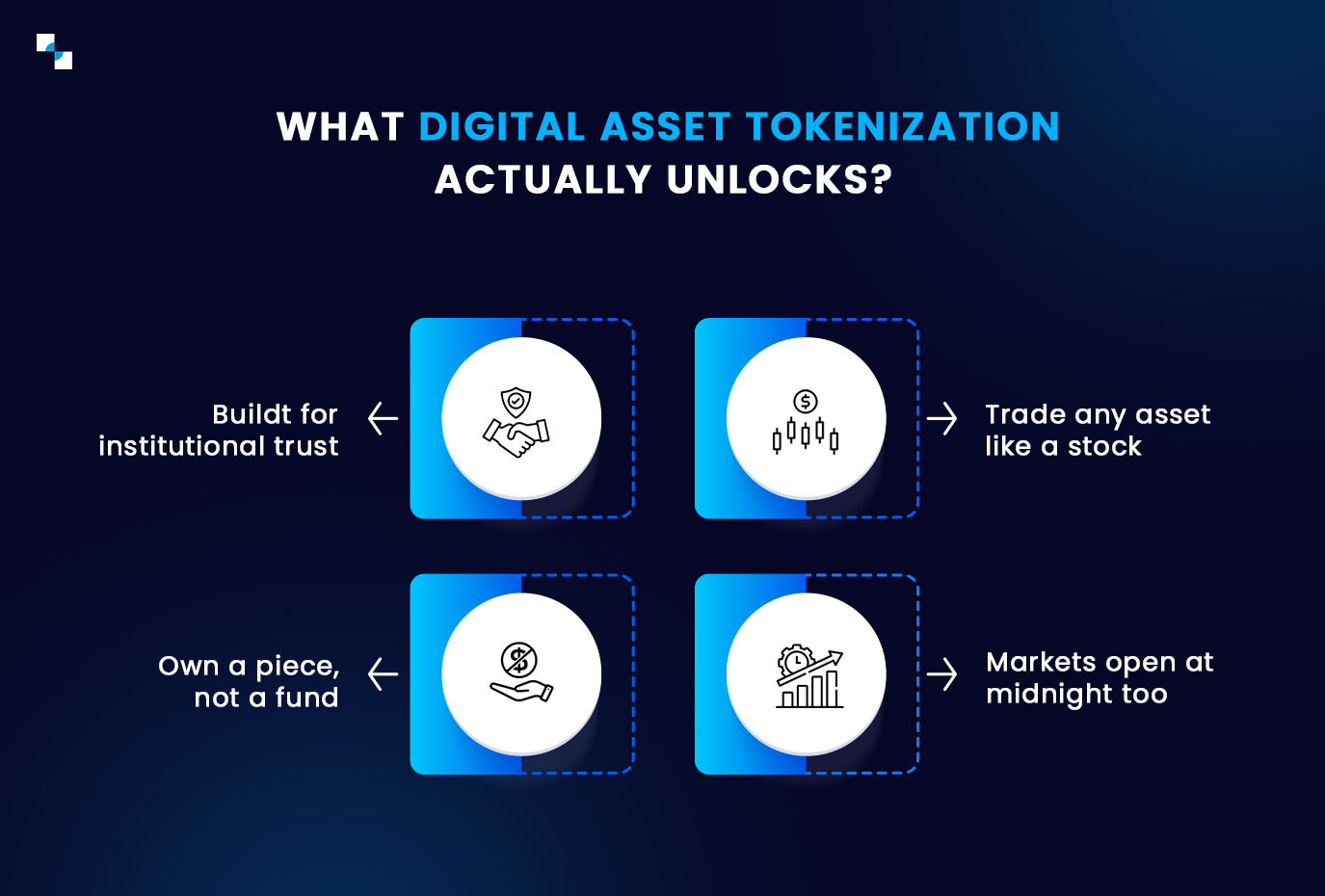
Traditional markets close. Tokenized markets do not.
A fund manager waiting until Tuesday to clear a Friday trade is not dealing with bad luck, but with an infrastructure that was never built for speed. Tokenized assets trade on compliant secondary platforms at any hour, across any time zone. Smart contract execution can cut transaction costs by 40 to 80 percent by removing intermediary layers entirely.
Delivery versus Payment logic, built into the tokenization infrastructure architecture, moves the asset and payment in a single transaction with no settlement gap, no exposure, no reserve capital held in waiting. For assets like private credit, infrastructure debt, and venture equity, where secondary markets barely exist digital asset tokenization doesn’t just enhance liquidity; it actually makes trading these assets possible in the first place.
The tokenization infrastructure model comprising of cross-chain architecture, compliance, and custody, is what makes that possible at institutional scale.
What If You Could Own a Fraction of Everything?
A REIT gives investors access to real estate, but what they are actually buying is a fund — separated from the underlying asset by a layer of management, fees, and decisions that belong to someone else. Digital Asset Tokenization removes that intermediary entirely. It creates direct fractional ownership of a specific asset, with yields distributed automatically and ownership transferable without the friction of a traditional secondary transaction.
A portfolio manager operating with the right Digital Asset Infrastructure can hold fractional positions across a logistics facility in Mumbai, an infrastructure bond in Nairobi, and a residential development in São Paulo — each generating on-chain distributions, each tradeable, all within a single platform. These structures are in live deployment today. The concept is not theoretical.
Investment minimums that once started at $250,000 can fall to $1,000 without compromising deal structure or regulatory integrity — transforming, not merely expanding, the available investor pool. Lock-up periods that once made private market participation a multi-year commitment shorten considerably when ownership transfers in minutes rather than months.
The quality of outcome depends on the quality of structure. A credible Digital Asset Tokenization Development company builds token architectures that account for the actual legal, tax, and regulatory environment of the underlying asset — not just the mechanics of the smart contract. That distinction determines whether a fractional tokenization strategy scales cleanly or creates problems it cannot easily resolve.
What Defines a High-Performance Tokenization Infrastructure Model in 2026?
In early days of tokenization, when someone used to deploy a basic ERC20 token on Ethereum, and write a basic smart contract, it was termed a tokenized asset. It was fine for conferences, but completely unfit for institutional capital.
In 2026, the bar is much higher. The deployments are live, operating across several chains, dealing with multi-jurisdictional compliance in real-time, and working with institutional custodians, all while providing investor-grade reporting that does not require a team of people to generate. The tokenization infrastructure model that enables all of this is layered, modular, and designed for evolution, as regulations will continue to shift and so will the blockchain world.
A production-ready digital asset infrastructure exists across Ethereum, Avalanche, and Polygon, as well as with permissioned networks such as Hyperledger Fabric and R3 Corda. You route assets where liquidity is deepest and regulatory conditions are most favorable. Such kind of flexibility requires multi-chain architecture from the start, not as an afterthought. Enterprise-grade systems are structured in distinct, independent tokenization infrastructure layers, which includes token issuance, compliance engine, custody interface, investor management, secondary market rails. When regulations evolve, you update the relevant layer, not the whole stack.
Compliance doesn’t get bolted on after the fact. KYC/AML, transfer restrictions, and jurisdictional whitelisting belong inside the tokenization infrastructure architecture from the first line of code. Those who learn this lesson post-deployment usually learn it through an enforcement action. Additionally, every smart contract powering the tokenization infrastructure layers needs independent security audits before it touches real capital. One vulnerability in a live contract isn’t a technical inconvenience, it’s a news cycle that damages trust you spent years building.
The enterprises that will matter in tokenized capital markets are the ones who built the most trustworthy tokenization infrastructure model, and then quietly let it work.
Are You Too Late to the $16 Trillion Tokenization Race?
No, you are never late, but “not too late” isn’t the same as “plenty of time,” and anyone telling you otherwise is being charitable.
BlackRock’s BUIDL fund crossed $500 million in tokenized assets faster than any launch in the firm’s history. JPMorgan’s Onyx platform has cleared hundreds of billions in tokenized transactions. The on-chain tokenized asset market reached USD 1,756.58 billion in 2025. Sovereign wealth funds in Abu Dhabi and Singapore are running live infrastructure debt pilots. This needs no proof that tokenization is working. The enterprises building relationships and infrastructure right now are on the success pathway, and that’s what the latecomers will have to accept.
The compliance landscape has cleared considerably. MiCA in the EU, VARA in the UAE, MAS frameworks in Singapore. Real and actionable regulatory pathways exist now in ways they simply didn’t two years ago.
Working with a forward-thinking digital asset tokenization development company in 2026 means starting from proven infrastructure components, not reinventing the wheel. What took two years of development in 2020 takes a fraction of that time today.
The harder reality is the competitive gap. Every month that goes by, your competitors who entered the market before you are strengthening their relationships with investors, improving the tokenization infrastructure architecture, and gaining familiarity with institutions that takes time to achieve. That gap is real and it compounds. When you look at the demand side, institutional allocators are looking for tokenized alternatives right now. The bottleneck isn’t buyers. It’s issuers with the infrastructure to meet them.
Launch your Digital Asset Tokenization Platform Faster with Us
Concluding Thoughts
Trillions in capital are trapped behind slow settlement, high costs, and outdated infrastructure. Digital Asset Tokenization fixes that by enabling 24/7 markets, fractional ownership, and near real-time settlement on a compliance-ready digital asset infrastructure.
The institutions that recognized this earliest have already moved. The regulatory clarity is here, and the investor demand is real.
Ready to provide a platform for tokenization?
Antier is a globally trusted digital asset tokenization development company with deep expertise across tokenization infrastructure layers and smart contract architecture, delivering production-grade digital asset infrastructure across five continents.
Frequently Asked Questions
01. What are the current liquidity issues in the global financial system?
The global financial system faces liquidity issues with trillions of dollars stuck in illiquid, siloed markets, affecting real estate, private equity, commodities, art, and infrastructure.
02. How does digital asset tokenization improve the investment process?
Digital asset tokenization streamlines the investment process by allowing direct fractional ownership of assets, reducing investment minimums, and enabling faster, more transparent transactions without the traditional complexities.
03. What is the projected value of tokenized assets by 2030?
The projected value of tokenized assets is expected to reach $16 trillion by 2030, according to research from BCG and ADDX.