





✨ AI Summary
- Prediction markets have transformed from a fringe experiment to an integral part of the web3 app ecosystem, with notional trading volumes in the sector rising by over 300% from $15.8 billion in 2024 to $63.4 billion in 2025.
- This blog post examines Hyperliquid's HIP-4, an upgrade that pivots the protocol into prediction-style, event-based trading.
- HIP-4 is a technical framework that enables developers to start fully collateralized prediction markets and non-linear derivatives on the Hyperliquid layer 1.
- It extends the permissionless model to binary event markets with higher stake requirements.
- The blog also discusses the benefits and drawbacks of staking 1M HYPE to launch a market on Hyperliquid, suggesting that building your own prediction market ecosystem could be more advantageous.
Prediction markets have changed their status quo from being a fringe experiment to a web3 app essential module. Notional trading volumes in the sector grew from $15.8 billion in 2024 to $63.4 billion in 2025, a more than 300% increase, as per Coingecko’s 2025 industry report. An analysis from gaming analytics firm, Blask, also reveals a 2X spike in the prediction markets-related search interest during 2025-2026.
The prediction market is not plateauing but accelerating.
- Polymarket and Kalshi generated around 85-90% of the total notional prediction markets trading volume in 2025.
- Monthly trading volumes by the end of 2025 remained above $13 billion, setting a firm foundation for higher growth in 2026.
- In February 2026, Kalshi processed a record of $9.8 billion in monthly volumes while Polymarket hit its own $7 billion record, a 7.5 YoY increase.
- The week of April 6-11, 2026, was the strongest ever for prediction markets when $3.54 billion was traded over Kalshi and $2.48 billion on Polymarket, in a single week.
Besides the growth patterns projected above, Bernstein’s projected $1 trillion prediction market opportunity by 2030, and a wave of firms are planning their Polymarkets or Kalshi-style platforms. Against this backdrop, Hyperliquid released HIP-4, its outcome contract upgrade that formally pivots the protocol into prediction-style, event-based trading.
What is HIP-4, How Does It Work & What It Changes
Definition
Hyperliquid Improvement Proposal-4, abbreviated as HIP-4, is a technical framework that brings outcome contracts on the hyperliquid layer 1. It allows developers to launch fully collateralized prediction markets and non-linear derivatives like options, directly on its native Central Limit Order Book (CLOB).
The progression is clear that Hyperliquid is building a general-purpose financial platform layer by layer, in which crypto, commodity, spot, perpetuals, and outcome contracts run on the same execution engine.
HIP-1 established the native unit of account for the Hypercore chain.
HIP-2 introduced the Hyperliquid Liquidity Pool (HLP) vault that enhanced liquidity
HIP-3 opened up perpetual futures market creation to participants willing to stake HYPE, enabling broader market expansion.
HIP-4 extends the same permissionless model to binary event markets, with higher stake requirements. It brought prediction markets on Hypercore, allowing participants to leverage hyperliquid’s token, matching, liquidity, and execution infrastructure by staking 1M HYPE.
The introduction of prediction markets to Hyperliquid L1 introduces new optionality and functionality to the Hyperliquid protocol. It expands HyperCore’s capabilities while allowing builders on HyperEVM to build new primitives and protocols that interact with both outcome markets and the recently introduced portfolio margin mechanism. As of April 2026, no mainnet launch date for HIP-4 has been confirmed.
How Does HIP-4 Work
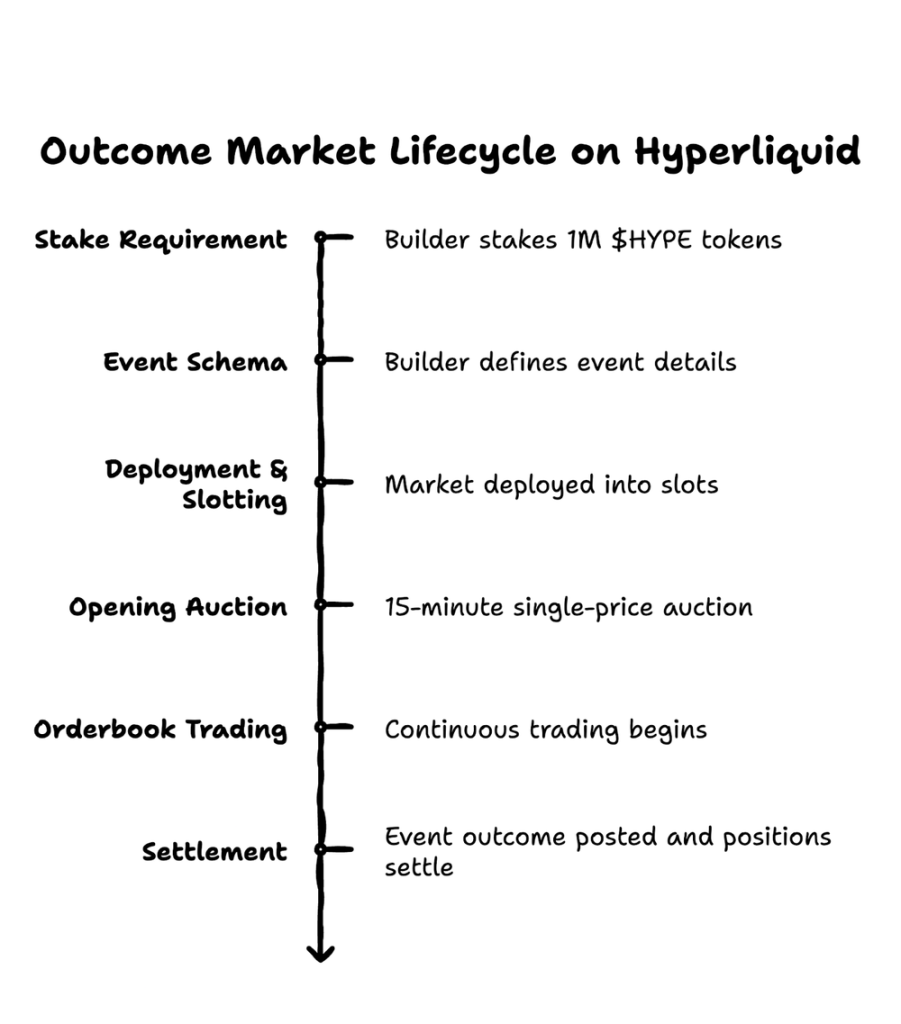
- A builder stakes 1M HYPE to initialize a market with specific oracle parameters.
- The builder defines event details, and the market is deployed into slots.
- The price discovery phase establishes initial liquidity.
- Real-time buying/selling of “Outcome Tokens” takes place.
- The oracle resolves the event, and the contract pays out exactly $1$ USDH per winning share.
Each HIP-4 outcome contract trades between $0.001 and $0.999, where the price directly reflects the market’s implied probability that the specified event occurs. A contract priced at $0.72, for example, means the market collectively believes there is a 72% chance the event resolves as true.
Key Technical Advantages of HIP-4
- No Liquidations: Fully collateralized positions eliminate liquidation risk, even during high volatility.
- CLOB-Based Engine: High-performance matching (up to 200K orders/sec), unlike AMM-based systems.
- Composable Design: Supports options-like payoffs and event markets, integrated with portfolio margin.
Naturally, every operator, builder, and exchange-curious founder immediately asked the same question after HIP-4 release on testnet, “How do I get in on this”
But that’s actually the wrong question because once one understands what HIP-4 actually gives you, and what it doesn’t, a smarter question emerges:
Why stake $45M to rent a slot in someone’s ecosystem, when you can build your own at 20X lower cost?
What Staking 1M HYPE Actually Gets You (And What It Doesn’t)
Builders stake their 1M HYPE tokens to launch their outcome contract market on Hyperliquid. They’re responsible for:
- Choosing market topics
- Setting parameters such as settlement time and oracle provider
- Managing market operations, including liquidity bootstrapping and marketing
When trading begins on their event markets, they also earn up to 50% of their market’s trading fees. But builders deploying their decentralized prediction market platforms on Hyperliquid are doing everything inside the Hyperliquid house on Hyperliquid’s infrastructure, and under Hyperliquid’s rules. You’re bringing liquidity yourself for your prediction markets but are actually strengthening Hyperliquid’s ecosystem.
Their stake in Hyperliquid’s ecosystem is slashable in case someone attempts to manipulate the oracle or trigger any invalid state transitions. And any partial or fully slashed HYPE will be burned.
So let’s be precise and clear about the trade-off:
When you stake 1M HYPE, you are buying a slot, which is a license to deploy outcome contract markets inside Hyperliquid’s ecosystem. You leverage their CLOBs, their liquidity engine, their settlement infrastructure. But you are a tenant, and you own none of it.
The Real Cost Comparison: Staking 1M HYPE vs. Building Your Own Cryptocurrency Prediction Platforms
| Factor | Staking 1M HYPE To Deploy Prediction Markets on Hyperliquid | Building Your Own Prediction Ecosystem with Antier |
| Capital Outlay | $45M (1M HYPE locked, not spent) | $1M–$2M (development cost, fully owned) |
| Capital at Risk | Yes Stake is slashable and burnable | No You own the infrastructure outright |
| Infrastructure Ownership | No Hyperliquid’s CLOBs, their rules | Yes Your CLOB, your DEX, your markets |
| CLOB Control | Hyperliquid’s matching engine | Your own order matching engine |
| Market Listing Authority | Subject to HIP-4 schema requirements | Full authority, you can list any event you want |
| Fee Structure | Up to 50% of fees Rest goes to Hyperliquid | You get 100% of your platform’s fee revenue |
| Oracle Design | Your responsibility, Hyperliquid’s framework | Full control over defining resolution sources |
| Tokenomics | No native token possible | Launch your own token, governance, and staking |
| Frontend / Brand | You must build your own, no Hyperliquid UI | Your brand, your UX, your user relationships |
| Slash Risk | Yes, 100% of the stake can be burned | None |
| Mainnet Dependency | Waiting on Hyperliquid’s timeline | Launch your cryptocurrency outcome contracts on your own schedule |
| Platform Governance Exposure | High Subject to protocol changes | None |
| Product Scope | Prediction markets only | Spot DEX + Perpetuals + Prediction Markets |
The table speaks for itself. The $45M route saves your prediction market’s spot on Hyperliquid, and in a fraction of this crypto prediction market deployment cost, you can own the ecosystem.
What Does It Actually Mean To Own A Prediction+Exchange Ecosystem?
When Antier builds your sovereign event trading market ecosystem with spot/perpetuals trading, they’re not building on Hyperliquid but actually building another Hyperliquid for you. This full ownership decentralized crypto prediction market development approach gets you the following:
- Your Own CLOB
The CLOB is the heart of any serious trading platform. Hyperliquid’s chain currently supports 200,000 orders per second, and every order, cancellation, trade, and liquidation happens transparently on-chain.
When you build your own CLOB-based decentralized exchange software with Antier, you get that same architecture facilitating high-performance order matching, price-time priority, deep order book, etc., operating under your brand and control.
- Your Own DEX (Spot, Perpetuals, and Prediction Markets Under One Roof)
If outcome trading gains traction on Hyperliquid, it would become the only platform in crypto offering spot trading, perpetual futures, and prediction markets natively on a single execution layer. No centralized or decentralized competitor currently matches this offering.
You can actually build exactly this combination yourself with Antier. They deliver a full-stack CLOB-based decentralized exchange software that can feature spot trading, perpetual futures, and prediction markets, all in one ecosystem, that you actually own. You don’t need Hyperliquid’s permission or their timeline, nor do they have any control over your prediction platform.
- Your Own Oracle Design
One of the most technically demanding parts of HIP-4 is oracle management. The builder defines the event schema, which contains the specific conditions that determine whether the contract settles at 0 or 1. This includes title, resolution time, resolution source, Oracle details, authorized updates, and an optional challenge window.
When you build with Antier, your Oracle architecture is designed for your specific use case and is not constrained by third-party protocol requirements.
- Your Own Revenue Model
On Hyperliquid, you earn up to 50% of your market’s fees. The other 50% flows back to the protocol on which your crypto prediction platform operates.
On your own platform, every basis point of fee revenue is yours. You design the fee structure. You capture the revenue, and only you decide how it compounds.
- No Slashing. No Waiting. No Governance Risk.
500k to 1M HYPE is a meaningful stake that helps you deploy your prediction platforms on Hyperliquid among well-capitalized teams. Even after putting such huge capital at stake, risk remains throughout operations.
When you build sovereign CLOB DEX infrastructure for crypto, RWA, spot, perpetuals, etc., there is nothing to slash. No governance vote can change your rules. There is no mainnet launch date you are waiting on.
The Hyperliquid Tenant vs. Sovereign Owner: A Direct Comparison
| Feature | HIP-4 Tenant | Sovereign Owner |
| Launch Prediction Markets | Yes, inside Hyperliquid | Yes, on your own platform |
| Own Exchange Infrastructure | No | Yes |
| Run Spot & Perpetuals | Not via HIP-4 | Yes, full DEX |
| Keep 100% Fee Revenue | Max 50% | Yes |
| Launch Your Own Token | Not applicable | Yes, full tokenomics |
| Control Market Listings | Within HIP-4 rules | Fully |
| Choose Branding/UX | Must build separately | Fully branded |
| Capital at Risk | $45M locked, slashable | No capital at risk |
| Time to Market | Wait for the mainnet launch | Ship on your timeline |
| Independence | Exposed to governance risk | Fully sovereign |
The Market Opportunity You’d Be Capturing With Custom Decentralized Crypto Prediction Market Development
As of 2026, the trading volume on Polymarkets and Kalshi has been increasing consistently. The graph below from the token terminal shows the mounting monthly prediction market trading volumes during 2025-2026.
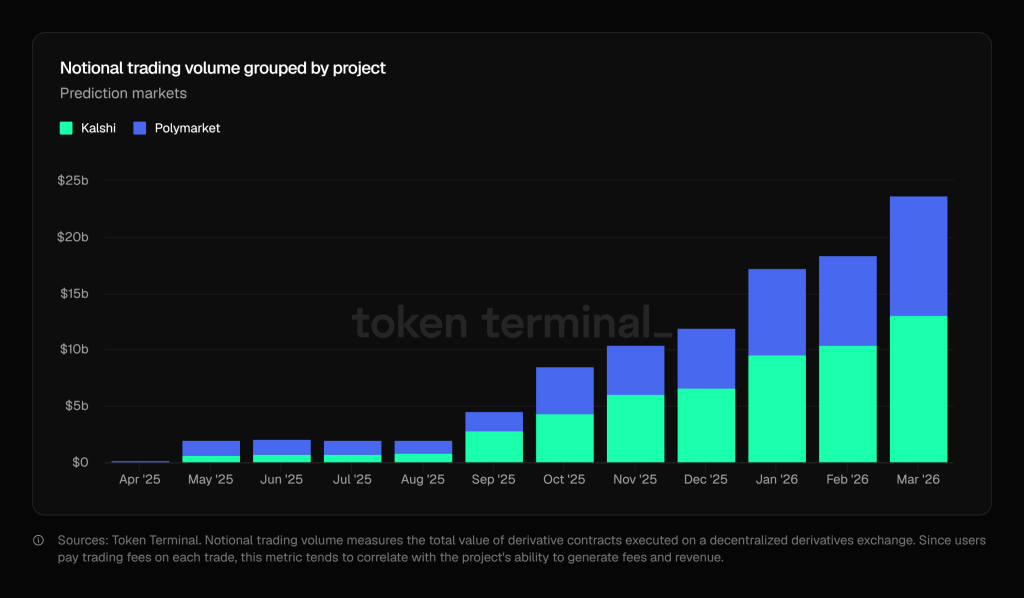
The cryptocurrency prediction platforms capturing this volume don’t have permission from anyone, as they operate individually and own the infrastructure. They own their own users and keep their revenue without giving anyone a share.
Similarly, operators who own their infrastructure will be positioned to capture surging retail and institutional flows as they arrive. Tenants on Hyperliquid will be sharing those flows and the fee revenue with the protocol.
Who Should Be Making This Move Right Now
A sovereign prediction platform development with Antier is the right move for:
- Crypto-Native Teams with dedicated sports, politics, DeFi events, RWA, and entertainment Verticals. If you have domain expertise and a community, the platform should be yours to monetize entirely.
- Exchanges Looking to Add Prediction Markets. If you already run spot or derivatives trading and want to add prediction markets as a product line, Antier’s stack integrates event contract trading platform modules with existing exchange infrastructure.
- TradFi and Fintech Companies Entering On-Chain Derivatives. The regulated entry point into on-chain outcome markets is through owning your infrastructure and your compliance stack. Renting a slot could lose your prediction market’s spot anytime Hyperliquid makes a regulatory mistake.
- Web3 Startups Raising Capital. A sovereign CLOB DEX + prediction market platform is a fundable, defensible product, and a tenant position on Hyperliquid’s infrastructure is clearly not.
- Existing Event Contracts Trading Platforms that want to graduate from being a front-end on top of someone else’s infrastructure and own the full stack, order book, settlement, oracle, UI, and revenue.
The Rise of Industrial-Grade Prediction Primitives
| Entity | The “Industrial” Move | The Infrastructure Choice | Strategy Label |
| Binance | Integrated Predict.fun | BNB Chain (DApp) | The Gateway: Aggregating others’ liquidity to minimize their own risk. |
| Kraken | Acquired Bitnomial | Own Clearinghouse | The Fortress: Full vertical integration and total fee capture. |
| Hyperliquid | Launched HIP-4 | L1 Native CLOB | The Landlord: Building the “rails” so others have to pay them to trade. |
| OKX | Institutional Margin Integration | Partnered with Ripple (RLUSD) to allow stablecoins as margin collateral for event-based derivatives. | Utility: Prediction markets are now used as a hedge for spot/perp portfolios. |
| Crypto.com | Launched “OG” App | Standalone Sovereign | The Specialist: Creating a separate brand for event-driven retail. |
| Robinhood | 8.8 Billion Contracts Traded | Launched a dedicated “Prediction Markets Hub” for politics, sports, and economic data. | Record Volume: 320% YoY growth in “Event Contract” revenue. |
| Bybit | AI-Driven Consensus Ratings | Integrated real-time “AI Sentiment” and historical patterns into their price-prediction tools. | Engagement: Moving from simple “bets” to “data-driven intelligence.” |
| Bitget | The “Fintech Disruption” Pivot | Positioned prediction markets as the bridge between high-growth fintech and digital banking. | Growth: Reported a 78% annual rise in “Other Transaction Revenue” (Prediction/RWA). |
| DraftKings | “Predictions” Vertical Launch | Intermediated FCM Model (Transitioning to proprietary Tech Stack via Railbird Tech) | The Hybrid Giant: Moving from state-regulated betting to federally-regulated (CFTC) financial trading. |
| Drift Protocol | Drift BET (Bullish on Everything) | Solana V3 Native CLOB (Cross-margin with perps and spot) | The Capital Efficiency King: Using 30+ assets as collateral to create a sub-second, high-frequency prediction hub. |
| B3 Brazil Stock Exchange | Launched Bitcoin Event Contracts | Regulated Exchange Infrastructure (CVM Authorized) | The Sovereign Monopolist: Used local regulation to block global competitors (Polymarket/Kalshi) and capture the domestic market. |
The Window Is Now, And It Won’t Stay Open Forever
Bernstein analyst Gautam Chhugani estimates that total market volumes in 2026 will reach $240 billion, a 370% YoY increase. He also expects an 80% CAGR during 2025-30, with transaction volumes estimated to be $1 trillion during early 2030. The prediction market is already poised to reach those heights.
Growth in prediction markets from less than $100 million per month in early 2024 to more than $13 billion by the end of 2025 represents a 130-fold increase.
For operators, this means that the capital is flowing and users are arriving. The question is how you enter, as a tenant or as an owner. Operators who own sovereign crypto and event contract trading infrastructure right now will compound advantages that tenants never can.
What Antier Delivers
Antier is a full-stack blockchain and exchange development firm with deep expertise in building CLOB-based exchanges and trailblazing DeFi protocols. If you’re planning to build your sovereign CLOB-driven prediction market ecosystem designed to compete directly with the architecture that made Hyperliquid a dominant force in decentralized derivatives, Antier delivers the following:
- High-performance CLOB matching engine (spot + perpetuals + prediction markets)
- Binary outcome contract framework with fully collateralized markets
- Oracle integration and event schema design
- Liquidity bootstrapping framework
- Admin dashboard and market management tooling
- Full frontend branded for your platform, optimized for your users
- Native token architecture and tokenomics design
- HyperEVM-compatible smart contract layer for composability
With less than $4M investment and an 8-16 week prediction platform development timeline, you can own everything outright.
Don’t become another builder on Hyperliquid; Capture the $1 trillion market potential with your own CLOB and execution engines. Share your project requirements today!
Frequently Asked Questions
01. What are prediction markets and how have they evolved recently?
Prediction markets are platforms where participants can trade on the outcomes of future events. They have evolved from a fringe experiment to a crucial web3 application, with trading volumes increasing from $15.8 billion in 2024 to $63.4 billion in 2025, marking over a 300% growth.
02. What is HIP-4 and what does it introduce to the Hyperliquid platform?
HIP-4, or Hyperliquid Improvement Proposal-4, is a technical framework that enables the launch of fully collateralized prediction markets and non-linear derivatives on the Hyperliquid platform. It allows for the trading of binary event markets using Hyperliquid's token.
03. Which platforms dominated the prediction markets trading volume in 2025?
Polymarket and Kalshi dominated the prediction markets in 2025, generating around 85-90% of the total trading volume, with monthly volumes consistently exceeding $13 billion by the end of the year.