




✨ AI Summary
- In this blog post, the transition from tokenized equities to equity perpetuals is explored in the cryptocurrency exchange market.
- While tokenized equities allowed for on-chain trading, equity perpetuals offer continuous price exposure without ownership limitations.
- The shift towards equity perpetuals is driven by increased demand for leveraged trading strategies and capital efficiency across asset classes.
- Cryptocurrency exchanges are expanding into offering equity perpetuals to attract new trader segments and increase revenue streams.
- This transition changes market structures by enabling continuous price discovery, shifting liquidity towards derivatives, and making capital fully composable across markets.
For a brief moment, it looked like tokenized equities had solved it by:
- Bringing stocks on chain
- Enabling 24/7 access
- Globalizing participation without traditional brokerage barriers
And the numbers backed it up, $32 million in Jan 2025 to $363 million in Jan 2026, a staggering 2878% YoY jump.
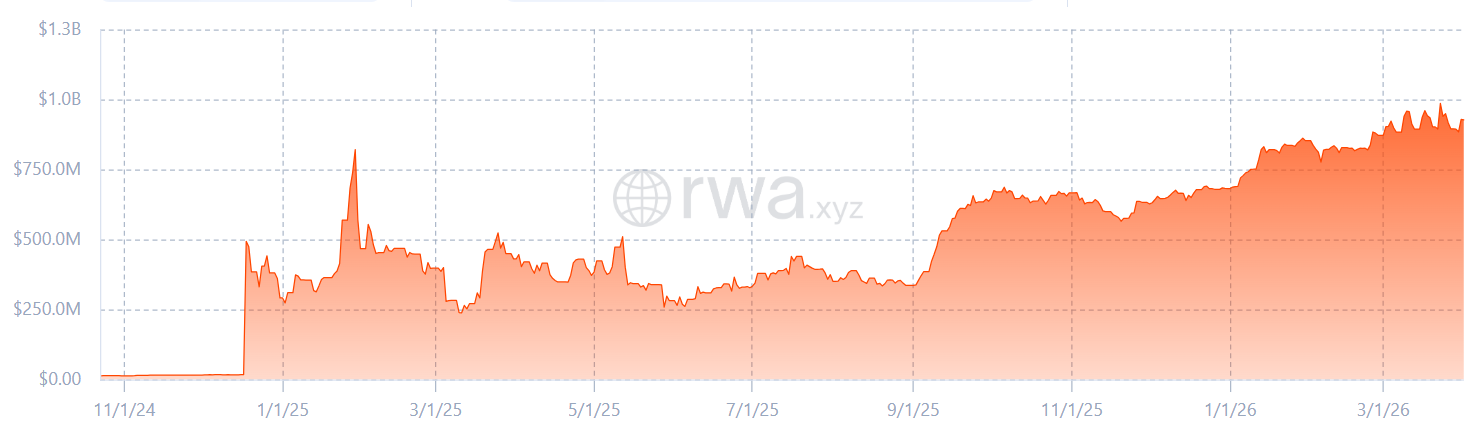
Platforms like xStocks cut across $25 billion in cumulative trading volumes, with daily volumes stabilizing around $80 million. This was, however, characterized by xStocks Deutsche Borse expansion, its launch on TON wallet and its integration within Alpaca’s brokerage-as-a-service.
It might look like a mass adoption pattern but in reality, it was a validation of demand that was not fulfilled yet. Because despite being on crypto rails, tokenized equities never fully escaped the traditional market structure. Here’s why:
- Pricing anchored to off-chain equities, even after they are available on crypto exchange software.
- Liquidity dropped sharply outside market hours (weekend volumes falling to $30 million
- Dependency on custodians, oracles, or synthetic tracking remained even after decentralization
“This means you can buy oil stocks at 3AM on your crypto exchange but you’ll be trading the shadow of yesterday’s close.”
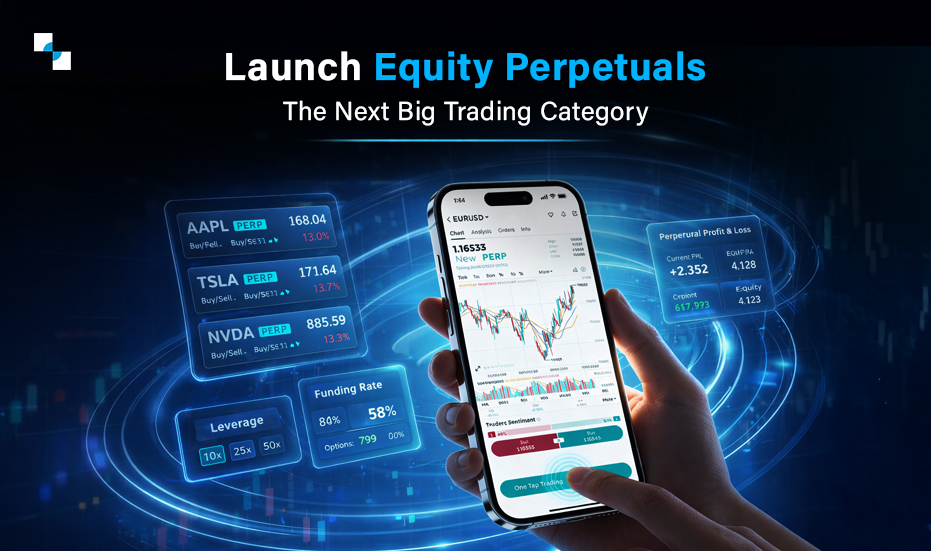
Equity perpetual swaps change the game. Major cryptocurrency exchange software like OKX, Binance, Coinbase, etc. are expanding beyond tokenized stock swaps into perpetual markets, where exposure replaces ownership, and trading is independent of external market structures.
What Are Equity Perpetuals?
Definition
Equity perpetuals are derivative contracts allowing traders a continuous price exposure to stocks without ownership boundations. Instead of buying shares, traders open long or short positions on a contract that tracks the stock’s price, using crypto or stablecoins as collateral. These “no expiry date” contracts use a funding rate mechanism, where periodic payments between traders keep the prices aligned with the underlying equity.
“From a trading perspective, they function as a continuously active market for stock exposure, rather than a representation of stock itself.”
Core Mechanics of Equity Perpetuals
- No expiry or settlement cycles: Positions can be held indefinitely on perpetual crypto exchange software, without rollovers or contract expirations.
- Funding rate mechanism: Prices stay aligned with the underlying asset through periodic payments between long and short traders.
- Crypto-collateralized margin: Traders use crypto assets instead of fiat as their collaterals, enabling cross-asset capital efficiency.
- Continuous pricing: Markets operate 24/7, driven by trader activity rather than exchange-defined sessions.
- No ownership dependency: There is no requirement to hold or custody the actual stock. Traders can simply place their wagers on the price.
Most traders are already familiar with crypto derivatives. So, cryptocurrency exchange software can easily integrate equity perpetuals since they behave similarly. They can offer faster, capital-efficient, and leverage-enabled equity perpetual trading and benefit from enormous liquidity that remains concentrated in derivatives.
Tokenized Equities Vs Equity Perpetuals: What Changes
To understand why popular exchanges like Binance, OKX, Kraken, etc. are moving toward equity perpetuals, it helps look at how they both differ at structural level.
| Aspect | Tokenized Equities | Equity Perpetuals |
| Core Model | Representation of a stock (backed or synthetic) | Derivative tracking stock price |
| Ownership | Implied (direct or synthetic exposure) | No ownership—pure price exposure |
| Pricing Source | Anchored to underlying market (NYSE/Nasdaq) | Driven by trader activity + funding rates |
| Trading Hours | 24/7 access, but weak price discovery off-hours | Continuous price discovery, independent of market hours |
| Settlement | Required (custody, redemption, or rebalancing) | No settlement layer |
| Collateral | Fiat or stablecoins (mostly) | Crypto-native (BTC, ETH, etc.) |
| Primary Use Case | Access to equities | Trading, hedging, speculation |
| Market Dependency | External (traditional markets) | Internal (exchange-driven) |
What Does This Shift Actually Imply
The comparison above highlights how equity perpetuals differ structurally from tokenized equities. But more important is to know what changes when multi asset trading platforms start offering equity perpetuals instead of tokenized equities.
Traditional equity markets, including tokenized versions, are built around ownership as the end goal. That’s how their lifecycle goes:
Traders Buy the Asset -> Hold It -> Settle It -> Transfer It
Even when equities move onchain, the market structure logic doesn’t change; custody and settlement models remain intact. It just simply becomes more accessible. Pricing remains anchored to traditional markets.
Equity perpetuals, similar to the crypto derivatives, are designed around continuous trading, leverage, liquidity rotation, and short-term positioning, not ownership.
- Positions replace ownership.
- Pricing is driven by market participants, not external exchanges.
- Markets operate continuously, without dependency on settlement cycles.
This aligns very closely with how crypto markets already function. Equities, therefore didn’t introduce a new behavior but extended an existing one to a new asset class.
“Tokenized equities brought stocks into crypto.
Equity perpetuals make stocks behave like crypto. – Always Tradeable, Margin-Based, Position-Driven and Independent of Settlement Cycles”
Build the Next-Gen Equity Market with Perpetual Futures Infrastructure
Why Are Crypto Exchange Software Moving Toward Equity Perpetuals?
- Increased Demand for Perps
Crypto markets are not built for long-term ownership but active trading strategies. Traders prioritize leverage, short exposure, and hedging across positions. Spot ownership is often secondary to capital rotation and volatility capture. This is why perpetual futures already dominate trading volumes. As per Coingecko’s latest 2026 report, perps trading volumes grew by 75% over the past two years, with DEX share expanding by 50%.
By extending the same model to equities, crypto exchange software can offer traders more such instruments, helping them diversify their portfolios.
- Capital Efficiency Across Asset Classes
Equity perpetuals remove one of the biggest inefficiencies in traditional finance, that is capital fragmentation. When crypto exchange software onboard equity perpetuals, users can trade equities using BTC, ETH, or stablecoins and maintain a single margin account across assets. This reduces capital fragmentation and also enhances user experience since users no longer have to off-ramp into fiat or move capital between brokerages and exchanges.
Popular exchanges like OKX and Binance are already enabling this unified collateral model by creating a trading environment where capital moves freely across markets, not institutions.
- Perpetuals Are A Superior Revenue Engine
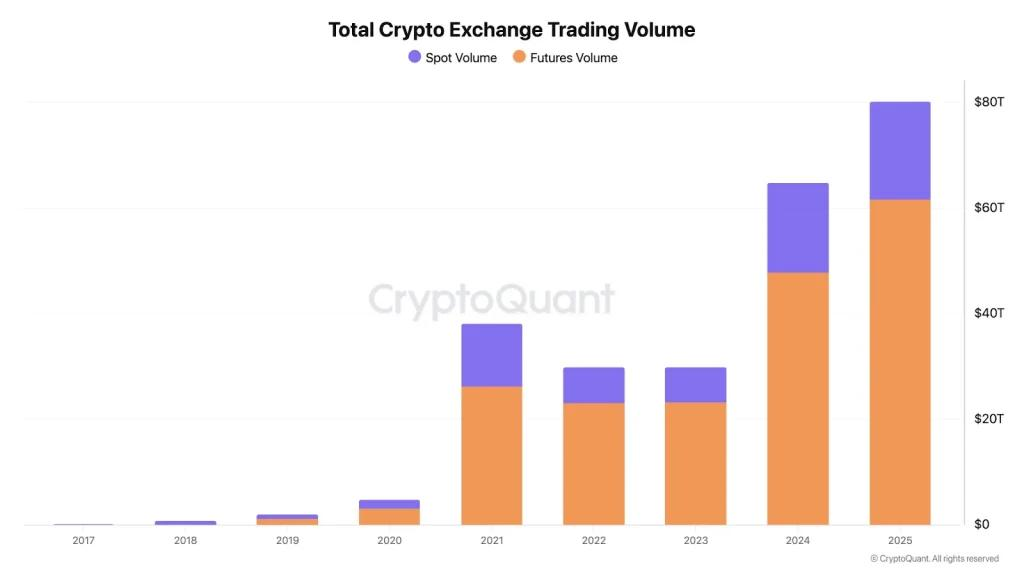
From a crypto exchange developer or entrepreneur’s perspective, this is straightforward. Perpetual futures generate higher trading frequency, continuous funding fees and deeper liquidity pools as compared to spot or tokenized equity markets. Users trade more actively on perpetual futures crypto exchanges, positions stay open for longer and liquidity compounds instead of fragmenting. This is the reason why derivatives already account for the majority of trading activity across major exchanges.
Equity perpetuals extend that same revenue model into a new and widely known asset class, increasing chances for its adoption.
- Expanding Beyond Crypto Into Equities
Cryptocurrency exchanges are no longer competing only within crypto. They are expanding into RWAs such as equities, commodities, etc. Equities represent a significantly larger addressable market and have an established demand and volatility. By offering equity perpetuals, exchanges can attract new trader segments, increase cross-asset participation and position themselves as multi asset trading platforms.
This isn’t about adding a new feature or a listing but expanding the scope of a crypto exchange software itself.
The Shift Is Already Rolling Playing Out Across Crypto Exchanges
This transition toward equity perpetuals, as mentioned above, isn’t isolated or still an experiment. Leading cryptocurrency exchanges are launching equity derivatives within weeks of each other in early 2026.
Top Cryptocurrency Exchanges That Launched Equity Perpetuals
| Exchange | Status / Launch Date | Max Leverage | Key “Equity” Feature | Primary Assets Offered |
| OKX | Launched (Mar 24, 2026) | 5x | Yield-Bearing Collateral: Use BTC, ETH, or staked assets as margin while they still earn yield. | Mag 7, MSTR, COIN, HOOD, SPY Index |
| Binance | Launched (Mar 26, 2026) | 10x | Deep Liquidity: Focused on high-volume USDⓈ-Margined contracts for major tech. | NVDA, META, GOOGL (Expanding) |
| Coinbase | Launched (Mar 20, 2026) | 10x | Institutional Grade: Available via Coinbase International; 24/7 synthetic exposure with USDC settlement. | Mag 7, SPY, QQQ (Non-US only) |
| Kraken | Launched (Feb 24, 2026) | Varies | xStocks Integration: Uses tokenized digital representations of stocks for 24/7 trading in 110+ countries. | US Stocks, Indices, Gold ETFs |
| Bybit | Launched (Early 2026) | 10x | Pre-Market Perpetuals: Ability to trade price action of companies before they officially IPO. | Tech Equities, RWA (Oil/Gold), Pre-IPO |
| Deribit | Launched (Feb 27, 2026) | 20x | HFT Infrastructure: New high-frequency trading nodes designed specifically for equity volatility. | NVDA, TSLA, Equity & Crypto Indices |
| Bitget | Launched (Mar 31, 2026) | 10x | Universal Exchange (UEX): A single interface bridging 2M+ crypto tokens with 100+ tokenized stocks. | 100+ Tokenized Stocks, ETFs, FX |
| Backpack | Announced (Mar 23, 2026) | TBD | Equity Staking: $BP token holders can eventually convert tokens into company equity milestones. | Tech and Crypto-correlated equities |
This isn’t a product trend but a convergence toward a derivatives-first equity market.
How Equity Perpetuals Are Changing Market Structure?
- Price Discovery Is Moving Beyond Traditional Market Hours
In traditional markets, price discovery is constrained by exchange hours.
Even with tokenized equities offered on crypto exchange software, pricing remains anchored to underlying markets like NYSE or Nasdaq. Activity outside these hours is limited, with lower liquidity and weaker price signals.
Equity perpetuals change this dynamic:
- Markets operate continuously
- Prices are driven by trader activity, not exchange sessions
- New information can be priced in instantly, regardless of time
This creates a system where price discovery is no longer tied to geography or trading windows.
- Liquidity Is Shifting Toward Derivatives
Crypto markets have already demonstrated that the majority of trading volume sits in perpetual futures and spot markets play a secondary role in price discovery.
The same transition is underway for equities. As more exchanges introduce equity perpetuals:
- Liquidity concentrates around derivatives.
- Trading activity increases due to leverage and flexibility.
- Spot or tokenized markets become less central.
Crypto has followed the same trajectory over the past few years.
- Capital Becomes Fully Composable Across Markets
Traditional finance separates capital across systems:
- Brokerages for equities
- Exchanges for crypto
- Banks for fiat
Unified exchanges like Bybit, Kraken, Binance, etc. are bridging the gaps, making a single margin account support crypto assets, equity exposure and future RWA instruments.
This enables faster capital rotation, cross-market strategies and reduced friction in execution. As said earlier, this way capital only moves between positions and not platforms.
- Equities Begin to Behave Like Crypto Assets
Once equities are traded through perpetuals on cryptocurrency exchange software, their behavior changes:
- Continuous volatility instead of session-based movement
- Faster reaction to global events
- Increased speculative participation
This does not replace traditional markets immediately, but it introduces a parallel system where equities behave more like crypto-native instruments.
- Exchanges Become Multi Asset exchange Infrastructure
Exchanges are no longer confined to crypto, they are expanding into more asset markets such as RWAs and also going beyond spot trading. It becomes:
- A unified trading engine
- Supporting multiple asset classes
- Built around derivatives-first architecture
Capital stops moving between systems and stays within one unified trading ecosystem.
Enable 24/7 leveraged trading on top US stocks—no ownership required
Risks To Consider When Adding Equity Perpetuals To Crypto Exchanges
Whether you’re planning a complete cryptocurrency exchange development with equity perpetuals into it or just adding a tokenized equity perpetuals bolt on, the following risks must be considered:
- Regulatory uncertainty: The rules around equity-linked derivatives across jurisdictions are still evolving.
- Funding rate distortions: Prices can temporarily diverge due to long/short imbalance.
- Liquidity fragmentation: Since equity perpetuals are early-stage, depth may vary across platforms and assets.
- Over-leverage risk: Amplified gains come with higher liquidation probability for traders.
Crypto Exchanges Are Rewriting Stock Trading
Derivatives trading volumes are eclipsing spot, making spot-only exchanges lose their relevance in the face of perpetual exchanges offering leverage and flexibility. Besides the variation in types of trading instruments, traders also expect multi asset exposure so it is becoming a baseline expectation for crypto exchange development.
Tokenized equities are therefore no longer sufficient so cryptocurrency exchanges must offer equity perpetual trading, The following architecture-level features are essential to support such trading infrastructures:
- High-performance matching engines: Capable of handling continuous, low-latency derivatives trading
- Advanced risk engines: Supporting real-time liquidation, margin calculations, and funding rate mechanisms
- Cross-margin and collateral systems: Allowing users to trade equities, crypto, and RWAs from a unified capital pool.
- Multi-asset liquidity architecture: Ensuring depth across equities, indices, and future asset classes like commodities
Jumping into the equity race with tokenized stocks, third-party liquidity and brokerage-style models is no longer enough. In order to capture the increasing cross-asset trading and derivatives demand, one needs to launch a multi-asset derivatives hub.
Antier delivers advanced crypto exchange development with support for derivatives, cross-margin systems, and multi-asset trading. Talk to our team to integrate equity perpetuals into your platform with production-grade architecture or build a brand-new derivatives-first multi asset trading platform with equity perpetuals.
Frequently Asked Questions
01. What are equity perpetuals?
Equity perpetuals are derivative contracts that provide continuous price exposure to stocks without ownership, allowing traders to open long or short positions using crypto or stablecoins as collateral.
02. How do equity perpetuals differ from traditional tokenized equities?
Unlike tokenized equities, which are anchored to off-chain prices and dependent on traditional market structures, equity perpetuals allow for independent trading without expiry or settlement cycles.
03. What is the funding rate mechanism in equity perpetuals?
The funding rate mechanism involves periodic payments between long and short traders to keep the prices of perpetual contracts aligned with the underlying equity, ensuring continuous market activity.