




AI Summary
- Discover why the Middle East and North Africa (MENA) region is becoming a global crypto exchange hub in this insightful post.
- With the UAE leading the way in regulated digital asset markets, the MENA region presents a $250 billion opportunity.
- Learn about the key features and regulatory requirements for launching crypto exchange software tailored to this growing market.
- From institutional custody to stablecoin settlement capabilities, find out how to align your exchange with regional licensing and compliance frameworks.
- Explore the core architecture components necessary for MENA-ready crypto exchange development, including multi-asset trading engines, tokenization infrastructure, and Sharia-compliant configurations.
The Middle East and North Africa (MENA) region is rapidly emerging as one of the world’s most structured environments for regulated digital asset markets. Regulated hubs like the UAE, alongside fast-growing grassroots adoption across North Africa, create a $250B addressible market. According to the World Crypto Rankings 2025 report released by DL and Bybit, the UAE ranks #1 in MENA and 5th globally for crypto adoption. The country recorded $56 billion in crypto inflows between 2024-25, reflecting a 33% YoY growth, with institutional transfers accounting for roughly half of the activity. In December 2024, the MENA-wide digital asset transaction volumes also reached their monthly peak at $60B, indicating a robust regional demand beyond the Gulf hubs.
This rapid expansion of regulated digital asset activity is driving demand for compliant crypto exchange software development tailored to regional licensing, banking integrations, and asset-issuance requirements. Across the Gulf, crypto trading platforms are evolving beyond retail exchanges into regulated financial infrastructure supporting custody, brokerage, tokenized-asset issuance, and cross-border digital-asset settlement within unified venues.
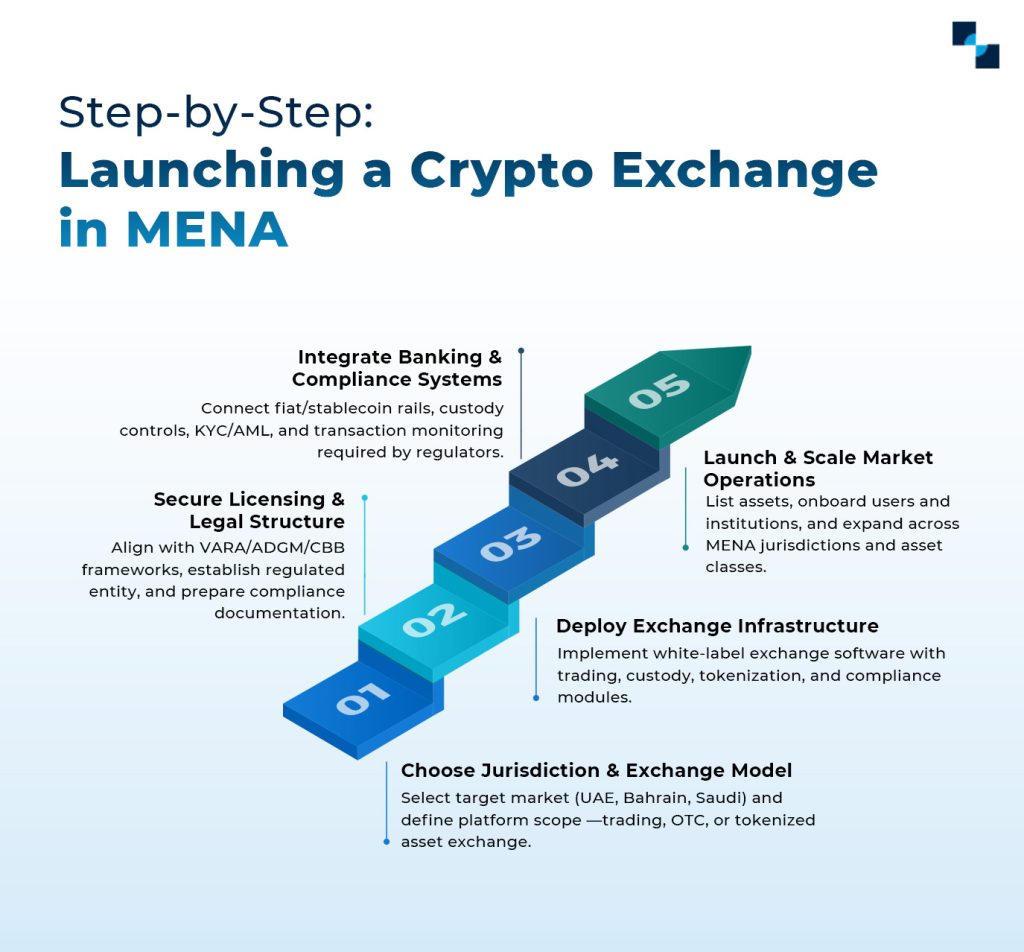
For institutions, fintech operators, and market entrants, launching cryptocurrency exchange software in the MENA region, therefore, requires architecture and features aligned with both market demand and regulatory frameworks. The guide outlines the core architecture, essential features, regulatory requirements, and step-by-step process needed to deploy crypto exchange software across the MENA region.
Why the MENA Region Is Becoming a Global Crypto Exchange Hub?
- Regulatory clarity led by the UAE and Bahrain
VARA (UAE), ADGM (Abu Dhabi), CBB (Bahrain), and emerging Saudi regulatory frameworks provide licensing pathways for crypto exchange software, custodians, and brokers across the region.
- Rapid growth in regulated digital-asset activity
As stated earlier, the UAE processed tens of billions in crypto flows and ranks among the leading global adoption markets.
- Institutional and high-value transaction dominance
According to Chainanalysis, institutional and VIP-sized transfers accounted for a substantial share of regional crypto activity in 2024-2025, reinforcing demand for custody-integrated and OTC-capable exchange infrastructure.
- Expansion of tokenized real-world asset markets
GCC economies are advancing regulated tokenization initiatives, including national real-estate tokenization programs and large-scale asset-issuance pilots.
- High cross-border capital and remittance flows
GCC countries collectively processed over USD 131.5 billion in outbound remittances annually in 2023. Stablecoin settlement and digital-asset transfers have captured more than 10-20% of the remittance market globally over the past year.
- Adoption beyond regulated hubs
MENA crypto exchange development opportunity isn’t limited to the UAE or middle east. North African markets, such as Egypt and Morocco, rank among the world’s top crypto-adoption economies, despite having restrictive regimes, indicating latent exchange demand across the broader region.
- Institutional capital entering digital assets
Several banks, brokers, and investment firms are launching regulated crypto trading services. Over the past few years, the following regional banks and institutions in the UAE have embedded regulated digital asset offerings into their existing services.
| Entity Type | Institution | Service Launched | Year | Key Features |
|---|---|---|---|---|
| Bank | Standard Chartered (UAE) | Institutional Custody | 2024 | DFSA-licensed; services for institutional clients like hedge funds. |
| Bank | Emirates NBD (ENBD) | Partior Blockchain Rails | 2024 | Real-time cross-border settlement using blockchain technology. |
| Invest. Firm | CBB Licensed Firms | Stablecoin Issuance (SIO) | 2026 | First framework for BHD-pegged and USD-pegged stablecoins. |
| Central Bank | Saudi Central Bank (SAMA) | Bitcoin Holding/Sovereign Exposure | 2024/25 | Indirect exposure via micro-strategy style holdings ($68B+). |
| Broker | OKX Middle East | VASP Broker-Dealer | 2024 | Full retail/institutional license for spot, derivatives, and fiat. |
| Broker | Binance FZE | Full VASP License | 2024 | Migrated to a full operational license for trading and custody in Dubai. |
| Bank | Neom/Digital Banks | Blockchain Settlements | 2026 | Exploring CBDC and blockchain-based smart contracts. |
| Broker | IG UAE | Crypto CFDs | 2024/25 | Regulated crypto derivative trading without needing a digital wallet. |
| Bank | RAKBANK | Retail Trading (Bitpanda) | 2025 | First major local bank to offer direct AED-to-crypto in-app trading. |
| Broker | Binance Bahrain | VASP License / Banking Rails | 2024 | Full license to operate in the Kingdom’s “Crypto Hub.” |
| Bank | Liv Bank (ENBD) | Retail “Liv X” Trading | 2025 | Digital-native bank offering trading via Aquanow partnership. |
| Invest. Firm | Mashreq Capital | BITMAC Fund | 2025 | Regulated hybrid fund (BTC + Gold/Equity) with low entry barriers. |
| Invest. Firm | Blockchain Founders Fund | Web3 VC Operations | 2025/26 | Expanded Dubai presence for institutional Web3 equity & token deals. |
| Bank | Sygnum Bank (DIFC) | Crypto-Lending & Staking | 2026 | Lombard loans against crypto assets and 24/7 instant settlement. |
| Invest. Firm | QFC Digital Asset Lab | Tokenized Asset Trading | 2025 | Qatar Financial Centre legalized “Security Tokens.” |
| Bank | Comm. Bank of Dubai | Open Finance APIs | 2026 | First “Open Finance” bank connecting bank accounts to crypto VASPs. |
| Broker | Local VASPs | Regulated Trading License | 2025/26 | Shifted from a ban to licensing under Law No. 14 of 2025. |
| Broker | Bitunix / Deepcoin | Specialized Derivatives | 2026 | High-leverage futures trading for experienced local traders. |
| Bank | BBK (Bank of Bahrain & Kuwait) | Crypto-as-a-Service (MoU) | 2025 | First GCC bank to integrate Binance’s white-label API. |
Core Architecture & Essential Features for MENA-Ready Crypto Exchange Development
Launching crypto exchange software in the MENA region requires an architecture that supports regulated trading, tokenized asset issuance, compliance controls, and financial integration aligned with regional markets. Core infrastructure components and essential features must, therefore, include:
1. Multi-Asset Trading and OTC Execution Engine
As mentioned above, the MENA markets show significant demand for high-value, specific and institutional-size transactions. Cryptocurrency exchange software must therefore support spot, OTC and block-trade execution with configurable spreads, competitive pricing, and broker-assisted workflows.
2. RWA Tokenization and Listing Infrastructure
Observing the pace of regional tokenization initiatives, no crypto exchange software can afford to exclude asset issuance and listing. Crypto trading platforms must build infrastructure to onboard, list and support secondary trading of tokenized RWAs such as real estate, funds, and structured investments within the same venue as crypto assets.
3. Institutional Custody and Settlement Controls
Cryptocurrency exchange development requires custody controls such as segregated wallets, managed accounts, settlement approvals, and reporting suitable for regulated financial entities to support increasing institutional participation in MENA.
4. Stablecoin Transfer and Settlement Capability
Given the region’s massive remittance flows and stablecoin adoption, cryptocurrency exchanges should facilitate deposits, withdrawals, and on-platform cross-border value transfers alongside trading functionality.
5. GCC Banking and Fiat Integration
Cryptocurrency exchange software must connect to regional banking rails for deposits and withdrawals in local currencies and stablecoins redemptions, enabling compliant treasury and settlement operations.
6. Compliance, Surveillance, and Reporting Systems
For MENA-based cryptocurrency exchange development, businesses must integrate AML/KYC onboarding, transaction monitoring and regulatory reporting workflows required by VARA and other frameworks.
7. Sharia-Aligned Asset and Market Configuration
Islamic-finance-alligned markets require configurable screening of assets, trading rules and product structures to support Sharia-compliant digital-asset offerings. Cryptocurrency exchange software targeting middle east markets must integrate such controls to enhance authorities and peoples’ confidence in their platforms.
8. Privacy and Data Governance Controls
Apart from the Sharia regime, various regional data protection and AML frameworks govern crypto activity in the region. Crypto exchange software built for the MENA markets must, therefore, implement user-data governance, permissioned visibility and transaction monitoring controls to comply with such requirements.
Antier recently introduced VARA-ready white label crypto exchange infrastructure for UAE and MENA markets, reflecting growing demand for regulated digital-asset venues capable of supporting both trading and compliant asset issuance within unified exchange environments. For institutions planning early entry into the region, it combines remittance, asset issuance, banking connectivity, robust custody and other region-relevant functionalities.
What are the Regulatory Requirements for Launching a Crypto Exchange in MENA?
| Regulatory Area | What Regulators Require | Operational Impact on Crypto Exchange Software |
|---|---|---|
| VASP / Exchange Licensing | Authorization from VARA (Dubai), ADGM (Abu Dhabi), CBB (Bahrain), or relevant authority | Defines permitted services (trading, brokerage, custody, issuance) and geographic scope |
| Custody & Asset Safeguarding | Segregation of client assets, secure wallet architecture, settlement controls | Requires institutional custody, segregated accounts, approval workflows |
| AML/KYC & Transaction Monitoring | Identity verification, sanctions screening, ongoing transaction surveillance | Onboarding, monitoring, and reporting modules embedded in vcrypto exchange software development |
| Market Surveillance & Reporting | Trade monitoring, abuse detection, regulator reporting | Crypto exchange software must implement surveillance and audit trails |
| Banking & Fiat Integration Approval | Licensed banking partnerships and approved fiat rails | Fiat deposits/withdrawals and stablecoin redemption tied to banking partners |
| Tokenization / Asset Issuance Authorization | Approval for listing or issuing tokenized assets under securities/asset frameworks | Cryptocurrency exchange software must support compliant asset onboarding and lifecycle controls |
| Data Protection & Privacy Compliance | User data storage, consent, and processing rules under regional laws | Data governance, access control, and auditability requirements |
| Sharia Compliance (where applicable) | Asset screening and product structuring aligned with Islamic finance | Cryptocurrency exchange must enable Sharia-aligned asset configuration and trading rules |
Since regulatory requirements differ across MENA jurisdictions, exchange operator must collaborate with legal council at cryptocurrency exchange development company to pursue country-specific licensing strategies while deploying adaptable exchange infrastructure.
How Antier Enables MENA Crypto Exchange Software Launches
It is clear that launching a regulated crypto exchange software in the MENA region requires fool-proof infrastructures embedded with regional-specific architecture and feature components. Those building crypto exchange software must now build crypto exchange superapps with features that resonate with the target region’s demand.
Antier’s VARA-ready white label crypto exchange infrastructure supports the regional evolution by combining regulated trading, RWA tokenization, institutional custody, banking connectivity, and compliance controls aligned with MENA regulatory frameworks. This enables financial institutions, fintech operators, and market entrants to deploy crypto exchange software tailored to regional licensing and market requirements without building from scratch.
For organizations planning entry into MENA digital-asset markets, adopting jurisdiction-aligned exchange architecture early provides a structural advantage in licensing readiness and banking integration. As the region continues to formalize regulated digital-asset ecosystems, cryptocurrency exchange software built on compliant and adaptable infrastructure will be best positioned to scale across multiple MENA jurisdictions.
Talk to our experts to get started with MENA-alligned crypto exchange development.
Frequently Asked Questions
01. What is driving the growth of digital asset markets in the MENA region?
The growth is driven by regulatory clarity from countries like the UAE and Bahrain, rapid adoption of digital assets, and significant institutional and high-value transactions.
02. How much did the UAE record in crypto inflows between 2024-2025?
The UAE recorded $56 billion in crypto inflows during that period, reflecting a 33% year-over-year growth.
03. What are the essential requirements for launching cryptocurrency exchange software in the MENA region?
Launching cryptocurrency exchange software in the MENA region requires architecture and features aligned with market demand and regulatory frameworks, including compliance with local licensing and banking integrations.