




AI Summary
- In the fast-evolving landscape of Web3, capital is shifting purposefully towards P2P crypto wallet solutions, indicating a move towards efficient, secure finance.
- Key trends include a significant increase in cross-border P2P transactions, embedded finance adoption, and biometric authentication.
- P2P wallets enable direct, secure exchange of digital assets between users, offering features like on-wallet order books, atomic swaps, and biometric unlock.
- The rise of P2P transactions is driven by institutional demand for transparency, lower fees, and regulatory compliance.
- White-label P2P wallet solutions offer a shortcut to market entry with proven security features.
Capital in Web3 is moving with intent, not experimentation, and P2P crypto wallet solutions sit at the center of that shift. In 2025 alone, cross-border P2P transaction volume expanded by 51%, while embedded finance adoption advanced 36% as enterprises embedded native payment rails into digital ecosystems. Biometric authentication reached 58% penetration across leading platforms, and 71% of users actively favored contactless scan-and-pay experiences, signaling a decisive move toward frictionless yet secure finance. Voice-enabled payments grew 24%, reinforcing the demand for intelligent, always-on payment infrastructure. These are not usage anomalies but structural indicators of where capital efficiency, user trust, and platform defensibility converge for long-term value creation.
What is a P2P Crypto Wallet?
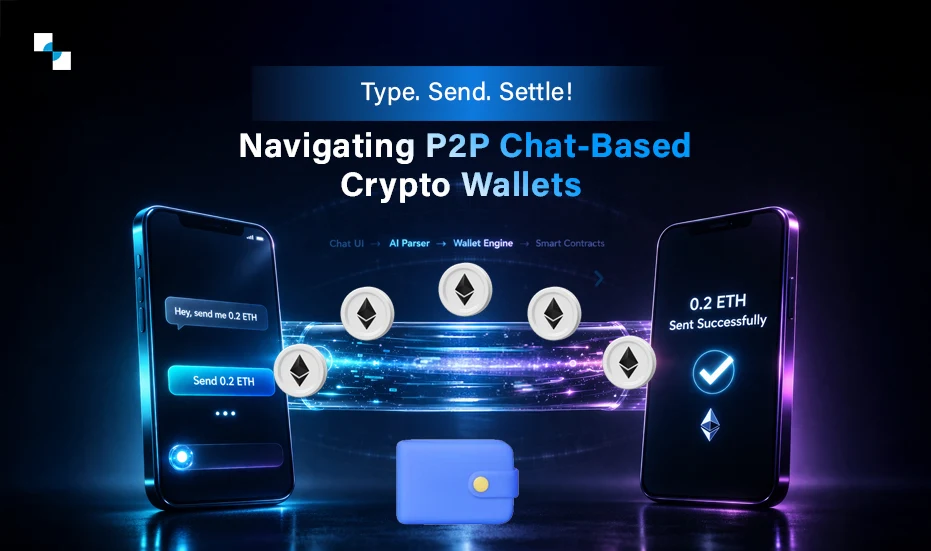
A P2P crypto wallet is a software wallet designed to enable peer-to-peer exchange and settlement of digital assets directly between users, without routing trades through a central matching engine. P2P wallets can be non-custodial, meaning users keep their private keys, or hybrid, offering optional custody services. They typically provide on-wallet order books or secure on-chain trade settlement, atomic swap or smart contract mediated exchanges, and in-app messaging or negotiation layers so counterparties can discover and agree on terms. The key differentiator is that trades are executed directly between participants and settled on-chain or via cryptographic settlement channels. Now, let us scroll through the blog to deeply understand the factors impacting the rise of peer-to-peer transactions and how a crypto wallet supports it.
What is The Hype About P2P Transactions & Web3 Wallet Solutions?
The momentum behind P2P Web3 crypto wallets stems from multiple converging forces. Institutional demand for self-custody and transparency has grown, while retail users seek lower fees and censorship-resistant rails. Regulators have tightened oversight of custodial services, which increases the attractiveness of non-custodial and privacy-preserving mechanisms for compliance-conscious players. At the same time, infrastructure improvements such as cross-chain messaging, layer 2 settlement, and programmatic escrow primitives make direct peer settlement practical at scale. These advances position P2P wallets as a market segment where decentralization and enterprise needs can be reconciled.
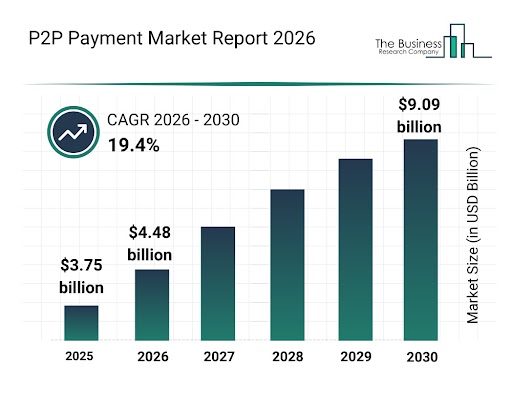
Source link: https://www.thebusinessresearchcompany.com/report/p2p-payment-global-market-report
Core P2P Payment Market Trend
- Cross-border P2P transfers jumped 51% in 2025, driven by lower fees and wider access.
- Embedded finance grew 36% as more brands added native P2P options in 2025.
- Gen Z and millennials fueled a 28% rise in social-payment P2P apps in 2025, prioritizing social features.
- Voice-activated payments via AI assistants rose 24% in 2025, reflecting demand for hands-free convenience.
- 71% of users favored apps with contactless scan-and-pay in 2025, accelerating innovation.
- Biometric authentication reached 58% adoption across major P2P apps in 2025, strengthening security.
- Real-time processors like Zelle maintained the industry standard by settling transactions in seconds in 2025.
Key market context to consider: analysts place the global cryptocurrency wallet development market in the multi-billion dollar range in 2026, underlining the rapid adoption and strong commercial opportunity for wallet providers.
Advantages of P2P Crypto Wallet Development
Investors should view P2P crypto wallet development as more than technology; it is a strategic lever that creates durable business advantages. A thoughtfully designed P2P wallet builds network effects, predictable revenue channels via platform services, and clear pathways to enterprise partnerships and bank integrations. It makes product roadmaps measurable, governance models transparent, and M&A or tokenization outcomes cleaner. Understanding these levers today lets you quantify upside, stress test assumptions, and negotiate terms from a position of strength when the market demands scale and regulatory clarity.
1. Greater user control and trust retention- Users hold keys or retain control over keys, improving trust metrics and reducing counterparty risk exposure for the product.
2. Reduced counterparty solvency risk- Direct settlement reduces dependence on exchange ledgers and central custody, lowering systemic risk from exchange failures.
3. Lower ongoing regulatory capital and reserve requirements- Operators of non-custodial P2P wallets avoid some capital and reserve obligations that custodial exchanges face, while still being able to provide compliance tooling where required.
4. New monetization channels without custody- Fees on on-chain settlement, premium matching, liquidity brokering, and enterprise SDK licensing create recurring revenue with lower operational overhead.
5. Increased resilience and censorship resistance- P2P structures reduce single points of failure and make it harder for a single authority to interrupt user access.
6. Competitive edge in markets with high fiat friction- P2P wallets that integrate local payment rails and stablecoin flows can capture remittance and cross-border volumes where traditional rails are slow or expensive.
7. Better alignment with institutional treasury policies- Institutional clients increasingly demand custody flexibility and programmable controls that P2P flows can support via multisig, time locks, or policy engines.
Features Essential for P2P Crypto Wallets Built For Success
Basic feature set
- Secure key management and mnemonic handling with clear recovery flows
- Simple send and receive UX with transparent gas and fees
- Multi-chain support for major EVM chains and Bitcoin via compatible bridges
- On-chain settlement support and clear transaction status indicators
- Address book, QR scanning, and transaction history auditing
- Basic wallet encryption, PIN, and biometric unlock
Advanced Enterprise Grade Capabilities
- Integrated P2P order matching and negotiation engine with optional on chain escrow contracts
- Smart routing: atomic swaps, cross-chain bridges, and layer 2 settlement channels
- Role-based access and enterprise wallet profiles for treasury management
- Multi-signature workflows and threshold signature schemes for institutional custody
- Real-time blockchain analytics and risk scoring integrated with compliance pipelines
- Decentralized identity integration and selective disclosure using verifiable credentials
- Replay protection, transaction batching, and gas optimization modules for cost efficiency
- Insurance orchestration and proof of reserves integration for optional custody guarantees
- API and SDK suites for partners and white-label customers.
You can always achieve this level of success and acquire the wide range of advantages mentioned above by hiring an accredited team of blockchain experts from a renowned cryptocurrency wallet development company. Apart from this, the company will also help you achieve success after with their alternative solutions, like customized solutions as per business needs.
Plan Your P2P Wallet Strategy With Our Experts
Are White Label P2P Crypto Wallets the Winning Path?
White-label blockchain wallet solutions are an attractive route for enterprises and institutional entrants because they compress time to market and offer proven building blocks. For investors, a professionally engineered white-label product reduces execution risk and often includes battle-tested security modules, audit trails, and compliance hooks. This allows businesses to focus on customer acquisition and integrations rather than building cryptographic infrastructure from scratch. However, the trade-off is customization. For high compliance or differentiated product strategies, a hybrid approach where a white-label core is extended with bespoke modules often yields the best risk-adjusted return.
Market practitioners report that high-quality white label cryptocurency wallet service providers can deliver robust deployments quickly, while providing upgrade paths for enterprise integrations and regulatory controls.
How Much Does a P2P Crypto Wallet Development Cost?
The cost of a P2P crypto wallet development is primarily determined by the level of customization required, rather than a fixed pricing model. A basic white-label wallet with minimal modifications typically requires lower investment because the core architecture, UI framework, and security modules are already prebuilt, and development mainly involves branding and minor configuration.
As customization increases, the cost rises due to the need for deeper integrations, extended multi-chain support, tailored compliance workflows, and enterprise-grade APIs or SDKs. These requirements involve additional engineering, testing, and infrastructure setup.
A fully custom P2P crypto wallet requires the highest investment since the architecture, smart contracts, security layers, and user experience are designed specifically for the business model. Advanced capabilities such as multisignature custody, cross-chain routing, escrow mechanisms, and bespoke dashboards demand extensive development time, third-party audits, and ongoing maintenance, all of which significantly influence the overall cost.
How Much Time Does It Take To Create a P2P Crypto Wallet?
A P2P crypto wallet development timeline differs by approach. Below are practical estimates mapped to development phases.
1. White label deployment with light customization
- Typical duration: 1 to 4 weeks
- Activities: branding, token preloads, basic compliance toggles, testing, and deployment.
2. White label with enterprise integrations and moderate customization
- Typical duration: 4 to 10 weeks
- Activities: integrate KYC provider, analytics, and fiat on-ramp; add off-chain order features, QA, and security checks.
3. Full custom enterprise build
- Typical duration: 3 to 6 months or longer
- Activities: architecture design, smart contract development, multisig and custody integrations, compliance workflow construction, security audits, penetration testing, user acceptance testing, and regulatory sign-offs.
Note that parallelizing activities such as UI design, smart contract audit, and legal compliance work reduces overall calendar time. Real-world schedules also depend on the availability of third-party integrations, audit timelines, and regulatory filings.
Security & Compliance Realities Investors Must Weigh
Security is not optional. Rising on-chain criminal flows and targeted attacks are reshaping risk models, and platforms must invest in proactive controls. Threats include hot wallet exploits, social engineering, private key compromise through coercion, and off-chain identity fraud. Monitoring, anomaly detection, wallet heuristics, and safe recovery models are required to maintain institutional trust. Recent industry reports highlight notable rebounds in illicit on-chain flows and reaffirm the need for rigorous analytics and cooperation with law enforcement.
Regulation is also evolving. Many jurisdictions now distinguish custodial and non-custodial wallet development services more clearly, and AML KYC expectations are tightening, including live selfie verification and geo-tagging in some markets. For global deployments, you must design compliance as a first-class component rather than an afterthought.
Why Partner With Antier?
P2P crypto wallets are a high-potential and high-responsibility segment of the market. For investors, the opportunity lies in products that combine strong cryptography, pragmatic compliance, and enterprise integrations.
Connect with our team today to learn about our offerings and the entire process. We build white label P2P wallet solutions with an emphasis on security, auditability, and regulatory readiness. Our team combines cryptography engineers, compliance experts, and product designers who can guide you from requirements to launch, including policy design for KYC and AML, architecture for multisig custody, and production-grade smart contract audits. We also assist with jurisdictional analysis so your rollout aligns with local supervisory expectations. If you are evaluating investments or planning a wallet product, we can provide a technical due diligence brief, a costed implementation roadmap, and a compliance checklist tailored to your target markets.
Frequently Asked Questions
01. What is a P2P crypto wallet?
A P2P crypto wallet is a software wallet that enables direct peer-to-peer exchange and settlement of digital assets between users, without relying on a central matching engine. It can be non-custodial or hybrid, offering features like on-wallet order books and secure trade settlement.
02. Why are P2P transactions gaining popularity in Web3?
P2P transactions are gaining popularity due to increased institutional demand for self-custody, lower fees sought by retail users, tighter regulatory oversight of custodial services, and advancements in infrastructure that facilitate direct peer settlement.
03. What are the benefits of using P2P crypto wallets?
P2P crypto wallets offer benefits such as enhanced privacy, lower transaction fees, and the ability for users to maintain control over their private keys, making them attractive for both compliance-conscious players and those seeking decentralized financial solutions.