





✨ AI Summary
- In 2026, privacy coins are regaining popularity due to real business needs for enhanced privacy in transactions.
- Consumers seek protection from tracking, merchants want revenue privacy, and exchanges aim to meet demand while managing compliance risks.
- Web3 brands are realizing the importance of privacy to safeguard users.
- To capitalize on this trend, a robust cryptocurrency development approach is essential, ensuring product design, security, liquidity, and user experience.
- The blog explores why privacy coins are trending, the emerging use cases, and how various entities can adopt privacy effectively.
Privacy coins are back in 2026, and this time the momentum is coming from real business pressure, not just market noise. Wallet users want protection from tracking. Merchants want revenue privacy at checkout. Exchanges are seeking more effective ways to support demand without increasing compliance exposure. Even Web3 brands in gaming, creator economies, and marketplaces are realizing that public transactions can turn their best users into easy targets.
If you are building in Web3 right now, the opportunity is clear, but so is the challenge. You cannot capitalize on privacy coins with a basic integration or a copy-paste token strategy. You need the right cryptocurrency development approach to ensure product design, security, liquidity readiness, and risk controls, all while maintaining a smooth user experience. This blog breaks down why privacy coins are trending again, where the strongest use cases are emerging, and how founders, exchanges, payment providers, and enterprises can adopt privacy in a way that is scalable, commercially viable, and future-ready.
Why Privacy Coins Are Trending Again in 2026
Privacy coins never fully disappeared. They simply went quiet while the market prioritized other narratives. Now they are resurfacing because the Web3 ecosystem has matured, and users are demanding more control over their transaction visibility. This shift is also influencing how platforms design payments, security, and product trust, which is why many teams are partnering with a cryptocurrency development company to build privacy-ready infrastructure without slowing down adoption.
Here’s what’s driving the comeback:
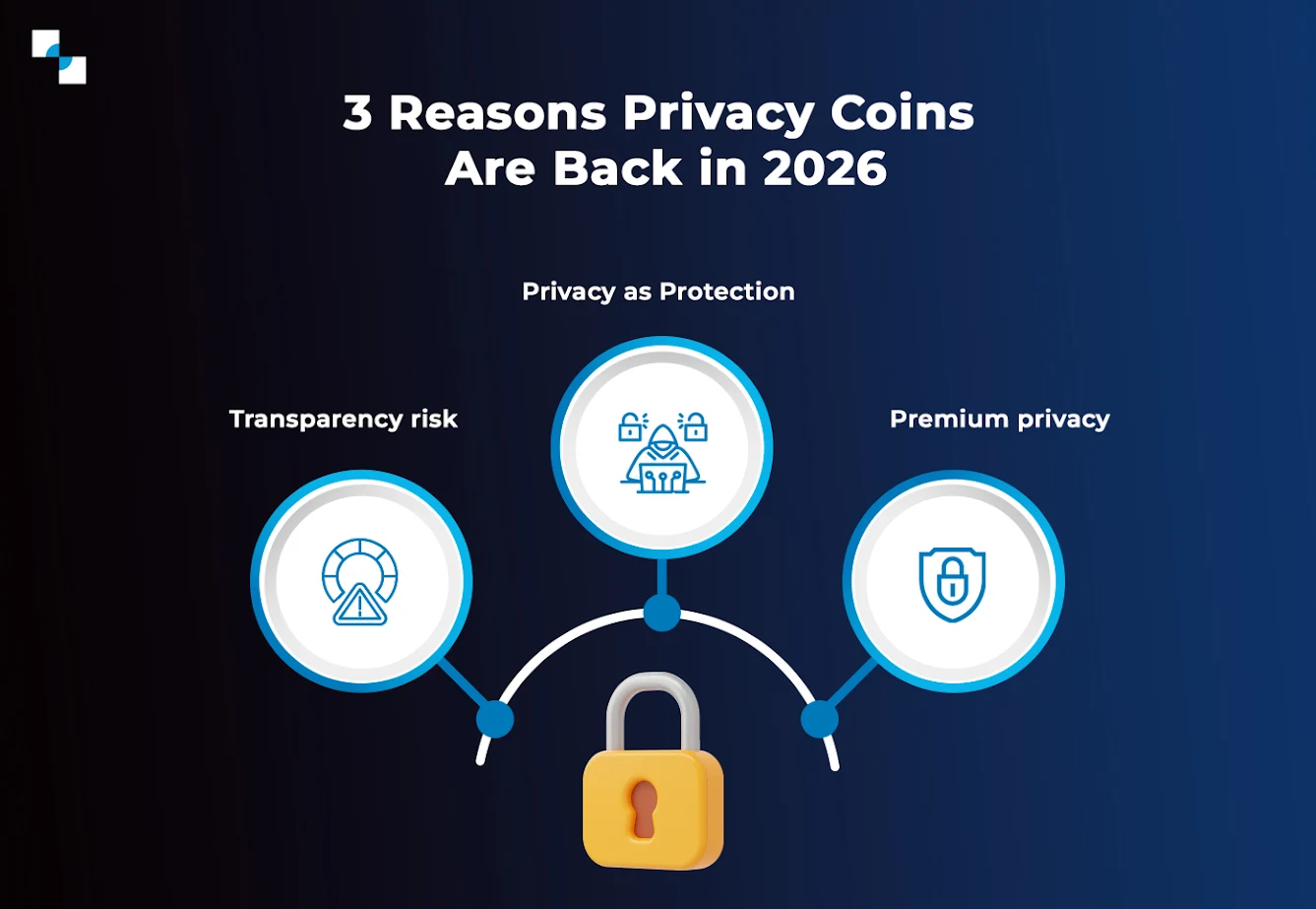
1) Transparency risk
Public ledgers are great for auditability, but they also expose wallet balances, spending behavior, counterparties, trading patterns, and even business revenue flows. For consumers, that feels intrusive. For merchants and enterprises, it becomes a competitive weakness because revenue movement and treasury activity can be tracked externally. That is why brands are now exploring cryptocurrency development services to implement privacy-focused payment flows while maintaining a balance between compliance and usability.
2) Privacy as Protection
Privacy coins help reduce exposure, protect high-value activity, and support safer payments across wallets, exchanges, and merchant platforms by limiting unnecessary transaction visibility, This is exactly why privacy-first infrastructure is gaining momentum, and why advanced cryptocurrency development is becoming essential for teams that want to build trust-driven products at scale.
3) Premium privacy
In 2026, privacy is no longer just a niche ideology. It is becoming a premium feature for high-value transfers, B2B settlements, VIP users, and cross-border payroll. Businesses that integrate privacy options can unlock stronger trust, better retention, and premium monetization opportunities. For faster execution, many teams choose structured coin development planning that aligns privacy design, security controls, and scalable deployment from day one.
Make privacy your premium feature in 2026. Start planning now.
What “Privacy” Actually Means in Crypto (No Confusion)
Before you build or integrate anything, you need clarity: privacy in crypto can mean different architectures. It shapes everything from transaction visibility to user trust and security controls. The best outcomes come when your cryptocurrency development company aligns privacy design with real product needs.
- Privacy Coins (Native Privacy by Design)
These are assets designed to hide transaction details at the protocol level (like sender/receiver/amount, depending on the design).
Best for: private transfers, payments, treasury movement, and user protection.
- Privacy Layers (Privacy as a Feature on Top of Chains)
Instead of building a new coin, some businesses integrate privacy layers, mixers, or privacy-enabled transfer routes.
Best for: existing ecosystems that want privacy without a standalone asset.
- Privacy-Preserving UX (Privacy Through Smart Product Design)
Even without deep cryptography, businesses can improve privacy via:
- Rotating addresses
- Stealth wallets
- Private invoices
- Off-chain metadata controls
Best suited for wallets, exchanges, and payment gateways that require practical privacy enhancements.
Use Cases: How Web3 Businesses Can Capitalize on Privacy Coins
Different players win differently. Here’s how different Web3 businesses can turn the privacy trend into an advantage.
1) Founders & Web3 Product Teams
If you’re building wallets, DeFi apps, or consumer Web3 products, privacy helps you win trust and retention. Where privacy adds real value:
- “Private send” for everyday transfers
- Hidden balances for safer self-custody
- Private salary or contributor payouts
- Stealth transactions for high-net-worth users
What founders need most:
- A scalable architecture
- Smooth UX (no complex steps)
- A safe compliance strategy
This is where a crypto development company becomes critical, not just to build, but to build it right the first time.
2) Exchanges & Trading Platforms
Exchanges don’t want to ignore privacy demands. But they also can’t afford regulatory exposure.
How exchanges can capitalize safely:
- Offer privacy assets with strong listing frameworks
- Implement policy-based deposit/withdrawal rules
- Add monitoring logic and risk scoring for flows
- Create controlled privacy rails for verified users
The winning strategy is not “list everything.” It enables privacy responsibly.
This is where advanced cryptocurrency development services help exchanges implement technical controls while maintaining user trust.
3) Payment Companies
For payment providers, privacy is a business multiplier. Why? Because merchants don’t want competitors tracking their revenue. Customers don’t want their spending public. And enterprises want a discreet settlement.
Privacy coin-powered payment opportunities:
- Private checkout for global customers
- B2B invoice settlement with less exposure
- Payroll payouts for remote teams
- High-ticket commerce where privacy matters
If you already run stablecoin payments, adding privacy rails can create a premium tier without rebuilding your entire stack.
4) Web3 Brands (Gaming, NFTs, Communities)
Gaming platforms, creator ecosystems, and marketplaces are full of users who transact frequently and become easy targets.
Privacy can protect:
- Whales
- Creators
- High-volume traders
- Marketplace power users
Business outcome: better trust, fewer scams, higher retention.
5) Investors & Strategics
If you’re looking at privacy as an investment narrative, the strongest opportunities often sit behind the coins:
- Privacy-enabled wallets
- Compliance-aware privacy infrastructure
- Payment layers
- SDKs, monitoring tools, and routing engines
In 2026, privacy becomes valuable when it’s usable, scalable, and commercially deployable.
Ready to build privacy-first crypto products? Let’s map your launch strategy.
The Real Challenge: Privacy vs Compliance (And How Teams Solve It)
Privacy coins are gaining momentum again, but for serious Web3 businesses, the real decision comes down to one thing: privacy vs compliance.
| Privacy vs Compliance Challenge | What It Means | How Teams Solve It |
|---|---|---|
| Privacy demand vs regulatory pressure | Users want confidentiality, and regulators raise restrictions | Region-based controls + compliance-first architecture |
| Anonymity vs traceability | Private flows reduce visibility for audits | Risk-based rules + configurable privacy settings |
| User protection vs abuse risk | Privacy can be misused by bad actors | Monitoring safeguards + policy enforcement |
| Seamless UX vs compliance checks | Extra checks can slow the payment flow | Smart UX defaults + automated verification |
| Security vs operational control | Privacy adds complexity and attack surface | Audits + secure key management + ongoing monitoring |
The winning approach is not choosing one side, but engineering both into the system through expert-led cryptocurrency development.
What It Takes to Build a Privacy Coin Product That Can Scale
Whether you’re integrating or building, the foundation matters. Here are the non-negotiables:
1) Security-First Smart Contract Design
Privacy attracts sophisticated users and sophisticated attackers. Audits, threat modeling, and secure key management are mandatory.
2) Liquidity + Usability Planning
Privacy coins fail when they’re hard to use. Your roadmap must cover:
- Wallet support
- Exchange routes
- Bridging strategy
- User onboarding
3) Compliance-Aware Architecture
You don’t want to “build first and panic later.” Privacy systems should be designed with:
- Configurable compliance controls
- Monitoring hooks
- Operational policies
4) UX that doesn’t feel like a crypto lab
If users need a tutorial to send money privately, adoption will be slow. The best privacy products feel simple, even when the backend is complex.
When these four fundamentals are built into your roadmap from day one, privacy becomes a real growth lever, not a risky experiment, backed by the right cryptocurrency development services.
Final Thoughts
Privacy coins are making a strong comeback in 2026, but the real opportunity is not in watching the trend. It is in building products that turn privacy into adoption, trust, and long-term utility. Whether you are running an exchange, scaling a wallet, launching a payment platform, or designing the next Web3 product layer, privacy is quickly becoming a competitive advantage that users actively look for.
The winners in this cycle will be the teams that execute privacy with the right balance of confidentiality, security, usability, and compliance. With the guidance of a proven crypto development company like Antier, you can move faster with the right architecture, stronger smart contract foundations, compliance-ready controls, and a market-ready rollout strategy that supports real-world usage.
Ready to turn privacy into a scalable Web3 advantage? Connect with Antier today and build your privacy-first roadmap with confidence.
Frequently Asked Questions
01. Why are privacy coins gaining popularity again in 2026?
Privacy coins are trending again due to increased demand from users for transaction visibility control, as well as the need for merchants and enterprises to protect sensitive financial information from being publicly tracked.
02. What challenges do developers face when integrating privacy coins?
Developers must adopt a comprehensive cryptocurrency development approach that ensures product design, security, liquidity readiness, and risk controls, while also providing a smooth user experience, rather than relying on basic integrations.
03. How are businesses responding to the risks associated with public ledgers?
Businesses are exploring cryptocurrency development services to implement privacy-focused payment flows that protect their revenue movement and treasury activities, balancing compliance with usability.