




✨ AI Summary
- Dive into the world of Web3 ecosystems with Aptos and Sui, two standout platforms using the Move programming language to enhance blockchain security.
- As developers flock to build DeFi platforms and NFT marketplaces, the need for specialized Move smart contract auditing becomes paramount to prevent catastrophic losses due to vulnerabilities.
- Discover the unique challenges and benefits of Move audits, from preventing hacks to boosting investor confidence and regulatory compliance.
- Uncover the intricacies of auditing in Aptos and Sui ecosystems, where audits are crucial for reliability, performance, and community trust.
- With a detailed breakdown of audit methodologies and the significance of security in both ecosystems, learn how Move smart contract auditing fortifies the foundations of these cutting-edge platforms.
The growth of Web3 ecosystems has been fueled by the pursuit of faster, safer, and more scalable blockchains. Among the new entrants, Aptos and Sui stand out for their use of the Move programming language, a resource-oriented language created to address vulnerabilities seen in earlier blockchain frameworks. Both platforms are drawing developers, investors, and enterprises eager to build DeFi platforms, NFT marketplaces, and on-chain games.
Yet with this promise comes risk. Every smart contract deployed on Aptos or Sui holds digital assets, manages user interactions, and defines financial transactions. Even the smallest bug or misconfiguration can result in catastrophic losses. History across Ethereum, BNB Chain, and Solana shows how hacks worth millions of dollars stemmed from unchecked vulnerabilities.
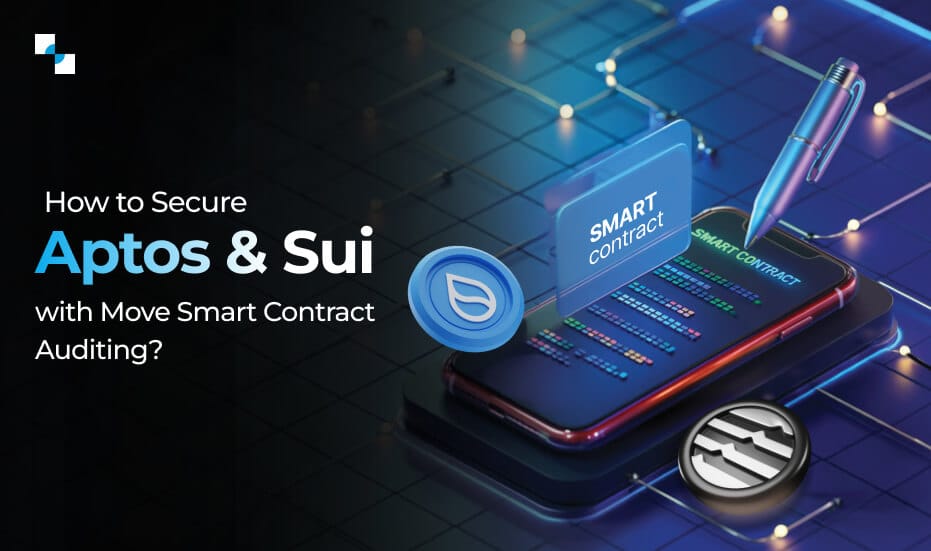
This is where Move smart contract auditing enters the picture. By subjecting code to a comprehensive security review, projects on Aptos and Sui can prevent attacks, protect users, and strengthen credibility with investors and partners. This blog explores the why, what, and how of Move smart contract audits while covering their process, benefits, and role in securing Aptos and Sui ecosystems.
Why Move Smart Contracts Need Specialized Auditing
The Move language was originally developed for Meta’s Libra (later Diem) project and later adopted by Aptos and Sui. Unlike Solidity or Rust, Move uses a resource-oriented programming model where assets are treated as resources that cannot be accidentally copied or destroyed. This design addresses common attack vectors like double-spending and reentrancy. But while Move provides stronger safety guarantees, it introduces new complexities:
- Unfamiliarity among developers: Most blockchain engineers trained in Solidity or Rust face a steep learning curve when coding in Move. This increases the risk of subtle bugs.
- Unique execution model: Move’s strict type system and resource semantics demand specialized testing and auditing methodologies.
- Rapidly growing ecosystems: With Aptos and Sui gaining traction, projects often prioritize speed-to-market over rigorous security testing.
This makes a Move blockchain security audit different from audits on Ethereum or Cosmos. Standard automated tools may not catch issues unique to Move contracts. Instead, specialized Move smart contract audit services are required, staffed by auditors with deep familiarity with the language, runtime, and network-level behavior.
Security Challenges in Aptos and Sui Ecosystems
While Aptos and Sui benefit from Move’s design, vulnerabilities still exist. Some common risks that auditors look for include:
Logic Flaws in Business Rules
Errors in the way tokens are minted, burned, or transferred can cause asset mismanagement. For example, incorrect validation of a withdrawal function could allow malicious actors to drain liquidity pools.
Resource Mismanagement
Since Move treats tokens as resources, incorrect handling, such as failing to release or reassign resources, can lead to locked funds or denial-of-service scenarios.
Access Control Misconfigurations
Smart contracts often include privileged functions like pausing transactions or upgrading modules. If these functions are not properly restricted, they can be exploited by attackers.
Cross-Contract Interaction Risks
DeFi protocols frequently interact with other contracts. Without thorough auditing, assumptions about external contract behavior can create entry points for exploits.
Gas and Performance Issues
Inefficient Move code can increase transaction costs or create bottlenecks in throughput while affecting usability and trust in the application.
Common Benefits of Move Smart Contract Auditing for Aptos & Sui Projects
A thorough audit offers multiple advantages beyond just security:
- Prevention of Hacks and Exploits: Audits identify flaws before attackers can exploit them, saving projects from financial losses and reputational damage.
- Investor and Partner Confidence: A Move smart contract audit demonstrates a project’s commitment to security, making it easier to attract venture funding and partnerships.
- Regulatory Readiness: As regulators worldwide tighten their grip on digital asset projects, having a Move asset security audit helps demonstrate due diligence and compliance.
- Performance Improvements: Auditors often flag inefficiencies in code that, once fixed, reduce gas fees and improve user experience.
- Community Trust: In ecosystems like Aptos and Sui, where community adoption drives growth, an audited contract signals responsibility and professionalism.
Schedule a Move Smart Contracts Audit today
How Move Smart Contract Audit Enhances Security in the Aptos Ecosystem
Vulnerabilities in Aptos
- Aptos faces issues like improper resource handling, where borrows create dangling references.
- Transaction ordering attacks exploit sequence dependencies, requiring thorough simulation in audits.
Audit Focus Areas
- Auditors review entry points to confirm access controls allow only authorized calls.
- In DeFi protocols, liquidation logic is examined to ensure fair outcomes.
- High throughput demands audits that verify performance under load without introducing security gaps.
Key Benefits
- Reliable dApps allow users to stake funds with confidence.
- Audited projects such as Thala report fewer incidents.
- Early fixes shorten development cycles and speed up launches.
- Community trust grows, encouraging more builders to join Aptos.
Common Fixes
- Examples from audits include adding checks for vector lengths to prevent out-of-bounds errors.
- Formal proofs are applied to modules handling value, strengthening guarantees.
Ecosystem Impact
- Aptos’ TVL growth depends on consistent audits to sustain momentum.
- Institutional players often require Move asset security audit reports before onboarding.
Audit Tools and Processes
- Tools like Move Analyzer are used for static analysis.
- Manual penetration testing complements automated checks.
- Post-audit, teams monitor and update code to counter new threats.
How Move Smart Contract Audit Bolsters Security in the Sui Ecosystem
Vulnerabilities in Sui
- Sui’s object model creates risks such as ownership disputes from shared objects.
- Parallel execution bugs appear when dependency checks are missed.
Audit Focus Areas
- Auditors trace object flows, verifying transfers and deletions.
- Multi-transaction simulations are run to uncover conflicts.
- For gaming dApps, item ownership consistency is checked.
- Fast finality is reviewed to ensure no shortcuts weaken security.
Key Benefits
- Post-audit contracts often achieve lower fees through efficient code.
- NFTs and DeFi apps integrate more smoothly, boosting adoption in gaming and financial sectors.
- Projects like Navi show stable operations after audits.
Audit Methodologies
- Services are tailored to Sui’s parallel execution model.
- Simulations of parallel paths are conducted, backed by metrics proving safe handling of higher transaction volumes.
Ecosystem Impact
- Sui’s growing TVL reflects confidence in its audited infrastructure.
- Audits reduce risks in cross-object interactions, preventing unauthorized access.
Tools and Recommendations
- Auditors employ custom simulators along with Move Prover.
- Best practices include using capabilities to enforce control.
Key Steps Involved in Move Smart Contract Auditing
A Move smart contract audit is not just a quick scan with automated tools. It is a layered process that blends manual review, automated testing, and adversarial thinking. Here’s how a reputable smart contract audit company approaches the process:
Step 1: Requirement Analysis & Threat Modeling
Auditors begin by studying the contract’s intended functionality and mapping potential attack surfaces. For example, a DeFi lending protocol has risks different from an NFT marketplace.
Step 2: Automated Scanning
Tools are used to detect common vulnerabilities such as integer overflows, reentrancy-like patterns, and access control issues. While these tools are helpful, they are never sufficient on their own.
Step 3: Manual Code Review
Auditors with expertise in the Move language conduct a line-by-line examination of the code. They assess logic implementation, resource handling, and adherence to best practices.
Step 4: Functional Testing & Simulation
Contracts are tested in a sandbox environment to simulate different scenarios—including edge cases, malicious inputs, and stress conditions.
Step 5: Reporting & Recommendations
A detailed report is shared with the project team, highlighting vulnerabilities, severity levels, and actionable remediation steps. This stage often includes direct collaboration between auditors and developers.
Step 6: Verification & Certification
After fixes are applied, auditors perform a final check to ensure all vulnerabilities are resolved. Projects often receive a public audit certificate, which helps build user and investor trust.
Get Move Smart Contract Auditing services for your Aptos project
Conclusion
Aptos and Sui are positioned as leading ecosystems for scalable and secure Web3 applications. Move smart contract auditing secures Aptos and Sui by addressing gaps. As Aptos and Sui ecosystems expand, auditing practices are also evolving to meet growing security demands. One emerging trend is AI-assisted auditing, where machine learning tools are developed to detect patterns of vulnerabilities with greater speed and accuracy. By investing in Move smart contract auditing, projects gain more than just protection. Partnering with Antier, a trusted smart contract audit company, ensures that Aptos and Sui projects undergo rigorous Move blockchain security audits backed by expert-driven methodologies.