




✨ AI Summary
- In the blog post, the focus is on the significance of ISO 20022-compliant cryptocurrencies in shaping the future landscape of global finance.
- By adhering to this standard, digital assets can seamlessly integrate with traditional banking systems, enabling real-world adoption and trust.
- The post delves into the technical aspects of ISO 20022, its integration with blockchain architecture, and outlines a strategic roadmap for developing such currencies by 2025.
- It emphasizes key components like research, defining use cases, selecting development teams, designing architecture, building core features, testing, launching, and maintaining these coins.
- Additionally, it highlights the top ISO 20022 coins projected for 2025, such as XRP, Cardano, and Stellar.
The cryptocurrency projects that will dominate the next decade are not necessarily the ones making the most noise today. They are the projects that integrate seamlessly with the systems that move the world’s money. In 2025, the global financial system will rely on ISO 20022 coins, the universal standard that banks and payment networks use for secure and structured financial messaging. ISO 20022 coin development is no longer just a technical upgrade. It is the backbone of global finance. For cryptocurrencies, compliance with this standard translates to credibility, interoperability, and an open door to institutional adoption. It is the difference between remaining in a niche market and becoming a key player in the global financial ecosystem.
This guide will explain why ISO 20022 matters more than ever, how it connects to blockchain, and the roadmap for creating a cryptocurrency that meets this standard. If your goal is to stay relevant and attract real-world adoption, this is your blueprint.
What is An ISO 20022-Compliant Cryptocurrency?
An ISO 20022-compliant cryptocurrency is a digital asset that follows the ISO 20022 messaging standard used in global finance. This standard enables banks and financial institutions to exchange payment information in a structured, consistent, and clear manner. It improves the speed, accuracy, and transparency of financial communications across different countries and systems.
When a cryptocurrency complies with ISO 20022, it means the coin is designed to work well within regulated financial networks. This allows it to connect more easily with traditional banking systems, making it suitable for real-time payments, settlements, and cross-border transfers. In simple terms, an ISO 20022-compliant cryptocurrency is a coin designed to communicate in the same language as the global financial system. This gives it a strong advantage in gaining trust, adoption, and long-term relevance in the evolving world of finance.
How Does the ISO 20022 Standard Integrate With Blockchain Architecture?
ISO 20022 is a universal financial messaging standard that enables structured and standardized data exchange across global payment systems. When integrated with blockchain technology, it creates a bridge between traditional banking systems and decentralized platforms. Using XML and JSON formats, ISO 20022 provides rich transaction data that supports automation, compliance, and interoperability in financial messaging.
- Enables rich, detailed, and standardized transaction messages for accuracy and transparency
- Aligns blockchain-based transactions with legacy banking systems without requiring complex conversions.
- ISO 20022-compliant coins like XRP and XLM use this standard to enable fast and cost-efficient cross-border settlements
- Smart contracts can integrate ISO-based message structures to create compliant, automated workflows.
- Helps financial institutions achieve regulatory compliance, real-time validation, and secure communication
- Builds a unified payment infrastructure for interoperability between decentralized finance and traditional banking
What Strategic Components Are Essential to Build ISO-Compliant Cryptocurrency in 2025?
To build an ISO-compliant cryptocurrency in 2025, these six strategic components form the foundation for regulatory alignment, technical strength, and global integration.
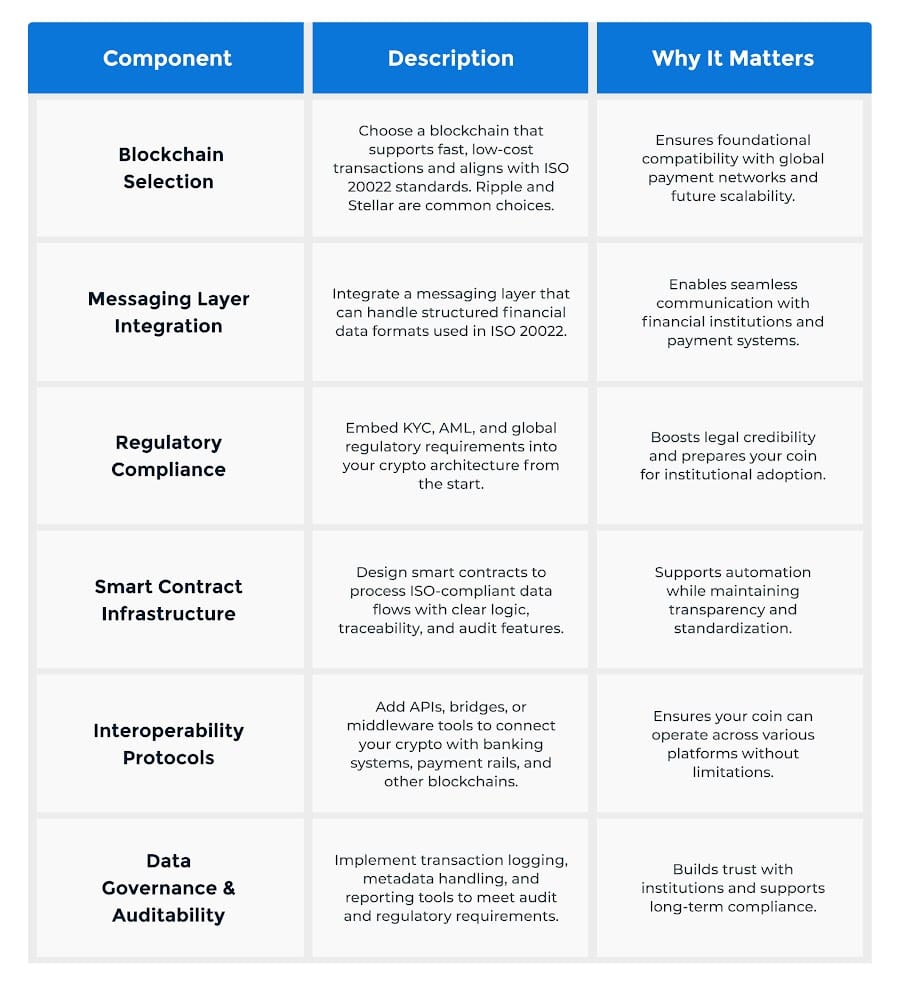
By embedding these components into your ISO-compliant cryptocurrency development strategy, you meet the global ISO 20022 standard and position your coin for real-world adoption, long-term trust, and regulatory approval.
What Is the Ideal Development Roadmap for ISO 20022 Coins?
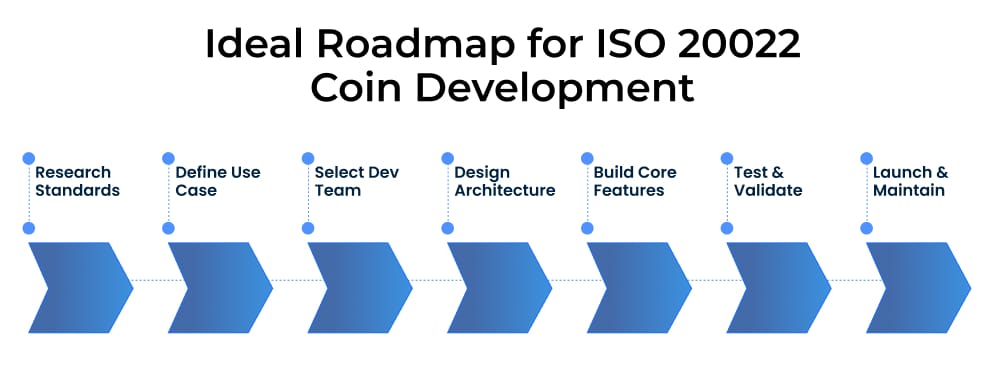
- Research Standards
Start by understanding the core of ISO 20022, what it is, how it works, and why it matters in financial messaging. Dive into how this standard is being adopted by banks, payment systems, and global financial institutions. At this stage, also explore how ISO 20022 intersects with technology, and evaluate which existing cryptocurrencies or networks are already aligning with it.
- Define Use Case
Clearly define the purpose of your cryptocurrency. Will it support cross-border payments, act as a bridge asset between networks, or power financial settlement layers? Your use case will influence everything, from blockchain selection to smart contract logic and compliance priorities. A sharp focus at this stage will prevent scope creep and align your development efforts with business goals and regulatory expectations.
- Select Dev Team
Choose a crypto token development company that specializes in blockchain infrastructure, ISO messaging structures, and compliance-driven systems. Look for experience in Ripple, Stellar, or other finance-ready blockchains. Your dev team should also understand how to integrate KYC/AML protocols, financial APIs, and smart contract automation in line with ISO data formats.
- Design Architecture
Now begin planning your coin’s technical framework. Select a blockchain that fits your goals, ideally one with strong performance, message structuring capabilities, and a track record in finance. Decide whether to build on an existing network or create a custom chain. Define transaction speeds, consensus mechanisms, fee structures, and the messaging layer that will enable ISO 20022 compatibility.
- Build Core Features
ISO coin development includes writing smart contracts, integrating structured ISO-compliant messaging fields, building wallets or dashboards, and developing user verification modules (KYC/AML). Your system should be capable of handling structured payment messages, referencing fields, and other ISO 20022 metadata elements securely and efficiently.
- Test & Validate
Testing is critical. Run extensive functional and security tests to validate smart contract logic, transaction processing, messaging format accuracy, and overall performance. Make sure your system can interact with other ISO-ready platforms and simulate real-world financial operations. Collaborate with external auditors or institutions to verify ISO compliance before launch.
- Launch & Maintain
Once tested and approved, launch your ISO-compliant cryptocurrency on the mainnet. Post-launch, continuously monitor performance, security, and updates to ISO 20022 standards. Regular maintenance and upgrades will be essential to remain compliant, especially as financial regulations evolve across regions.
Top ISO 20022 Coins in 2025

Source: Perplexity.ai
XRP
- Market Cap: $181.9 billion
- Leading ISO 20022-compliant cryptocurrency
- Used as a bridge asset for global financial transactions
Cardano (ADA)
- Market Cap: $26.7 billion
- Focuses on smart contracts, scalability, and interoperability
- Supports secure dApp development within ISO 20022-aligned ecosystems
Stellar (XLM)
- Market Cap: $12.8 billion
- Built for low-cost, cross-border payments
- Bridges fiat and crypto through ISO-standard messaging
Hedera (HBAR)
- Market Cap: $10.6 billion
- Uses Hashgraph for fast, fair, and secure consensus
- Ideal for enterprise-grade dApps in financial services
Algorand (ALGO)
- Market Cap: $2.1 billion
- Employs Pure Proof of Stake
- Delivers fast and energy-efficient transactions
XDC Network (XDC)
- Market Cap: $1.3 billion
- Tailored for trade finance and supply chain solutions
- Combines public and private blockchain capabilities
IOTA (MIOTA)
- Market Cap: $0.6 billion
- Built for IoT applications
- Implements DAG instead of traditional blockchain
Quant (QNT)
- Market Cap: $0.1 billion
- Powers Overledger for cross-chain communication
- Supports secure data exchange across multiple blockchains
Build Your ISO 20022 Coin Before It’s Too Late
The future of global payments is here, and ISO 20022 is at the heart of it. Coins that meet this standard are gaining trust and adoption from banks and enterprises worldwide. So, why wait when the world is moving fast? Building your ISO 20022-compliant coin today means staying relevant and ready for the next wave of financial innovation. It’s not just about compliance; it’s about being part of a system that connects traditional finance and blockchain seamlessly.
Antier can help you make it happen. We have deep expertise in blockchain development and ISO 20022 standards, delivering solutions that match global requirements. Talk to us now and build your coin for the future.