




AI Summary
- NFTs have taken the blockchain and cryptocurrency world by storm, with a trading volume exceeding $10 billion last year.
- This blog post delves into the key aspects and use cases of NFT development with the help of an NFT development company.
- Non-fungible tokens (NFTs) represent unique digital items on the blockchain, ranging from art to music and more.
- NFTs possess traits like marketability, scarcity, uniformity, interoperability, and liquidity, making them valuable assets in various industries.
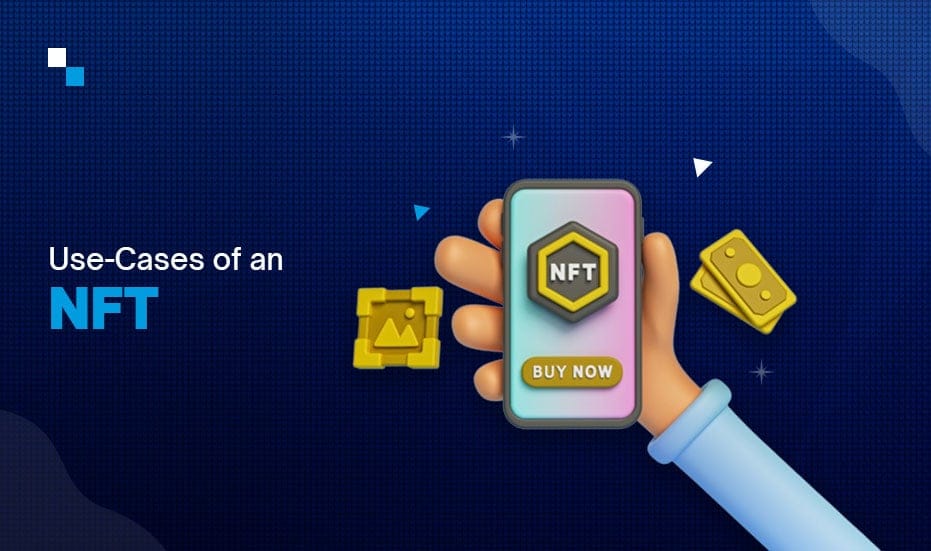
- Use cases for NFTs include online art, accreditations, real-world resources, gaming, loans, music, logistics, and coupons.
NFTs are already among the most talked-about concepts in the blockchain and cryptocurrency industries. NFTs witnessed an astonishing trading volume of over $10 billion in just the last few months last year. Several marketplaces sell thousands of NFTs every single day.
Everything – from visual art to social media comments and funny posts – can be converted into an NFT and auctioned worldwide.
In this blog, we will explore the key aspects of NFT development and various use-cases of NFT that can be implemented with the assistance of an NFT development company.
Understanding the Purpose of an NFT
Non-fungible tokens, built on blockchain technology, go by the abbreviation NFTs. An NFT is a digital representation of any item found in the real world, including artwork, music, virtual goods, films, and practically everything else. These might be purchased and traded in exchange for cryptocurrency or occasionally even for fiat money. Let’s now examine the key characteristics of non-fungible tokens. NFT Software Development is one such field that has attracted many businesses in recent times.
What traits does NFT possess?
- Marketability: NFTs are easily tradeable in online markets and other existing networks. Customers can trade NFT on marketplaces from other blockchain networks because of the interoperability functionality. It enables token owners to benefit from packaging, auction and developing an opportunity to trade NFTs.
- Scarcity: The availability of NFT is limited, which is critical for the business. To raise requirements, the programmers may restrict the availability of NFTs. The price of an asset increases in direct proportion to its scarcity.
- Uniformity: The creation of non-fungible tokens (NFT) on open-source blockchain networks enables creators to create universal specifications for all non-fungible tokens. As a result, NFTs that are placed on the market are standardized.
- Interoperability: The multi-chain capabilities would give customers a special opportunity to engage with numerous platforms created using different blockchain systems. It firmly establishes interoperability for the future.
- Liquidity: Markets make it easy to trade NFTs. A roadmap to more liquidity is made possible via instantaneous tradability. NFTs may also be utilized as security for repayments of liquid funds.
Understanding the use cases of NFTs
NFT software development can lead to the creation of various successful businesses.
Let us explore how an NFT development company can fulfill your business-specific requirements by developing NFTs.
1. Online Art
Digital art has always struggled with the issue of retaining unique pieces of work. Owing to their potential uniqueness, NFTs simplify the practice of establishing copyright and validity of visual art. Because virtual art is easily replicated or reproduced, a creator can create an NFT-based program that will completely ensure that the consumers are purchasing an authentic, one-of-a-kind work of virtual artwork. NFTs can potentially profit from aftermarket auctions of their visual art and pay creators royalties.
2. Accreditations
Both licenses and accreditation are available in analog and digital formats. Think about a certification in academia that states a particular individual has finished a bachelor’s program. Whenever this applicant applies for a position, his recruiter has to go through a tiresome method to confirm the validity of the credential that the applicant gave.
However, NFTs make it easier to confirm the validity of the certification if the institution provides the certificate that is attached to an NFT stored on a blockchain. The credibility of the issuance can also be verified. The same reasoning also holds for ticketing. Tickets can be easily authenticated when they are sold as NFTs. This is the reason why businesses are choosing to create a NFT.
3. Real-World Resources
Even if this use case seems improbable, it is nonetheless important to discuss. Tangible documents are used to sell and buy real-world properties like estate. The whole background and the proprietorship of the asset are accessible and permanently stored on the blockchain if such traditional agreements are transformed into virtual assets such as NFTs.
4. Gaming
Players are more familiar with the value of digital goods because in-game exchanges have existed since the ancient period. NFTs make it simpler to make in-game objects that are impossible to duplicate, and marketable. Since NFTs essentially combine storability and usefulness, they are a good option for in-game items and trades.
Just one side of the dilemma is addressed by transforming in-game resources into NFTs. However, there are also initiatives that have developed gameplay and tightly integrated blockchain technology into them. Hence, such applications provide interchangeable items and tokens that may be resold on other public, P2P marketplaces.
5. Loans
Loans guaranteed by the NFT are now a thing. You can, for instance, place an NFT you own as collateral and borrow money. Similar to that, you can lend someone money while using their NFT as collateral. These NFT-linked credits are entirely open, decentralized, mechanized, and devoid of middlemen, in contrast to conventional lending provided by banks. Additionally, this NFT-backed loan renders the entire system secured, trusted, and fee-light.
6. Music
An audio track can be connected and made into an NFT just like any artwork or any other art form can be transformed into it. This may very well be done, for example, to transform the very first album into a valuable musical piece. If we go deeper, we can indeed talk about NFT-linked music streaming services.
7. Logistics
NFTs are extremely useful in supply chain management because of their inherent immutability and transparency. Perishable items can be given a special NFT using blockchain software to keep an account of when they were shipped and how long they can last. By the utilization of NFTs and blockchain, anything can be monitored, including the time a specific item was packaged to the locations and facilities it visited. The opportunities are currently endless, and there have already been prominent businesses using blockchain-based logistics technologies.
8. Coupons
At this moment, digital vouchers are an integral part of our life. Then how do NFTs assist? These can be utilized as virtual wallet-compatible incentives. Since all coupons may be tracked back to and organized in a unified virtual wallet, it is important to note that this is a complex concept to implement. Furthermore, it is simple to sell NFT-based vouchers in a marketplace.
Conclusion
Hopefully, you might well have learned something new about NFTs by this point. We have explored every aspect of NFTs, from the advantages of creating your NFT market. You might be asking yourself yet another question: Where should I start when it comes to NFT development?
The development of the non-fungible token can be fostered by the best NFT development company like Antier Solutions. We are backed by a team of seasoned blockchain engineers and creative designers who work together to provide you with great NFTs that help you gain an essential competitive edge.
Connect with our subject matter experts to share your needs to create a NFT.