



Buod ng AI
- In a world where transactions shrink to cents, the limitations of traditional payment systems become apparent.
- This blog delves into how the rise of nanopayments is reshaping the digital economy, driving the need for stablecoin payment platforms.
- Businesses are facing challenges like high transaction fees, latency issues, and limited monetization opportunities for micro interactions.
- Stablecoins offer a solution with near-zero transaction costs, instant settlement, and programmable payment logic.
- The blog highlights the key market signals and cost advantages of stablecoins over traditional payment rails, emphasizing the importance of adapting to this shift for competitiveness.
When payments shrink to cents, your infrastructure gets exposed. If you are building a product where value moves in fractions of a dollar, your payment stack stops being a backend detail and becomes a growth bottleneck. Founders, CTOs, and product leaders across Web3, fintech, and AI-driven platforms are already experiencing this shift:
- Transaction fees are eating into already thin margins
- Payment latency is breaking real-time user experiences
- Failed or delayed transactions are increasing churn
- Inability to monetize micro interactions like API calls, content consumption, gaming rewards, or AI usage
The reality is simple. Traditional payment rails were never designed for nanopayments. Stablecoins were built for a programmable, low-cost, global economy. This blog explores how developing a stablecoin cross-border payment platform helps you make a strategic infrastructure decision, not just a technical one.
What Are Nanopayments & Why Do They Matter Now
Nanopayments refer to transactions that are typically below one dollar and often as low as fractions of a cent. While micropayments have existed for years, nanopayments are emerging as a core requirement for modern digital economies.
Real-world use cases driving demand.
- Pay-per-request APIs in AI and developer platforms
- In-game economies with high-frequency microtransactions
- Streaming payments for music, video, and content platforms
- Machine-to-machine payments in autonomous systems
- Tokenized access to digital services
According to multiple fintech market projections, the global digital payments market is expected to cross trillions in value, with a growing share attributed to micro and nano-level transactions driven by AI and automation. Yet, despite this demand, infrastructure has not kept pace. This is why businesses are actively exploring Stablecoin Payment Platform models that allow them to unlock new revenue streams without being constrained by legacy costs.
Identify bottlenecks, reduce costs, and optimize for high-frequency transactions.
Real-Time Market Data: Nanopayments and Stablecoins (2025–2026)
The shift to stablecoins is being driven by real demand from AI, real-time payments, and high-frequency digital economies.
Key Market Signals
- AI API Market: $44.41 billion in 2025, projected to reach $ 179 bilyon sa pamamagitan 2030
- Mga Real-Time na Pagbabayad: Inaasahang tatama $ 47.06 bilyon sa 2026 with 34.30% CAGR
- GenAI Adoption: 16.3% of the global population actively using AI tools
Cost Gap That Changes Everything
| Uri ng Riles | Avg Fee (2026) | Kasunduan |
|---|---|---|
| Traditional Cards | $0.25–$0.35 + 2.5% | 1-3 araw |
| Stablecoins (L2) | $ 0.001- $ 0.005 | <2 segundo |
Pangunahing Pananaw:
Transaction costs on Layer 2 have dropped by up to 90%, making nanopayments economically viable for the first time. For businesses building high-frequency payment models, this is not just a trend. It is a clear signal to move toward stablecoin payment platform development to stay competitive.
The Hidden Cost Problem in Traditional Payment Rails
At first glance, traditional payment systems seem reliable. They have global reach, regulatory clarity, and user familiarity. But when you go below one dollar, their inefficiencies become obvious.
- Bayad na istraktura
Traditional payment systems operate on a combination of fixed fees and percentage-based charges.
For example, a typical card transaction fee may range between 2% to 3% plus a fixed fee. For a $0.50 transaction, the fee could exceed the value being transferred. This makes nanopayments economically unviable.
- Mga Pagkaantala sa Settlement
Legacy systems often take hours or even days to settle transactions. For platforms that rely on instant access, this creates friction.
- Fragmented global infrastructure
Cross-border payments involve multiple intermediaries, each adding cost and delay. This makes global scaling difficult.
- Lack of programmability
You cannot easily implement:
- Streaming payments
- Usage-based billing
- Conditional or automated payouts
As a result, companies hit a ceiling when trying to innovate.
Ito ay kung saan pagbuo ng platform ng pagbabayad ng stablecoin becomes not just an upgrade, but a necessity.
How stablecoins unlock nanopayment infrastructure
Stablecoins are digital assets pegged to fiat currencies like USD. But their real value lies in how they move, not just what they represent.
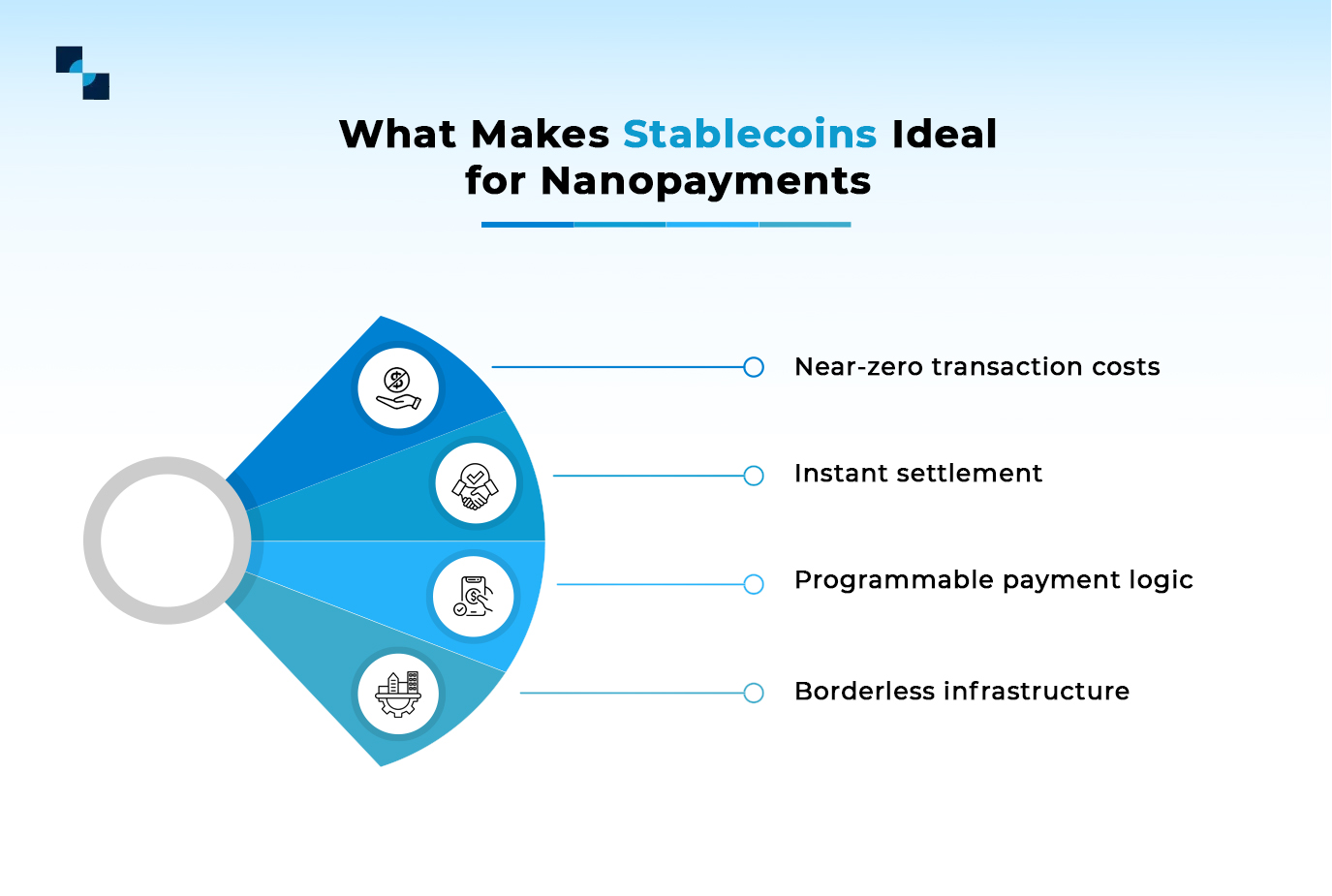
- Near-zero transaction costs
On optimized blockchain networks or Layer 2 solutions, transaction fees can drop to fractions of a cent. This fundamentally changes the economics of small-value transactions.
- Instant settlement
Stablecoin transactions settle within seconds. This enables real-time use cases such as:
- Streaming payments
- Mga instant na pagbabayad
- Real-time billing
- Programmable payment logic
Smart contracts allow businesses to embed logic directly into payments:
- Pay per second or per usage
- Automated escrow and release
- Conditional transfers based on triggers
- Borderless infrastructure
Stablecoins remove the need for intermediaries, enabling seamless global payments without currency conversion delays.
As Balaji Srinivasan once noted:
“Money that moves at the speed of software unlocks entirely new business models.”
This is exactly what stablecoins enable. Businesses investing in Sistema ng pagbabayad ng Stablecoin development are not just reducing costs. They are unlocking new monetization layers.
Stablecoins vs Traditional Payment Rails for Nanopayments
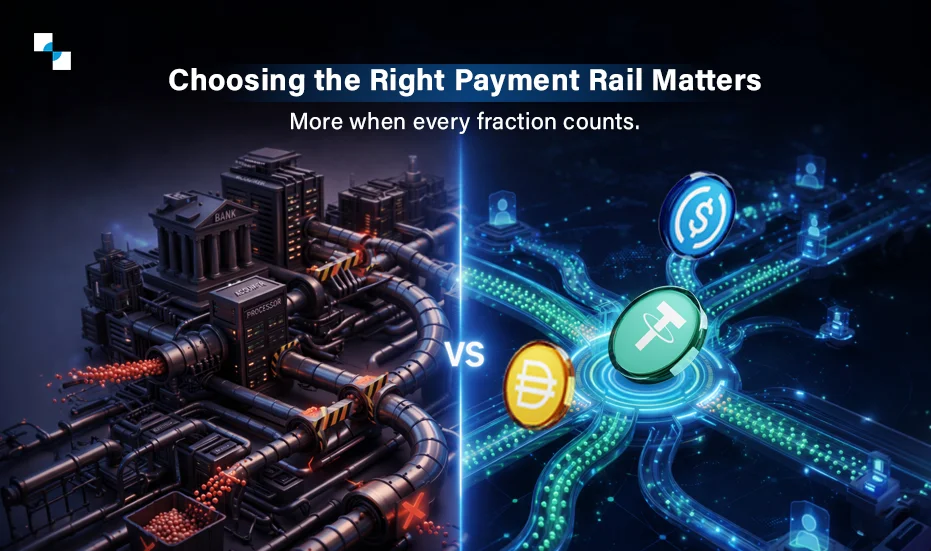
When transactions drop below a dollar, the limitations of traditional payment systems become impossible to ignore. Here’s a clear breakdown of how stablecoins compare across the factors that matter most:
| Salik ng Desisyon | Traditional Payment Rails | Stablecoin-Based Payment Infrastructure |
|---|---|---|
| Kahusayan ng Gastos | Costs increase as transaction value decreases due to fixed fees and percentage cuts | Maintains ultra-low fees, making even sub-cent transactions viable |
| bilis | Settlement can take hours to days, depending on intermediaries | Near-instant settlement with real-time finality |
| Kakayahang sumukat | Not designed for high-frequency, low-value transactions | Built to handle large volumes of micro and nano transactions efficiently |
| flexibility | Limited customization and no native programmability | Fully programmable with smart contracts, enabling automation and logic |
| Global Abutin | Fragmented systems with multiple intermediaries and currency barriers | Unified, borderless infrastructure with seamless cross-border payments |
At scale, these differences are not just technical. They directly impact your margins, user experience, and ability to unlock new revenue models. For any business exploring nanopayments, choosing the right rail is no longer optional; it is foundational.
Architecture of a Stablecoin Nanopayment System
To build a scalable nanopayment system, integrating a token is not enough. You need a well-structured infrastructure that supports speed, low cost, and high transaction volume from day one.
Isang malakas platform ng pagbabayad ng stablecoin combines multiple layers that work together to deliver seamless payments and real-time performance.
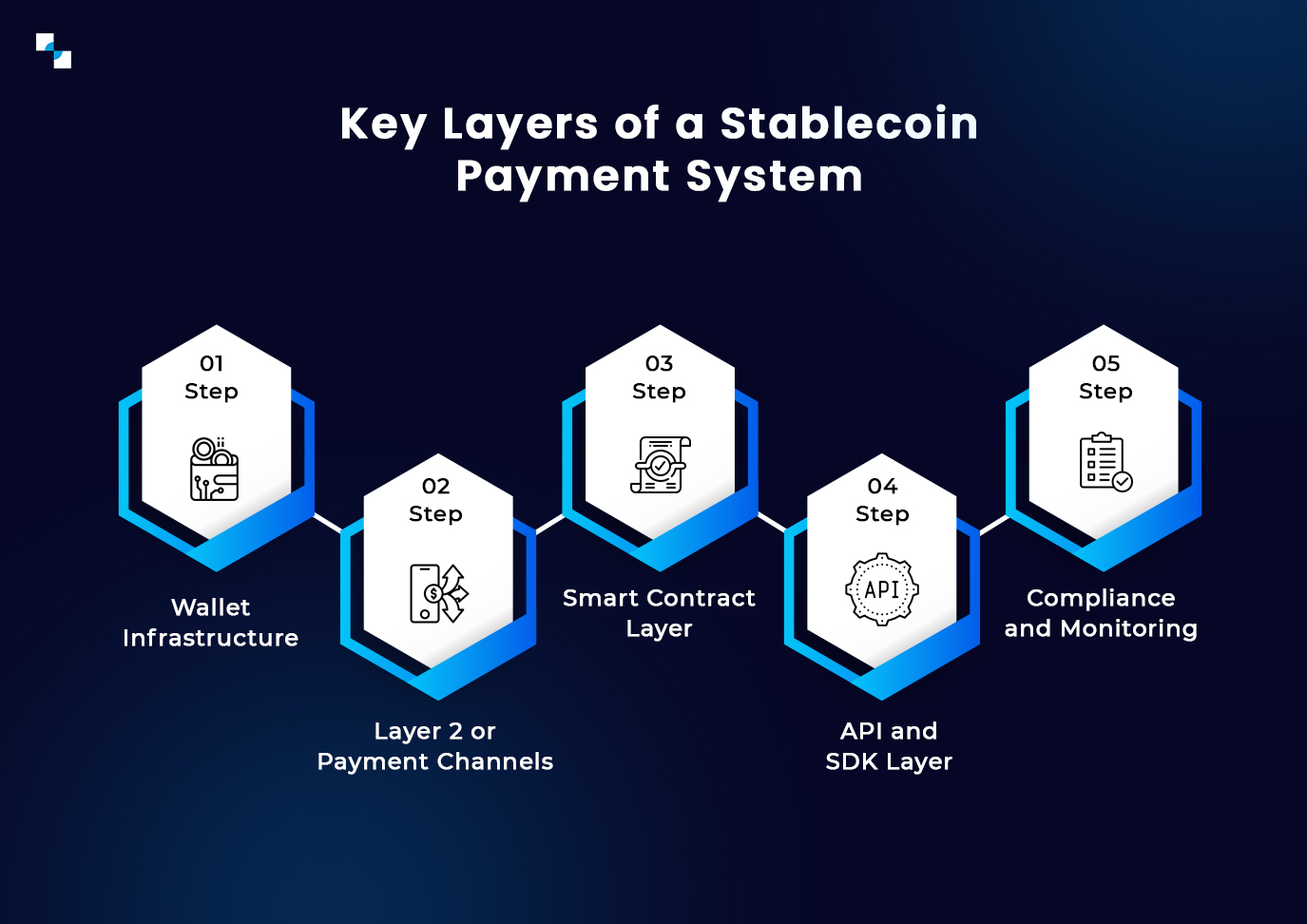
- Imprastraktura ng Wallet
Wallets are the foundation of your system and directly impact user experience.
- Custodial wallets simplify onboarding and reduce friction
- Non-custodial wallets offer more control and decentralization
For nanopayments, wallets should support fast transactions, simple access, and minimal user effort.
- Layer 2 or Payment Channels
Handling frequent low-value transactions requires scalability.
- Layer 2 solutions reduce fees and increase speed.
- Payment channels allow multiple off-chain transactions before final settlement.
This layer ensures your system can process high volumes without cost spikes.
- Layer ng Smart Contract
This is where payment logic is defined.
Ito ay nagbibigay-daan sa:
- Mga modelong pay-per-use
- Streaming payments
- Mga awtomatikong transaksyon
This layer turns payments into programmable systems rather than simple transfers.
- API and SDK Layer
To scale adoption, your infrastructure must be easy to integrate.
- APIs enable backend connectivity.
- SDKs help developers embed payments into apps quickly.
A strong integration layer reduces development time and improves flexibility.
- Pagsunod at Pagsubaybay
Depending on your market, compliance is essential.
Maaaring kabilang dito ang:
- Mga pagsusuri sa KYC at AML
- Pagsubaybay sa transaksyon
- Mga sistema ng pag-uulat
It ensures your platform remains scalable and regulation-ready.
Isang mahusay na dinisenyo sistema ng pagbabayad ng stablecoin development approach brings all these components together into a unified system that supports low-cost, real-time, and high-frequency nanopayments at scale.
Mga karaniwang pagkakamali upang maiwasan ang
- Overlooking user experience: Even the best infrastructure fails if onboarding is complex. Gas abstraction and simple interfaces are critical.
- Treating stablecoins as a feature: They should be part of your core architecture, not an add-on.
- Ignoring scalability early: Your system should handle growth from day one.
- Underestimating compliance: Regulatory frameworks are evolving. You need to stay aligned.
Let’s redesign your payment stack for speed, scale, and sub-cent transactions.
Huling Takeaway
Nanopayments are exposing the limits of traditional payment rails. High fees, delays, and lack of flexibility make them unfit for modern, high-frequency use cases. Stablecoins offer what growing platforms actually need: low cost, real-time settlement, and programmable payments at scale. If your product depends on micro or nano transactions, the right infrastructure is not optional. It is the foundation of your growth.
Handa nang Buuin?
At Antier, we help businesses design and launch a scalable, stablecoin cross-border payment platform tailored for real-world use cases. Connect with our experts to start building your stablecoin-powered payment system today.